
🏺 History इतिहास
1077 exam-ready facts · 1001 MCQs
-
881
Satyendranath Tagore made history in 1863 by becoming the first Indian to successfully qualify for the Covenanted Civil Service.
Satyendranath Tagore, elder brother of Rabindranath Tagore, cracked the ICS examination in London.
Asked in SSC CGL 2023 (24 Jul, Shift 2)
Practice (1)
Q847Who was the first Indian to qualify for Covenanted service?
Show answer
Correct answer: C — Satyendra Nath Tagore
Answer: (C)
Satyendranath Tagore was the first Indian to join the Indian Civil Service (1863). -
882
The chronological order of early Delhi Sultanate rulers is Aibak, Iltutmish, Razia, and Balban.
Qutb al-Din Aibak founded the Slave Dynasty in 1206 AD.
Asked in SSC CGL 2025 (15 Sep, Shift 1)
Practice (1)
Q848Arrange the following rulers of the Delhi Sultanate in the correct chronological order of their reigns, starting from the earliest:<br>1.Razia Sultan<br>2.Ghiyas ud din Balban<br>3.Qutb al-Din Aibak<br>4.Iltutmish
Show answer
Correct answer: A — 3 - 4 - 1 - 2
Answer: (A)Place each ruler on the timeline.
Qutb al-Din Aibak (3): 1206–1210
Iltutmish (4): ruled until 1236
Razia Sultan (1): 1236–1240
Ghiyas ud din Balban (2): 1266–1287Earliest first, that is 3 - 4 - 1 - 2 → option (a).
Why the others are wrong(b)4 - 3 - 1 - 2: Iltutmish cannot come first. Aibak founded the line in 1206, and Iltutmish, once his slave and later his son-in-law, took the throne only after Aibak's death.(c)3 - 1 - 4 - 2: Razia before her own father is impossible. She became Sultan in 1236, after Iltutmish's death, so 1 cannot sit between 3 and 4.(d)1 - 3 - 4 - 2: Razia cannot open the list. Her reign, 1236–1240, came after both Aibak's and that of her father, Iltutmish. -
883
Mughal architecture is a unique Indo-Islamic aesthetic blending Persian, Islamic, Turkish, and Indian styles, using red sandstone and white marble.
Taj Mahal combines white Makrana marble with surrounding red sandstone structures.
Asked in SSC CGL 2025
Practice (1)
Q849Consider the following statements about Mughal architecture:<br>1.Mughal architecture is known for blending Persian, Islamic, Turkish, and Indian styles to create a unique Indo-Islamic aesthetic.<br>2.Red sandstone and white marble were the two most commonly used materials in Mughal construction.
Show answer
Correct answer: C — Both 1 and 2 are correct
Answer: (C)Statement 1 matches NCERT's Class XI text An Introduction to Indian Art: despite the obvious Saracenic, Persian and Turkish influences, it says, Indo-Islamic buildings were heavily shaped by Indian architectural and decorative forms.
Statement 2 matches the landmark buildings. At the Taj Mahal, NCERT notes, the white Makrana marble tomb is contrasted with the red sandstone of the surrounding structures. Both hold: option (c).
Why the others are wrong(a)Only 1 is correct: This rejects statement 2, but red sandstone and white marble are the pairing NCERT itself describes at the Taj Mahal, where the marble tomb stands against red sandstone structures.(b)Only 2 is correct: This rejects statement 1, yet NCERT describes Indo-Islamic buildings as carrying Saracenic, Persian and Turkish influences while heavily shaped by Indian forms: the blend the statement names.(d)Neither 1 nor 2 is correct: Both statements track NCERT's account, the blend of influences in statement 1 and the sandstone-marble pairing in statement 2, so rejecting both leaves nothing standing. -
884
Khan Bahadur Khan valiantly led the Indian uprising of 1857 against British rule from the city of Bareilly.
Khan Bahadur Khan formed a government in Bareilly during the 1857 revolt.
Asked in SSC CGL 2023 (24 Jul, Shift 2)
Practice (1)
Q850Khan Bahadur led the revolt of 1857 from:
Show answer
Correct answer: D — Bareilly
Answer: (D)
Khan Bahadur Khan led the 1857 revolt at Bareilly. -
885
January 26 was chosen as Republic Day to commemorate the declaration of Purna Swaraj made on that day in 1930.
The Indian National Congress first hoisted the tricolor and proclaimed Purna Swaraj on January 26, 1930.
Asked in SSC CGL 2023 (21 Jul, Shift 1)
Practice (1)
Q851What is the significance of 26 January being chosen as a day to celebrate the Republic Day, aside from the adoption of the constitution?
Show answer
Correct answer: C — Declaration of Purna Swaraj
Answer: (C)
26 January was chosen because the INC declared Purna Swaraj on 26 January 1930. -
886
The double-storeyed gates of Purana Qila are primarily built with red sandstone and decorated with marble inlay and blue tiles.
The three gates are Bara Darwaza, Humayun Gate, and Talaqi Gate.
Asked in SSC CGL 2025 (16 Sep, Shift 2)
Practice (1)
Q852What material were the double-storeyed gates of Purana Qila primarily built with?
Show answer
Correct answer: B — Red sandstone
Answer: (B)Purana Qila's three gates, the Bara Darwaza, the Humayun Gate and the Talaqi Gate, are double-storeyed sandstone structures, each flanked by two huge semicircular bastion towers.
So the building material is red sandstone. Marble and tiles are on the gates too, but as decoration: white and coloured marble inlay and blue tiles set into the stone.
Why the others are wrong(a)Marble: Marble appears on the gates as inlay, white and coloured marble set into the stone for decoration. The gates themselves are built of sandstone.(c)Glazed tiles: Glazed tiles are surface ornament here: blue tiles decorate the gates. A double-storeyed gateway flanked by bastions is not built of tiles, and its fabric is sandstone.(d)Rubble: Rubble means rough, undressed stone laid in mortar. The gates are recorded as sandstone structures, decorated with marble and tiles. -
887
The outer gate of Golconda Fort, the Fateh Darwaza, is studded with giant spikes to protect it from war elephants.
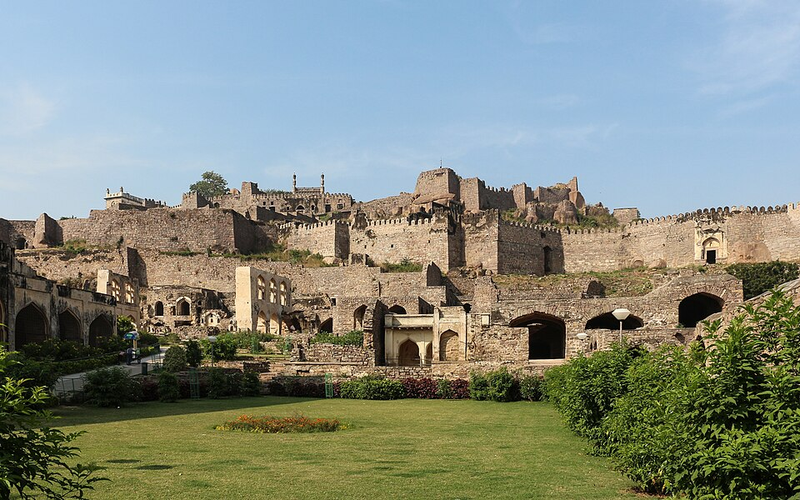
The spikes prevented war elephants from charging and battering down the doors.
Asked in SSC CGL 2025
Practice (1)
Q853What feature was used on Golconda Fort’s gates to protect it during attacks involving war elephants?
Show answer
Correct answer: C — Steel spikes on doors
Answer: (C)Golconda's outer gate, the Fateh Darwaza (Victory Gate), is studded with giant spikes so that war elephants could not batter it down.
The spikes kept an elephant's head off the door, and that is the defence the key names: spikes on the doors → option (c).
Why the others are wrong(a)Deep moat with water channels: A moat guards the approach to a fort, not the door itself. The question asks what was fixed on the gates, and at Golconda that was spikes.(b)Electrified spikes: Electrified spikes are an anachronism. The gate is named for Aurangzeb's army marching in through it, a 17th-century event, long before electricity could power a defence.(d)Stone cannon towers: Cannon towers would stand on the walls, not on the gates the stem asks about. The defence against elephants was fixed to the doors themselves. -
888
Lala Lajpat Rai suffered fatal injuries from a police lathi charge while leading peaceful protests against the Simon Commission in Lahore in 1928.
The Simon Commission faced widespread protests across India because it lacked any Indian members.
Asked in SSC CGL 2023 (21 Jul, Shift 1)
Practice (1)
Q854Who among the following freedom fighters lost his life during the protest against Simon Commission where black flags were waved at the Commission?
Show answer
Correct answer: A — Lala Lajpat Rai
Answer: (A)
Lala Lajpat Rai died after the lathi charge during the protest against the Simon Commission (1928). -
889
Key rulers of medieval India include Qutbuddin Aybak (1206–1210) and Alauddin Khalji (1296–1316).
Prithviraj Chauhan reigned from 1175 to 1192 and Muhammad Tughluq from 1324 to 1351.
Asked in SSC CGL 2025 (16 Sep, Shift 1)
Practice (1)
Q855Match each ruler listed in Column A with their respective period of reign given in Column B:<br><table><tr><td>Column A: Ruler</td><td>Column B: Reign Period</td></tr><tr><td>A. Qutbuddin Aybak</td><td>1. 1175–1192</td></tr><tr><td>B. Prithviraj Chauhan</td><td>2. 1206–1210</td></tr><tr><td>C. Alauddin Khalji</td><td>3. 1296–1316</td></tr><tr><td>D. Muhammad Tughluq</td><td>4. 1324–1351</td></tr></table>
Show answer
Correct answer: D — A → 2, B → 1, C → 3, D → 4
Answer: (D)Anchor each ruler by the year his reign ended.
Aybak (A) died in 1210 → 2 (1206–1210)
Prithviraj (B) lost the Second Battle of Tarain, 1192 → 1 (1175–1192)
Alauddin Khalji (C) died in 1316 → 3 (1296–1316)That leaves Muhammad Tughluq (D) → 4 (1324–1351).
Why the others are wrong(a)A → 1, B → 2, C → 3, D → 4: A → 1 puts Aybak on the throne in 1175, three decades before the Delhi Sultanate began. His reign was 1206–1210, and 1175–1192 is Prithviraj's.(b)A → 4, B → 1, C → 3, D → 2: A → 4 swaps Aybak and Muhammad Tughluq. Aybak ruled 1206–1210, more than a century before Tughluq's 1324–1351, so D → 2 is just as wrong.(c)A → 3, B → 1, C → 2, D → 4: A → 3 gives Aybak Alauddin Khalji's 1296–1316, and C → 2 gives Alauddin Aybak's. Aybak died in 1210, long before the Khaljis held Delhi.
A → 2, B → 1, C → 3, D → 4 → option (d). -
890
Mahatma Gandhi gave the iconic 'Do or Die' (Karo Ya Maro) speech at the Gowalia Tank maidan in Bombay, marking the launch of the Quit India Movement in 1942.
The Quit India Movement was a mass civil disobedience movement launched during World War II.
Asked in SSC CGL 2023 (21 Jul, Shift 1)
Practice (1)
Q856Who among the following gave the famous ‘Do or Die’ slogan during Quit India Movement?
Show answer
Correct answer: D — Mahatma Gandhi
Answer: (D)
Mahatma Gandhi gave the 'Do or Die' slogan (8 August 1942). -
891
The Indian National Congress passed the historic 'Purna Swaraj' resolution at its Lahore session in December 1929, presided over by Jawaharlal Nehru.
Following this resolution, January 26th was celebrated as Independence Day before India actually gained freedom.
Asked in SSC CGL 2023 (21 Jul, Shift 3)
Practice (1)
Q857When did the All India Congress formalise the demand for ‘Purna Swaraj’ or full independence for India?
Show answer
Correct answer: B — At its Lahore Session in 1929
Answer: (B)
The Lahore Session (December 1929) adopted the Purna Swaraj resolution. -
892
Akbar’s Tomb at Sikandra deviates from the typical square hasht-bihisht layout, rising as a stepped pyramid of five storeys.
The topmost storeys are made of white marble without a central dome.
Asked in SSC CGL 2025 (17 Sep, Shift 1)
Practice (1)
Q858Which of the following Mughal tombs deviates from the typical square 'hasht-bihisht' (eight-part) layout?
Show answer
Correct answer: B — Akbar’s Tomb (Sikandra)
Answer: (B)A hasht-bihisht ('eight paradises') plan sets a central chamber among eight rooms, four on the sides and four at the corners.
Akbar's tomb at Sikandra breaks from it. The main building rises as a stepped pyramid of five storeys, four of red sandstone and an open white-marble storey on top holding the cenotaph, with no central dome.
It was completed under Jahangir around 1613: option (b).
Why the others are wrong(a)Humayun’s Tomb: Humayun's Tomb is the model the question measures against. Its central chamber ringed by eight rooms is the classic hasht-bihisht plan.(c)Itimad-ud-Daulah: Itimad-ud-Daulah has no dome, but its plan keeps the grid: a central hall with four oblong side rooms and four square corner rooms.(d)Safdarjung’s Tomb: Safdarjung's Tomb (1754) follows the Humayun's Tomb model: eight rooms surround the square central chamber under its dome. -
893
Dadabhai Naoroji propounded the 'Drain of Wealth' theory, explaining how British colonial policies systematically transferred India's wealth to Britain.
He authored the seminal book 'Poverty and Un-British Rule in India' to highlight economic exploitation.
Asked in SSC CGL 2023 (24 Jul, Shift 1)
Practice (1)
Q859Who was the first nationalist to give the theory of drain of wealth from India to England?
Show answer
Correct answer: D — Dadabhai Naoroji
Answer: (D)
Dadabhai Naoroji first gave the Drain of Wealth theory (Poverty and Un-British Rule in India). -
894
Coins minted in Delhi under the Tomaras and Chauhans, known as 'dehliwal', had a wide circulation.
Delhi became an important commercial centre during the early medieval period under the Tomaras.
Asked in SSC CGL 2025 (17 Sep, Shift 1)
Practice (1)
Q860Which of the following dynasties minted the "Dehliwal" coins in Delhi?
Show answer
Correct answer: B — The Tomaras
Answer: (B)NCERT's Class 7 history text says Delhi became an important commercial centre under the Tomaras and the Chauhans, and that coins minted there, called dehliwal, had a wide circulation.
The Tomaras are the dynasty from that account on this list: option (b). Their successors, the Chauhans of Ajmer, are not offered.
Why the others are wrong(a)The Gahadavalas: The Gahadavalas ruled from Kannauj and Varanasi, not Delhi. NCERT ties the dehliwal to Delhi's own rulers, the Tomaras and the Chauhans.(c)The Khaljis: The Khaljis ruled the Delhi Sultanate from 1290 to 1320, well after Delhi's Tomara and Chauhan phase, when the dehliwal circulated.(d)The Lodis: The Lodis were the last Delhi Sultans (1451–1526), centuries after the dehliwal was minted under the Tomaras and Chauhans. -
895
The Ryotwari system of land revenue settlement established a direct relationship between the government and the cultivators (ryots).
It was primarily formulated by Alexander Read and Thomas Munro for southern and western territories.
Asked in SSC CGL 2023 (24 Jul, Shift 1)
Practice (1)
Q861The Ryotwari Settlement, in which cultivators had to pay annual taxes directly to the government, was primarily introduced in which of the following provinces?
Show answer
Correct answer: C — Madras and Bombay
Answer: (C)
The Ryotwari system was mainly introduced in the Madras and Bombay presidencies. -
896
Major early medieval dynasties include the Gurjara-Pratiharas in Rajasthan and Gujarat, Rashtrakutas in the Deccan, Palas in Bengal, and Cholas in Tamil Nadu.
These dynasties fought constantly for supremacy over the fertile region of Kannauj.
Asked in SSC CGL 2025 (16 Sep, Shift 3)
Practice (1)
Q862Match the dynasties listed in Column A with the regions they primarily ruled over, as given in Column B:<br><table><tr><td>Column A: Dynasty</td><td>Column B: Region</td></tr><tr><td>A. Gurjara-Pratiharas</td><td>1. Bengal</td></tr><tr><td>B. Rashtrakutas</td><td>2. Tamil Nadu</td></tr><tr><td>C. Palas</td><td>3. Gujarat and Rajasthan</td></tr><tr><td>D. Cholas</td><td>4. Western Deccan</td></tr></table>
Show answer
Correct answer: A — A → 3, B → 4, C → 1, D → 2
Answer: (A)Match each dynasty to its home region.
Gurjara-Pratiharas rose in Rajasthan and Gujarat before ruling from Kannauj → A-3.
Rashtrakutas ruled the Deccan from Manyakheta, in Karnataka → B-4.
Palas held Bengal and Bihar → C-1.
Cholas rose in the Kaveri valley of Tamil Nadu → D-2.A-3, B-4, C-1, D-2 → option (a).
Why the others are wrong(b)A → 4, B → 3, C → 1, D → 2: It swaps the first two. The Rashtrakutas were the Deccan power, with their capital at Manyakheta, and the Pratiharas the dynasty of Rajasthan and Gujarat.(c)A → 2, B → 3, C → 1, D → 4: Only the Palas-Bengal pair is right. It sends the Pratiharas to Tamil Nadu and the Cholas to the Deccan, but the Cholas' heartland was the Kaveri valley.(d)A → 4, B → 3, C → 2, D → 1: Every pair is wrong. It puts the Palas in Tamil Nadu and the Cholas in Bengal, and swaps the Pratiharas and the Rashtrakutas as well. -
897
Sher Shah Suri defeated Mughal emperor Humayun and founded the Second Afghan Empire in India.
Sher Shah defeated Humayun at Chausa in 1539 and at Kannauj in 1540.
Asked in SSC CGL 2025 (17 Sep, Shift 3)
Practice (1)
Q863Fill in the blank:<br>After defeating the Mughal emperor, _______ declared himself the ruler and founded the Second Afghan Empire.
Show answer
Correct answer: B — Sher Shah Suri
Answer: (B)Sher Shah Suri defeated the Mughal emperor Humayun at Chausa in 1539 and again at Kannauj in 1540, forcing him to flee.
Sher Shah was then crowned ruler of Hindustan and reigned until 1545.
The Afghan Lodis had been the last dynasty of the Delhi Sultanate, so his Sur empire was the second Afghan power in Delhi, the stem's Second Afghan Empire: option (b).
Why the others are wrong(a)Humayun: Humayun is the defeated Mughal emperor of the stem. He lost at Chausa and Kannauj, fled, and founded no Afghan empire.(c)Bahlul Lodi: Bahlul Lodi founded the Afghan Lodi dynasty in 1451, the last line of the Delhi Sultanate. He died in 1489, decades before the Mughals arrived.(d)Sikandar Lodi: Sikandar Lodi, Bahlul's son, was crowned in 1489 and shifted the capital from Delhi to Agra. He ruled before the Mughals reached India. -
898
During British rule, modern machine-based industries such as cotton textiles, jute mills, and iron and steel plants gradually emerged in India.
The first modern cotton mill was established in Bombay in 1854, followed by the first jute mill in Rishra, Bengal.
Asked in SSC CGL 2023 (24 Jul, Shift 1)
Practice (1)
Q864Which of the following modern industries was in operation in India during the British rule?<br>a. Cotton<br>b. Jute<br>c. Iron and Steel
Show answer
Correct answer: A — All of a, b and c
Answer: (A)
Cotton, jute and iron and steel industries were all operating during British rule. -
899
Rajendra Chola I built the grand Brihadisvara temple at Gangaikonda Cholapuram after defeating the Palas.
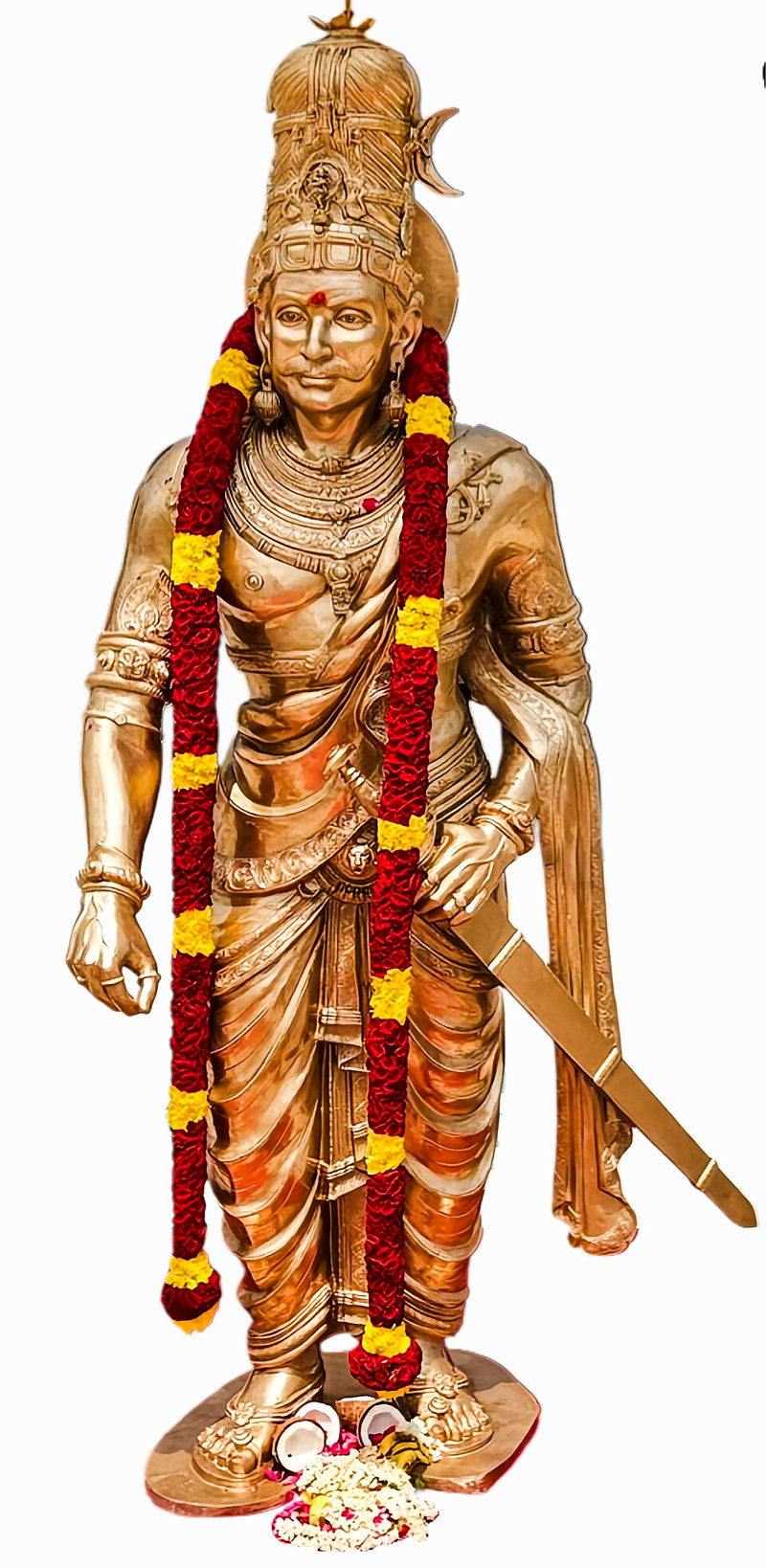
He moved the Chola capital to Gangaikonda Cholapuram and completed the temple around 1035 CE.
Asked in SSC CGL 2025
Practice (1)
Q865Who among the following Chola emperors constructed the grand temple at Gangaikonda Cholapuram?
Show answer
Correct answer: B — Rajendra Chola I
Answer: (B)Rajendra Chola I founded Gangaikonda Cholapuram to commemorate his victory over the Pala dynasty and moved the Chola capital there from Thanjavur.
The Brihadisvara temple he built there was completed in 1035 CE → option (b).
Why the others are wrong(a)Rajaraja Chola I: Rajaraja Chola I built the Brihadisvara temple at Thanjavur between 1003 and 1010 AD. Gangaikonda Cholapuram was his son's city.(c)Rajadhiraja Chola I: Rajadhiraja I was Rajendra's son and successor, sole ruler from 1044, nine years after the temple was completed. He died at the battle of Koppam in 1052.(d)Kulothunga Chola I: Kulothunga I ruled from 1070 to 1122, decades after 1035. He was Rajendra I's grandson through his mother, a Chola princess. -
900
The All India Kisan Sabha was established in 1936 at the Lucknow session of the Indian National Congress, with Swami Sahajanand Saraswati as its first president.
This peasant organization aimed to unite the Indian peasantry and fight against Zamindari exploitation.
Asked in SSC CGL 2023 (21 Jul, Shift 4)
Practice (1)
Q866Where was the first All India Kisan Sabha formed?
Show answer
Correct answer: A — Lucknow
Answer: (A)
The All India Kisan Sabha was formed at Lucknow in 1936.