
🏺 History इतिहास
1077 exam-ready facts · 1001 MCQs
-
901
Lord Curzon announced the territorial partition of Bengal in July 1905, officially implementing it on October 16 of the same year.
The partition triggered the Swadeshi Movement as a massive wave of public protest across the country.
Asked in SSC CGL 2023 (25 Jul, Shift 2)
Practice (1)
Q867In ________, Lord Curzon, the Viceroy of India, announced the partition of Bengal.
Show answer
Correct answer: D — 1905
Answer: (D)
Lord Curzon announced the partition of Bengal in 1905 (effective 16 October 1905). -
902
Hindu Beg served as a provincial governor and Mughal noble who constructed the Sambhal Jama Masjid under Babur's orders.
His name includes a Turkic military title of rank, and he operated as a regional administrator.
Asked in SSC CGL 2025 (18 Sep, Shift 1)
Practice (1)
Q868What position did Hindu Beg hold during Humayun’s reign?
Show answer
Correct answer: C — Provincial governor
Answer: (C)Hindu Beg was a Mughal noble and commander, not a chief, a scholar or a saint.
An inscription in the Jama Masjid at Sambhal says Babur's general Mir Hindu Beg built it on Babur's orders by 6 December 1526. Historian Catherine Asher reads it as Babur's permission to a regional governor to build a mosque. A governing noble is what option (c) describes.
Why the others are wrong(a)Rajput chief: 'Hindu' in the name misleads. Beg is a Turkic title of rank, and Hindu Beg built a mosque on Babur's orders. He was a Mughal noble, not a Rajput chief.(b)Court scholar: He appears in the record as Babur's general, a man of arms and administration, not a scholar at court.(d)Spiritual guide: He was a military noble, Babur's general, not a Sufi or a spiritual guide to the emperor. -
903
The chronological order of construction is Agra Fort (completed 1573), Jahangir Mahal in Orchha (early 17th century), and Red Fort in Delhi (completed 1648).
Akbar's Agra Fort was finished earlier than Shah Jahan's Red Fort.
Asked in SSC CGL 2025 (19 Sep, Shift 1)
Practice (1)
Q869Arrange the following historical structures in chronological order of their completion (earliest to latest):<br>(a) Red Fort, Delhi<br>(b) Jahangir Mahal, Orchha<br>(c) Agra Fort (Akbar)
Show answer
Correct answer: B — (c) → (b) → (a)
Answer: (B)Date each building, then sort.
Agra Fort, item (c): Akbar's rebuilding was completed in 1573.
Jahangir Mahal, Orchha, item (b): built by Bir Singh Deo in the early 17th century to receive Jahangir.
Red Fort, Delhi, item (a): Shah Jahan's fort was completed in 1648.Earliest to latest is (c) → (b) → (a), which is option (b).
Why the others are wrong(a)(a) → (b) → (c): This runs the list backwards. The Red Fort, completed in 1648, is the latest of the three, and Akbar's Agra Fort, completed in 1573, the earliest.(c)(b) → (c) → (a): It puts the Jahangir Mahal first. Akbar finished Agra Fort in 1573, and the Orchha palace is a 17th-century building, so it comes second.(d)(c) → (a) → (b): It swaps the last two. The Red Fort was completed only in 1648, under Shah Jahan, after the Orchha palace raised for his father Jahangir. -
904
Swami Dayanand Saraswati gave the clarion call 'Back to the Vedas' to revive pristine Vedic values and reject later corrupt social practices.
He founded the Arya Samaj in 1875 as a reformist movement within Hinduism.
Asked in SSC CGL 2023 (25 Jul, Shift 1)
Practice (1)
Q870‘Back to Vedas’ was the slogan of which Reform Movement?
Show answer
Correct answer: D — Arya Samaj
Answer: (D)
'Back to the Vedas' was the slogan of Swami Dayanand Saraswati's Arya Samaj (1875). -
905
Lord Curzon showed profound interest in the preservation of Indian heritage by passing the Ancient Monuments Preservation Act in 1904.
He also reformed the Archaeological Survey of India (ASI) to systematically protect historical sites.
Asked in SSC CGL 2023 (25 Jul, Shift 1)
Practice (1)
Q871The Viceroy who took keen interest in the restoration and protection of historical monuments was _____________.
Show answer
Correct answer: D — Lord Curzon
Answer: (D)
Lord Curzon passed the Ancient Monuments Preservation Act, 1904 and revived the Archaeological Survey of India. -
906
The Rashtrakuta king Krishna III defeated Chola forces at the Battle of Takkolam in 948–949 CE.
He earned the title 'conqueror of Tanjore' following this decisive victory.
Asked in SSC CGL 2025 (19 Sep, Shift 1)
Practice (1)
Q872Which Rashtrakuta king defeated Parantaka I of the Chola dynasty?
Show answer
Correct answer: C — Krishna III
Answer: (C)The Rashtrakuta king Krishna III defeated the Chola forces of Parantaka I at the Battle of Takkolam, fought in 948–949.
The Chola crown prince Rajaditya was killed there, struck by an arrow from Krishna III's Western Ganga ally Butuga II. Krishna III took the epithet Tanjaiyunkonda, 'conqueror of Tanjore' → option (c).
Why the others are wrong(a)Krishna I: Krishna I (756–774) is the Rashtrakuta king who commissioned the Kailasa temple at Ellora, nearly two centuries before Takkolam.(b)Dantidurga: Dantidurga founded Rashtrakuta power in the 8th century by defeating the Badami Chalukya king Kirtivarman II, long before Parantaka I ruled the Cholas.(d)Govinda III: Govinda III (793–814) is known for northern campaigns against the Pratihara Nagabhata II and the Pala Dharmapala. He died nearly a century before Parantaka I's reign. -
907
Lord Cornwallis introduced the Permanent Settlement (Zamindari system) in Bengal, Bihar, and Orissa in 1793 to stabilize land revenue collection.
Under this system, Zamindars were recognized as the permanent owners of the land.
Asked in SSC CGL 2023 (25 Jul, Shift 2)
Practice (1)
Q873Who introduced the Zamindari Settlement as a measure of land revenue<br>administration?
Show answer
Correct answer: C — Lord Cornwallis
Answer: (C)
Lord Cornwallis introduced the Permanent (Zamindari) Settlement in Bengal in 1793. -
908
The Sisodias were the ruling royal dynasty of Mewar in Rajasthan during the 15th century.
Rana Kumbha was a prominent Sisodia ruler who constructed the Vijaya Stambha at Chittor.
Asked in SSC CGL 2025 (19 Sep, Shift 3)
Practice (1)
Q874Which of the following kingdom was under the rule of the Sisodia dynasty during the 15th century?
Show answer
Correct answer: C — Mewar
Answer: (C)The Sisodias were the ruling house of Mewar in Rajasthan, an offshoot of the Guhila dynasty. Rana Hammir established their rule in 1326.
In the 15th century Rana Kumbha (r. 1433–1468) ruled Mewar, and in 1448 he built the Vijaya Stambha at Chittor after defeating the Malwa army of Mahmud Khalji. The kingdom is Mewar → option (c).
Why the others are wrong(a)Gujarat: Gujarat was ruled in the 15th century by its own sultans, the Gujarat Sultanate, whose Ahmad Shah I founded Ahmedabad. It was not a Sisodia kingdom.(b)Malwa: Malwa was a sultanate and Mewar's rival. Rana Kumbha's Vijaya Stambha celebrates his victory over the Malwa army of Mahmud Khalji at Sarangpur.(d)Bengal: Bengal was ruled in the 15th century by the sultans of the Bengal Sultanate, far from Rajasthan. The Sisodias were a Rajput house of Mewar. -
909
Mahatma Gandhi led the Champaran Satyagraha in 1917, marking his first major civil disobedience campaign in India against oppressive indigo cultivation.
He was invited by local leader Rajkumar Shukla to look into the grievances of the poor peasants.
Asked in SSC CGL 2023 (24 Jul, Shift 4)
Practice (1)
Q875The Champaran Satyagraha took place in
Show answer
Correct answer: C — 1917
Answer: (C)
Gandhi's Champaran Satyagraha took place in 1917. -
910
Babur's memoir, the Baburnama, records his invasion of Bhira in 1519 during his initial campaigns in India.
This military expedition marked the beginning of his successful incursions into Hindustan.
Asked in SSC CGL 2025 (19 Sep, Shift 2)
Practice (1)
Q876Which region did Babur first conquer during his initial campaigns in India?
Show answer
Correct answer: D — Bhira
Answer: (D)Babur's own memoir, the Baburnama, describes his campaign of 1519 (925 AH).
His army took Bajaur by storm and then 'went on into Bhira'. In his words: 'Bhira we neither over-ran nor plundered; we imposed a ransom on its people.'
Bajaur is not an option. Of the four places offered, Bhira came first, in 1519 → option (d).
Why the others are wrong(a)Panipat: Panipat was the end of the road, not the start. Babur beat Ibrahim Lodi there in April 1526, on what he himself calls his fifth move on Hindustan.(b)Lahore: Lahore came later. Babur set out for Lahore in 1524, five years after he ransomed Bhira.(c)Sialkot: Sialkot was taken on a later expedition, after the 1519 campaign that went from Bajaur into Bhira. -
911
Dadabhai Naoroji co-founded the Rahnumai Mazdayasnan Sabha in 1851 to uplift and reform the Parsi community in western India.
The association focused on the spread of women's education and the removal of orthodox social rituals.
Asked in SSC CGL 2023 (24 Jul, Shift 4)
Practice (1)
Q877Who among the following was one of the founders of Rahnumai Mazdayasnan Sabha or Religious Reform Association?
Show answer
Correct answer: B — Dadabhai Naoroji
Answer: (B)
Rahnumai Mazdayasnan Sabha (1851) was founded by Dadabhai Naoroji, Naoroji Furdonji and others. -
912
In Vijayanagara traditional texts, the ruling rayas are referred to as narapati (lord of men) and Deccan Sultans as ashvapati (lord of horses).
This categorization reflects the high strategic importance of cavalry in medieval warfare.
Asked in SSC CGL 2025 (20 Sep, Shift 1)
Practice (1)
Q878Which of the following statements is correct regarding Vijayanagara traditions?
Show answer
Correct answer: C — Rayas were called Narapati; Sultans were Ashvapati
Answer: (C)NCERT's Themes in Indian History, Part II, records that in the popular traditions of Vijayanagara the rayas are called narapati, or lord of men, and the Deccan Sultans ashvapati, or lord of horses.
Horses mattered because warfare then depended on effective cavalry. NCERT notes that their import from Arabia and Central Asia was very important for rival kingdoms.
Why the others are wrong(a)Rayas were called Ashvapati; Sultans were Narapati: This reverses the pair. In Vijayanagara tradition the rayas are narapati (lord of men) and the Sultans ashvapati (lord of horses).(b)Rayas were called Gajapati; Sultans were Rajguru: Gajapati, lord of elephants, was the name of a ruling lineage very powerful in Orissa in the fifteenth century, not a title of the rayas. Rajguru, a royal preceptor, is no title for Sultans.(d)Both Rayas and Sultan were called Rajadhiraj: The tradition gives the two powers different titles: narapati for the rayas, ashvapati for the Sultans. Rajadhiraj, king of kings, is a general royal title, not the pairing NCERT records. -
913
Lord Ripon introduced the landmark resolution on local self-government in 1882, earning him the title of the father of local self-government in India.
His progressive policies laid the foundation for democratic institutions at the grassroots level.
Asked in SSC CGL 2023 (25 Jul, Shift 3)
Practice (1)
Q879For the political education of the people at the local level, who brought the resolution on local self-government?
Show answer
Correct answer: A — Lord Ripon
Answer: (A)
Lord Ripon's Resolution of 1882 on local self-government (father of local self-government in India). -
914
The Rashtrakutas launched several campaigns to control Kanauj, while the Pratiharas and Palas were based in western and eastern India respectively.
This conflict formed the classic Tripartite Struggle for supremacy over northern India.
Asked in SSC CGL 2025 (21 Sep, Shift 1)
Practice (1)
Q880Consider the following statements regarding political rivalries in early medieval India:<br>Statement I: The Rashtrakutas launched several campaigns to gain control over the region of Kanauj.<br>Statement II: The Pratiharas were primarily based in eastern India, while the Palas were established in the western and central regions.<br>Which of the statements given above is/are correct?
Show answer
Correct answer: A — Only Statement I is correct
Answer: (A)Statement I is correct. The Rashtrakutas of the Deccan were one of three powers in the tripartite struggle for Kanauj, and their kings Dhruva and Govinda III led campaigns into the north.
Statement II is wrong because it swaps the two dynasties. The Pratiharas were based in western India and the Palas in Bengal and Bihar, in the east. Only Statement I → option (a).
Why the others are wrong(b)Only Statement II is correct: Only Statement II picks the wrong statement. Statement II reverses the map: the Pratiharas held western India, and the Palas held Bengal and Bihar.(c)Both Statement I and II are correct: Both correct cannot stand, because Statement II puts the Pratiharas in the east and the Palas in the west, the reverse of the facts.(d)Neither Statement I nor Statement II is correct: Neither correct throws out Statement I, but the Rashtrakutas' northern campaigns for Kanauj are what made them a party to the tripartite struggle. -
915
The All-India Hindu Mahasabha was officially founded in 1915 to protect and promote the socio-cultural interests of the Hindu community.
Madan Mohan Malaviya was one of its prominent founding figures.
Asked in SSC CGL 2023 (25 Jul, Shift 3)
Practice (1)
Q881The Hindu Mahasabha was founded as a response to muslim fundamentalism in which year?
Show answer
Correct answer: B — 1915
Answer: (B)
The All-India Hindu Mahasabha was founded in 1915. -
916
The Bahmani kingdom was founded in the Deccan in 1347 by Alauddin Hasan Bahman Shah, independent of Chola or Chera involvement.
It originated from a revolt against the Delhi Sultanate under Muhammad bin Tughlaq.
Asked in SSC CGL 2025 (21 Sep, Shift 3)
Practice (1)
Q882Neither the Chola nor the Chera dynasty was directly responsible for the establishment of:
Show answer
Correct answer: D — Bahmani kingdom
Answer: (D)The Bahmani kingdom was founded in the Deccan in 1347 by Alauddin Hasan Bahman Shah, after a revolt against Muhammad bin Tughlaq. Its first capital was Gulbarga, later Bidar.
It was a Deccan sultanate born of a break with Delhi, with no link to the Tamil dynasties, so neither the Cholas nor the Cheras had a hand in it → option (d).
Why the others are wrong(a)Naval expeditions to Southeast Asia: Naval expeditions are a Chola achievement. Rajendra I, son of Rajaraja I, built a navy and raided Sri Lanka and Southeast Asia, including the Srivijaya kingdom.(b)Tamil literary renaissance: Tamil literature flourished under both houses. Sangam poems praise Chera and Chola kings, and Chola-era poets such as Kamban and Sekkizhar wrote major Tamil works.(c)Devadasi temple system: The devadasi system of temple women grew under Chola temple patronage. Inscriptions at Rajaraja I's Brihadisvara temple in Thanjavur record the women attached to its service. -
917
Mughal Emperor Shah Jahan popularized pietra dura stone inlay and the double dome in Indian architecture.
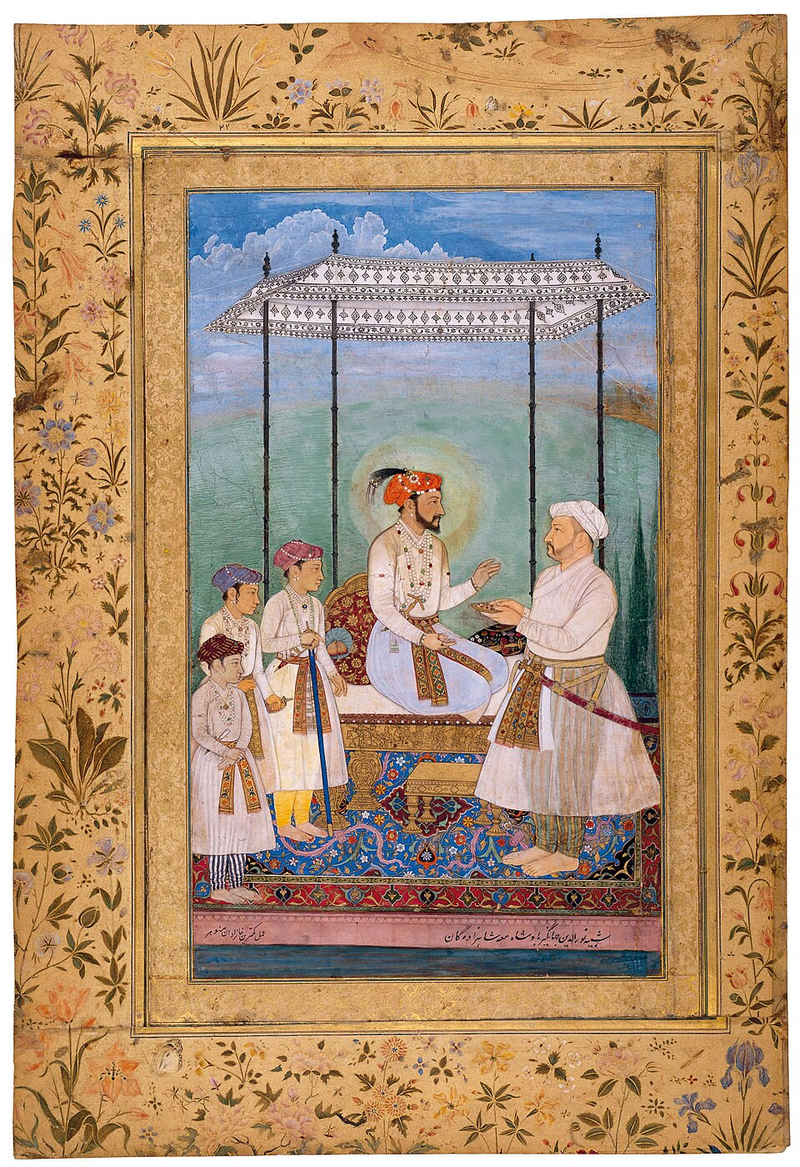
His iconic monuments like the Taj Mahal prominently feature these exquisite architectural elements.
Asked in SSC CGL 2025
Practice (1)
Q883Which Mughal Emperor is known for popularising pietra dura, or stone inlay technique, and the double dome in Indian architecture?
Show answer
Correct answer: C — Shah Jahan
Answer: (C)Shah Jahan (reigned 1628–1658) put both features on his most famous building. His Taj Mahal at Agra is white marble inlaid with coloured stone in pietra dura, and it is crowned by a double dome.
In the Red Fort at Delhi, pietra dura panels behind his throne show Orpheus playing the lute → option (c).
Why the others are wrong(a)Babur: Babur ruled in India only from 1526 to 1530. He is remembered for laying out formal gardens, not for marble inlay or domes.(b)Akbar: Akbar's signature buildings, Fatehpur Sikri and the Agra Fort, are mostly red sandstone. The marble inlay in the stem belongs to the next two reigns.(d)Aurangzeb: Aurangzeb built the Badshahi Mosque at Lahore and the small Moti Masjid in Delhi's Red Fort. The stem's pairing of inlay and dome is credited to his father, Shah Jahan. -
918
Raja Ram Mohan Roy founded the Brahmo Samaj in 1828 to purge Hindu society of idolatry, caste rigidities, and superstitious practices.
It was one of the earliest reform movements in modern India advocating monotheism and rational thinking.
Asked in SSC CGL 2023 (25 Jul, Shift 4)
Practice (1)
Q884Bramho Samaj was founded by whom?
Show answer
Correct answer: A — Raja Ram Mohan Roy
Answer: (A)
Raja Ram Mohan Roy founded the Brahmo Samaj in 1828. -
919
Usha Mehta operated an underground secret radio transmitter during the 1942 Quit India Movement to broadcast nationalist news.
This clandestine broadcast network played a crucial role in keeping public morale high despite severe British crackdown.
Asked in SSC CGL 2023 (25 Jul, Shift 4)
Practice (1)
Q885Who among the following, along with her close associates, started the secret congress radio during the Quit India Movement?
Show answer
Correct answer: D — Usha Mehta
Answer: (D)
Usha Mehta ran the secret Congress Radio during the Quit India Movement (1942). -
920
Chittorgarh Fort originally had 84 water bodies, including ponds, wells, and stepwells, of which 22 survive today.
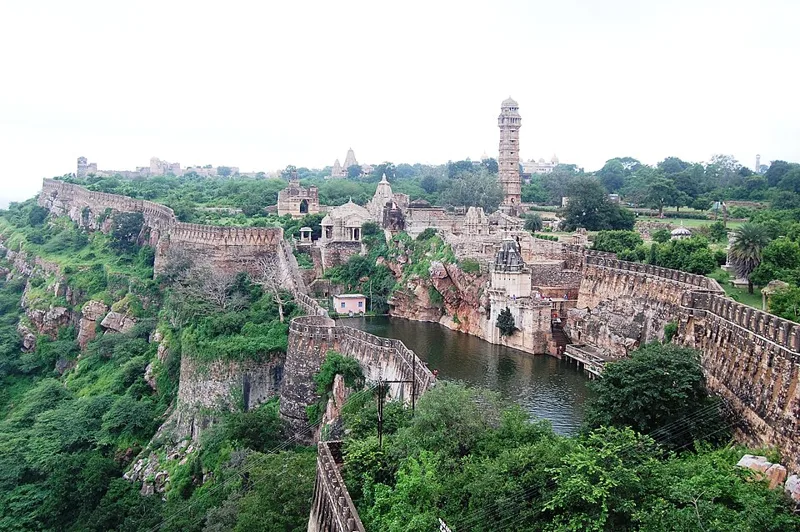
These traditional rainwater-harvesting structures sustained the fort's water requirements.
Asked in SSC CGL 2025
Practice (1)
Q886Approximately how many water bodies originally existed in Chittorgarh Fort?
Show answer
Correct answer: C — 84
Answer: (C)Chittorgarh Fort once had 84 water bodies, in the form of ponds, wells and stepwells fed by rainfall and natural catchment. Only 22 survive today.
The question asks how many existed originally, so the figure is 84 → option (c).
Why the others are wrong(a)22: 22 is how many water bodies survive today, not how many there were. The word 'originally' in the stem rules it out.(b)50: 50 is not a figure recorded for the fort. The record is 84 water bodies originally, of which 22 survive.(d)100: 100 overshoots. The recorded original count is 84, and only 22 of those survive.