
🏺 History इतिहास
1077 exam-ready facts · 1001 MCQs
-
861
Iltutmish introduced the silver tanka and the copper jital as standard coins of the Delhi Sultanate.
He was instrumental in laying the institutional foundations of the Sultanate.
Asked in SSC CGL 2024 (25 Sep, Shift 2)
Practice (1)
Q827Which of the following Delhi sultans introduced two coins, namely silver tanka and copper jital?
Show answer
Correct answer: C — Iltutmish
Answer: (C)
Iltutmish introduced the silver tanka and the copper jital. -
862
Portuguese explorer Vasco da Gama successfully discovered the direct sea route from Europe to India in the year 1498.
Vasco da Gama arrived at Calicut in 1498, opening maritime trade between Europe and India.
Asked in SSC CGL 2022
Practice (1)
Q828Which of the following has discovered the sea route to India 1498?
Show answer
Correct answer: D — Vasco Da Gama
Answer: (D)
Vasco da Gama reached India by sea in 1498. -
863
The Tripartite Struggle for the control of Kannauj was fought between the Pratiharas, Rashtrakutas, and Palas.
This prolonged conflict lasted for centuries over supremacy in northern India.
Asked in SSC CGL 2024 (25 Sep, Shift 3)
Practice (1)
Q829To gain control over Kannauj the Tripartite Struggle was fought between which of the following dynasties?
Show answer
Correct answer: B — Pratihara, Rashtrakuta and Pala
Answer: (B)
Pratiharas, Rashtrakutas and Palas fought the Tripartite Struggle over Kannauj. -
864
Sir Charles Wood dispatched the comprehensive Wood's Despatch on education to the Governor-General of India in 1854.
Often called the Magna Carta of English education in India, Wood's Despatch was issued in 1854.
Asked in SSC CGL 2023 (26 Jul, Shift 1)
Practice (1)
Q830When was a comprehensive despatch on education called Wood’s despatch on education sent?
Show answer
Correct answer: B — 1854
Answer: (B)Wood’s Despatch on education was sent to the Governor-General of India in 1854 by Sir Charles Wood, the President of the Board of Control.
Hence, the correct option is (2).
-
865
Muhammad bin Tughlaq founded the agricultural ministry known as 'Diwan-i Amir-i kohi'.
The department aimed to bring uncultivated land under tillage by offering state loans.
Asked in SSC CGL 2024 (26 Sep, Shift 1)
Practice (1)
Q831To promote agriculture, Muhammad Tughlaq founded which of the following new ministries?
Show answer
Correct answer: A — Diwan-i Amir-i kohi
Answer: (A)
Muhammad bin Tughlaq created Diwan-i-Amir-i-Kohi for agriculture. -
866
Karsondas Mulji and Dadoba Pandurang were prominent reformers associated with the Paramahansa Mandali, which fought against caste rigidities.
Paramahansa Mandali was founded in Maharashtra in 1849 to promote social reform and challenge caste discrimination.
Asked in SSC CGL 2023 (26 Jul, Shift 1)
Practice (1)
Q832Karsondas Mulji and Dadoba Pandurang were associated with ________, which worked against evils like caste system and encouraged widow remarriage.
Show answer
Correct answer: A — Paramahansa Mandali
Answer: (A)Karsondas Mulji and Dadoba Pandurang were associated with Paramahansa Mandali.
Paramahansa Mandali was a secret socio-religious society founded in 1849 in Maharashtra by Dadoba Pandurang Tarkhadkar and his associates.
Its main goals were to fight against the caste system (members often ate food cooked by people of all castes, which was a radical act at the time), oppose idolatry, and promote monotheism.
They also implicitly supported social reforms like widow remarriage, as they aimed to break away from rigid orthodox traditions.
Karsondas Mulji, a prominent Gujarati social reformer, was also associated with similar reformist ideas and movements in Bombay at the time.
The other options are:
Arya Samaj: Founded by Dayanand Saraswati (later than Paramahansa Mandali), also worked against caste and promoted widow remarriage, but Karsondas Mulji and Dadoba Pandurang were not its founders or primary figures.
Brahmo Samaj: Founded by Raja Ram Mohan Roy, predated Paramahansa Mandali, and also championed social reforms, but Dadoba Pandurang's direct association was with the Paramahansa Mandali.
Ramakrishna Mission: Founded by Swami Vivekananda, focused more on spiritual and philanthropic activities, and was established much later.
The correct answer is Option 1: Paramahansa Mandali.
-
867
Narasimhavarman I occupied Vatapi and defeated the Chalukyas, earning the title Vatapikonda.
He was a powerful Pallava ruler who avenged earlier defeats inflicted by Pulakeshin II.
Asked in SSC CGL 2024 (26 Sep, Shift 1)
Practice (1)
Q833Who among the following Pallava kings occupied Vatapi (Badami) and defeated the Chalukyas?
Show answer
Correct answer: C — Narasimhavarman
Answer: (C)
Narasimhavarman I took Vatapi and was called Vatapikonda. -
868
Debendranath Tagore established the Tattvabodhini Sabha in Calcutta in 1839 to propagate spiritual truth and Upanishadic philosophy.
Initially named Tattvaranjini Sabha, it was founded by Debendranath Tagore to explore spiritual truths.
Asked in SSC CGL 2023 (26 Jul, Shift 2)
Practice (1)
Q834Who founded the Tattvabodhini Sabha that was set up to explore spiritual truth?
Show answer
Correct answer: C — Debendranath Tagore
Answer: (C)Debendranath Tagore founded the Tattvabodhini Sabha in Calcutta in October 1839 (initially named the Tattvaranjini Sabha) to explore religious and spiritual truth and to propagate the philosophical teachings of the Upanishads.
Hence, the correct option is (3).
-
869
Medini Rai, Hasan Khan, and Mahmud Lodi joined Rana Sanga to fight against the Mughal emperor Babur.
This alliance was defeated at the historic Battle of Khanwa in 1527.
Asked in SSC CGL 2024 (26 Sep, Shift 2)
Practice (1)
Q835Medini Rai of Chanderi, Hasan Khan of Mewat and Mahmud Lodi joined Rana Sanga with their forces to fight against which of the following Mughal rulers?
Show answer
Correct answer: C — Babur
Answer: (C)
They allied with Rana Sanga against Babur in the Battle of Khanwa (1527). -
870
Bankim Chandra Chatterjee authored the famous Bengali novel 'Anandamath' (1882), which features India's national song 'Vande Mataram'.
Vande Mataram was adopted from Bankim Chandra Chatterjee's historical novel Anandamath.
Asked in SSC CGL 2023 (27 Jul, Shift 1)
Practice (1)
Q836Who among the following wrote 'Anand Math' from where India's National song 'Vande Mataram' has been taken?
Show answer
Correct answer: D — Bankim Chandra Chatterjee
Answer: (D)The Bengali novel Anandamath was written by Bankim Chandra Chatterjee and published in 1882. The national song of India, 'Vande Mataram', was featured in this novel against the backdrop of the Sannyasi Rebellion.
Hence, the correct option is (4).
-
871
The Indian National Congress was founded in December 1885, serving as a prominent platform for nationalist political dialogue.
Allan Octavian Hume played a key role in organizing the first session of the Indian National Congress in 1885.
Asked in SSC CGL 2023 (27 Jul, Shift 1)
Practice (1)
Q837Which of the following organisations was established in 1885?
Show answer
Correct answer: D — Indian National Congress
Answer: (D)The Indian National Congress (Option D) was established in 1885. This political party played a crucial role in the independence movement of India, fighting against British colonial rule and advocating for the rights and political representation of Indians.
Founded by Allan Octavian Hume, Dadabhai Naoroji, and Dinshaw Wacha, the Congress emerged as a platform for civil and political dialogue among Indians. Through its various sessions and resolutions, the Indian National Congress sought to influence British policies and eventually became the principal leader in the struggle for India's independence, which was finally obtained in 1947.
Here are some key events in the history of the Indian National Congress:
1885: The first session of the Indian National Congress was held in Bombay (now Mumbai), attended by 72 delegates.
Early 1900s: The Congress began to push for Swaraj (self-rule) and greater Indian participation in the administration.
1920-22: The Non-Cooperation Movement led by Mahatma Gandhi.
1930: The Salt March, a significant act of civil disobedience in the fight against British salt monopoly.
1942: The Quit India Movement, demanding an end to British rule in India.
The Indian National Congress's contribution extends beyond the freedom struggle into shaping modern India's policies and governance post-independence.
-
872
The historic Tripartite Struggle was fought among the Palas, Pratiharas, and Rashtrakutas.
Control over the prosperous city of Kannauj was the main prize of this conflict.
Asked in SSC CGL 2024 (26 Sep, Shift 3)
Practice (1)
Q838The Tripartite struggle happened among the Palas, the Pratiharas and the _______.
Show answer
Correct answer: A — Rashtrakutas
Answer: (A)
The Tripartite Struggle was among the Palas, Pratiharas and Rashtrakutas. -
873
Raja Ram Mohan Roy authored 'Tuhfat-ul-Muwahhidin' (A Gift to Monotheists) in Persian in 1803 to denounce polytheism and idol worship.
Raja Ram Mohan Roy's early work Tuhfat-ul-Muwahhidin advocated rationalist monotheism and condemned idol worship.
Asked in SSC CGL 2023 (26 Jul, Shift 3)
Practice (1)
Q839Who wrote ‘Gift to Monotheists’ in Persian to denounce the belief in many Gods?
Show answer
Correct answer: C — Raja Ram Mohan Roy
Answer: (C)Raja Ram Mohan Roy wrote Tuhfat-ul-Muwahhidin (A Gift to Monotheists) in Persian in 1803–1804. In this treatise, he argued against polytheism and idol worship, advocating for belief in a single supreme deity.
Hence, the correct option is (3).
-
874
The Pushyabhuti dynasty strengthened its position in Punjab and Haryana after defeating the Hunas.
Prabhakarvardhana played a key role in expanding and securing these northern territories.
Asked in SSC CGL 2024 (26 Sep, Shift 3)
Practice (1)
Q840Pushyabhuti dynasty, after Prabhakarvardhana, strengthened its position in the regions of Punjab and Haryana after defeating which of the following dynasties?
Show answer
Correct answer: B — Hunas
Answer: (B)
Prabhakarvardhana defeated the Hunas. -
875
Mahatma Gandhi visited Champaran in 1917 primarily upon the persuasion of local indigo cultivator Rajkumar Shukla.
Rajkumar Shukla met Gandhi at the 1916 Lucknow Congress and urged him to witness the plight of Champaran peasants.
Asked in SSC CGL 2023 (26 Jul, Shift 3)
Practice (1)
Q841Primarily under whose persuasion did Mahatma Gandhi visit Champaran to understand the problems of peasants?
Show answer
Correct answer: D — Rajkumar Shukla
Answer: (D)During the 1916 Lucknow Session of the Indian National Congress, Rajkumar Shukla, an indigo farmer from Champaran, met Mahatma Gandhi and persuaded him to visit Champaran to investigate the grievances of peasants under the exploitative tinkathia system.
Hence, the correct option is (4).
-
876
The First Battle of Panipat was a decisive battle in Indian history as it established Mughal rule.
Babur defeated Ibrahim Lodi in this battle, changing the political landscape of India.
Asked in SSC CGL 2024
Practice (1)
Q842Select the option that is true regarding the following two statements<br>labelled Assertion (A) and Reason (R).<br>A. The first battle of Panipat was one of the decisive battles of India.<br>R. It brought into power a new band of invaders called Mughals.
Show answer
Correct answer: B — Statements A and R are true, and R is the correct explanation of A.
Answer: (B)
The First Battle of Panipat (1526) was decisive because it established Mughal rule in India; R explains A. -
877
The dual system of government in Bengal was introduced by Robert Clive in 1765 following the Treaty of Allahabad.
Robert Clive's dual system divided power in Bengal, giving financial control to the Company and administrative duties to the Nawab.
Asked in SSC CGL 2023 (26 Jul, Shift 4)
Practice (1)
Q843The policy of dual system of government of Bengal was the brainchild of which Governor-General?
Show answer
Correct answer: B — Lord Clive
Answer: (B)The Dual System of Government in Bengal was introduced by Robert Clive in 1765 following the Treaty of Allahabad. Under this arrangement, the British East India Company held the Diwani rights (revenue collection and civil justice), while the administrative and judicial responsibilities (Nizamat) remained with the Nawab of Bengal.
Hence, the correct option is (2).
-
878
Muhammad bin Tughluq was the first recorded sultan to visit the shrine of Khwaja Muinuddin Chishti.
His visit is documented in the historical records of the Ajmer Dargah Sharif.
Asked in SSC CGL 2024
Practice (1)
Q844Who was the first sultan (in the recorded history of the Dargah Sharif) to visit the shrine of khwaja Muinuddin Chisti?
Show answer
Correct answer: D — Muhammad bin Tughluq
Answer: (D)
Muhammad bin Tughluq was the first sultan recorded to visit the Ajmer dargah. -
879
Humayun's Tomb was the first major Mughal garden tomb and directly inspired the design of the Taj Mahal.
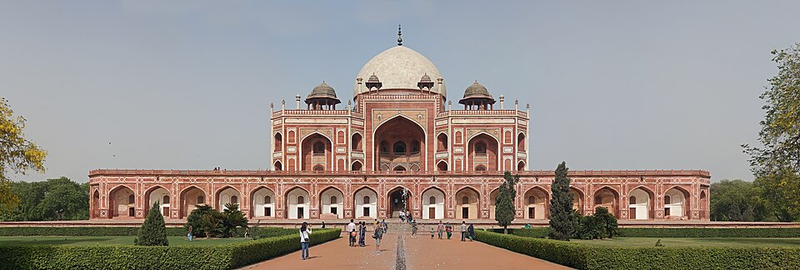
It introduced the classic charbagh layout and double-dome architecture to India.
Asked in SSC CGL 2025
Practice (1)
Q845Read the below statements marked as Assertion (A) and Reason (R). Mark the correct options:<br>Assertion (A): Humayun’s Tomb was the first major Mughal garden tomb and directly inspired the design of the Taj Mahal.<br>Reason (R): It introduced the charbagh garden layout and double-domed mausoleum style that became characteristic of later Mughal architecture.
Show answer
Correct answer: A — Both A and R are true, and R is the correct explanation of A.
Answer: (A)A is true. UNESCO calls Humayun's Tomb the first garden-tomb on the Indian subcontinent, and says it inspired innovations that culminated in the Taj Mahal.
R is true and explains A. The tomb stands at the centre of a charbagh, a four-part walled garden, under a marble-clad double dome. The Taj carries both features, so R names the link between the two → option (a).
Why the others are wrong(b)Both A and R are true, but R is not the correct explanation of A.: Both statements are true, but this option denies the link. R names the charbagh and the double dome, the features the Taj Mahal takes up, so R does explain A.(c)A is true, but R is false.: R is not false. The tomb stands in a charbagh of four quadrants divided by walkways and water channels, under a 42.5 m double dome clad in marble.(d)A is false, but R is true: A is not false. UNESCO calls the tomb the first garden-tomb on the subcontinent and traces the innovations it inspired to the Taj Mahal. -
880
In March 1942, the British government dispatched the Cripps Mission to India, led by Sir Stafford Cripps.
Sir Stafford Cripps headed the 1942 mission to secure Indian wartime cooperation.
Asked in SSC CGL 2023 (26 Jul, Shift 4)
Practice (1)
Q846In 1942, the British government sent the _______ mission to India.
Show answer
Correct answer: A — Cripps
Answer: (A)In March 1942, the British government sent the Cripps Mission to India, headed by Sir Stafford Cripps, to secure Indian cooperation for the British war effort during the Second World War.
Hence, the correct option is (1).