
🏺 Ancient India प्राचीन भारत
198 exam-ready facts · 198 MCQs
-
41
The Jorwe culture was an important Chalcolithic archaeological culture that flourished in the present-day Indian state of Maharashtra.
Inamgaon is one of the most extensively excavated Jorwe culture sites.
Asked in SSC CGL 2018
Practice (1)
Q41Jorwe culture' was a Chalcolithic archaeological site located in the present day Indian<br>state of ______.
Show answer
Correct answer: A — ['1', 'Maharashtra']
Answer: (A)
The correct option is (A). -
42
Lothal was a prominent port city of the Indus Valley Civilization featuring an artificial dockyard.
It is situated along the Bhogavo river in Gujarat.
Asked in SSC CGL 2018
Practice (1)
Q42Which of the following was a port city of the Indus Valley Civilization?
Show answer
Correct answer: A — ['1', 'Lothal']
Answer: (A)
The correct option is (A). -
43
The Buddhist monuments at Sanchi were rediscovered in 1818 by General Taylor after remaining abandoned for centuries.
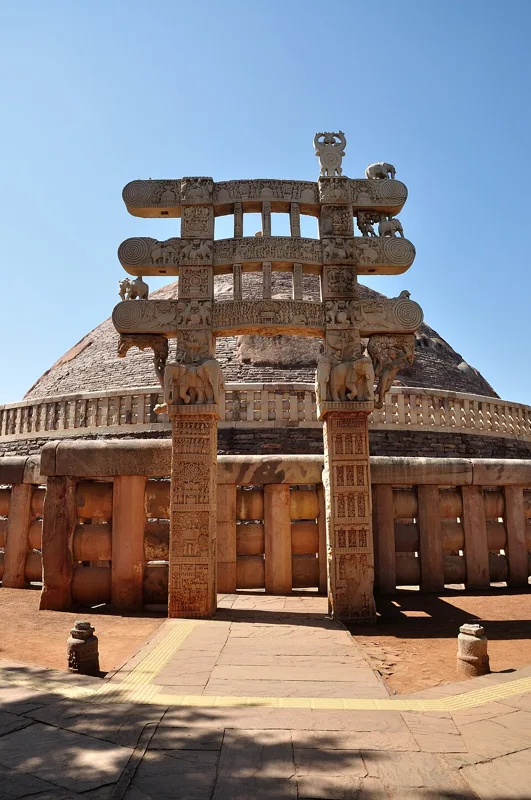
This discovery led to extensive archaeological studies of the stupa complex.
Asked in SSC CGL 2019
Practice (1)
Q43In which year Sanchi was discovered after being abandoned for nearly 600 Years?
Show answer
Correct answer: B — 1818
Answer: (B)
Sanchi was rediscovered in 1818 by General Taylor of the British army. -
44
Ajatashatru was a powerful monarch of the Haryanka dynasty and the son of King Bimbisara.
He annexed several neighboring territories, including the kingdom of Kosala and Vaishali.
Asked in SSC CGL 2020 (3 Mar, Shift 2)
Practice (1)
Q44Ajatashatru, a ruler of the Haryanka Dynasty, was the son of _____.
Show answer
Correct answer: D — Bimbisara
Answer: (D)
Ajatashatru was the son of Bimbisara, founder of the Haryanka dynasty of Magadha. -
45
Dhana Nanda was the last ruler of the Nanda dynasty before being overthrown by Chandragupta Maurya.
His vast army and immense wealth are mentioned in Greek accounts.
Asked in SSC CGL 2020 (3 Mar, Shift 2)
Practice (1)
Q45Who among the following was the last ruler of the Nanda dynasty?
Show answer
Correct answer: A — Dhanananda
Answer: (A)
Dhanananda was the last Nanda king; he was overthrown by Chandragupta Maurya. -
46
Vishnugupta is historically recognized as the last acknowledged king of the imperial Gupta dynasty.
His rule marked the final phase of the classical Gupta empire around the mid-6th century CE.
Asked in SSC CGL 2020 (3 Mar, Shift 3)
Practice (1)
Q46The last recognised king of the Gupta line was _______.
Show answer
Correct answer: D — Vishnugupta
Answer: (D)
Vishnugupta (c. 540-550 CE) is regarded as the last recognised Gupta king. -
47
King Bimbisara was the founder and the first prominent ruler of the Haryanka dynasty in Magadha.
He established matrimonial alliances to expand his political influence.
Asked in SSC CGL 2020 (3 Mar, Shift 3)
Practice (1)
Q47The first ruler of Magadha from the Haryanka dynasty was _______.
Show answer
Correct answer: C — Bimbisara
Answer: (C)
Bimbisara founded the Haryanka dynasty's rule over Magadha. -
48
Halivakara was a specific plough tax levied on cultivators during the Gupta period.
Epigraphic records mention various agrarian taxes collected by Gupta officials.
Asked in SSC CGL 2020 (3 Mar, Shift 3)
Practice (1)
Q48The Gupta rulers imposed a fine called _______ which was a plough tax paid by every cultivator owning a plough.
Show answer
Correct answer: C — Halivakara
Answer: (C)
Halivakara was the plough tax levied in the Gupta period. -
49
The early Vedic Civilisation in India primarily flourished along the sacred river Saraswati.
Rigvedic hymns frequently praise the mighty Saraswati as the best of rivers.
Asked in SSC CGL 2020 (4 Mar, Shift 1)
Practice (1)
Q49The Vedic Civilisation in India flourished along the river__________.
Show answer
Correct answer: B — Saraswati
Answer: (B)
Vedic texts describe the Saraswati as the main river of early Vedic culture. -
50
During the 4th century BCE, the imperial capital of Magadha was officially shifted to Pataliputra.
Its strategic confluence location offered immense military and trading advantages.
Asked in SSC CGL 2020 (4 Mar, Shift 1)
Practice (1)
Q50In the 4th century BCE, the capital of Magadha was shifted to ________.
Show answer
Correct answer: D — Pataliputra
Answer: (D)
Pataliputra became the capital of Magadha in the 4th century BCE. -
51
The Allahabad Pillar inscription (Prayag Prashasti), composed by Harisena, records the military achievements of Samudragupta.
He is often referred to as the Napoleon of India due to his extensive conquests.
Asked in SSC CGL 2020 (4 Mar, Shift 2)
Practice (1)
Q51Which pillar inscriptions has recorded the achievements of Samudra Gupta, who was known as the 'Napoleon of India' for his conquests?
Show answer
Correct answer: D — Allahabad Pillar
Answer: (D)
The Allahabad Pillar inscription (Prayag Prashasti) by Harisena records Samudragupta's conquests. -
52
Sudarshana Lake in Gujarat was an artificial reservoir originally constructed during the Maurya dynasty.
It was later repaired and maintained by subsequent rulers like Rudradaman and Skandagupta.
Asked in SSC CGL 2020 (4 Mar, Shift 1)
Practice (1)
Q52The ________ lake in Gujarat was an artificial reservoir built during the rule of the Mauryas.
Show answer
Correct answer: C — Sudarshana
Answer: (C)
Sudarshana lake near Girnar was built under Chandragupta Maurya and repaired by Rudradaman. -
53
Rajagaha (modern Rajgir) served as the early capital of the kingdom of Magadha prior to the 4th century BCE.
It was protected by five hills surrounding the valley.
Asked in SSC CGL 2020 (4 Mar, Shift 1)
Practice (1)
Q53_________ was the capital of Magadha before the 4th century BCE.
Show answer
Correct answer: A — Rajagaha
Answer: (A)
Rajagaha (Rajgir) was Magadha's capital before it shifted to Pataliputra. -
54
Kalpa is one of the six Vedangas that specifically deals with ritual practices and procedures.
Vedangas were auxiliary disciplines developed to understand the Vedas.
Asked in SSC CGL 2020 (7 Mar, Shift 1)
Practice (1)
Q54With reference to the Vedangas, which of the following terms denotes 'Ritual'?
Show answer
Correct answer: B — Kalpa
Answer: (B)
Kalpa is the Vedanga dealing with rituals. -
55
Swami Dayanand Saraswati proposed the Tibet-home theory for the Aryans, whereas Bal Gangadhar Tilak suggested the Arctic home theory.
Dayanand Saraswati founded the Arya Samaj in 1875.
Asked in SSC CGL 2020 (7 Mar, Shift 3)
Practice (1)
Q55Who among the following scholars is associated with the Tibet-home theory of the Aryans?
Show answer
Correct answer: A — Dayanand Saraswati
Answer: (A)
Swami Dayanand Saraswati held that the Aryans came from Tibet (Tilak gave the Arctic home theory). -
56
The ancient Sanskrit play 'Mricchakatika' (The Little Clay Cart), depicting a social drama, was written by the playwright Shudraka.
Shudraka was an ancient Indian playwright.
Asked in SSC CGL 2020 (7 Mar, Shift 2)
Practice (1)
Q56Who wrote the play 'Mricchakatika' (The Little Clay Cart), a social drama with touches of grim reality?
Show answer
Correct answer: A — Sudraka
Answer: (A)
Mricchakatika was written by Shudraka. -
57
The Jaugada Rock Edict of Emperor Ashoka is situated in the Ganjam district of Odisha.
Jaugada contains major rock edicts of Ashoka.
Asked in SSC CGL 2020 (7 Mar, Shift 3)
Practice (1)
Q57In which state The Jaugada Rock Edict of Asoka is located?
Show answer
Correct answer: A — Odisha
Answer: (A)
The Jaugada rock edicts are in Ganjam district, Odisha. -
58
In Jain philosophy, the term 'Jina' literally signifies 'the conqueror' who has mastered inner passions and desires.
Mahavira is referred to as a Jina.
Asked in SSC CGL 2020 (7 Mar, Shift 3)
Practice (1)
Q58According to the Jain Philosophy, the term 'Jina' means ________.
Show answer
Correct answer: B — the conqueror
Answer: (B)
"Jina" means the conqueror (of the inner passions). -
59
Sarnath, the prominent Buddhist site where Gautama Buddha delivered his first sermon, is located in Uttar Pradesh.
Sarnath is located near Varanasi.
Asked in SSC CGL 2021 (13 Aug, Shift 3)
Practice (1)
Q59Which of the following Buddhist sites is located in Uttar Pradesh?
Show answer
Correct answer: A — Sarnath
Answer: (A)
Sarnath (near Varanasi, UP) is where Buddha gave his first sermon. Karle is in Maharashtra, Sanchi in MP, Amaravati in Andhra Pradesh. -
60
Gautama Buddha was born in the sacred grove known as Lumbini, which is located in present-day Nepal.
Lumbini is a UNESCO World Heritage Site.
Asked in SSC CGL 2021 (16 Aug, Shift 2)
Practice (1)
Q60The place of Gautama Buddha’s birth was a grove known as ______.
Show answer
Correct answer: B — Lumbini
Answer: (B)
Buddha was born in the Lumbini grove (now in Nepal).