
🏺 Ancient India प्राचीन भारत
198 exam-ready facts · 198 MCQs
-
21
Brahmi script was predominantly used in most of Emperor Ashoka's inscriptions across the Indian subcontinent.
Kharosthi, Greek, and Aramaic scripts were also used in northwestern regions.
Asked in SSC CGL 2016 (2 Sep, Shift 3)
Practice (1)
Q21Which script was used in Ashoka's inscriptions?
Show answer
Correct answer: A — Brahmi
Answer: (A)
The correct option is (A). -
22
Aryabhatta and Kalidasa were notable scholars in the court of Gupta Emperor Chandra Gupta II.
Chandra Gupta II's reign is celebrated as a golden age of art, science, and literature in ancient India.
Asked in SSC CGL 2016 (3 Sep, Shift 2)
Practice (1)
Q22Aryabhatta and Kalidasa were in the court of<br>which Gupta Emperor?
Show answer
Correct answer: B — Chandra Gupta II
Answer: (B)
The correct option is (B). -
23
Charaka was a prominent ancient Ayurvedic scholar who served as the court physician of Kushan king Kanishka.
He is the author of the foundational medical treatise known as the Charaka Samhita.
Asked in SSC CGL 2016 (3 Sep, Shift 3)
Practice (1)
Q23Who among the following was the court physician of Kanishka?
Show answer
Correct answer: C — Charaka
Answer: (C)
The correct option is (C). -
24
The Yajurveda is the ancient Vedic Sanskrit text that primarily deals with the rituals and procedures of sacrifices.
It contains mantras and prose formulas for performing Vedic sacrificial rites.
Asked in SSC CGL 2016 (3 Sep, Shift 3)
Practice (1)
Q24The veda which deals with the rituals is known as_____________
Show answer
Correct answer: B — Yajurveda
Answer: (B)
The correct option is (B). -
25
The national motto 'Satyameva Jayate' has been directly derived from the ancient Mundaka Upanishad.
It translates to 'Truth alone triumphs' and is inscribed below the National Emblem of India.
Asked in SSC CGL 2016 (4 Sep, Shift 1)
Practice (1)
Q25The word 'Satyameva Jayate' have been derived from which Upanishad?
Show answer
Correct answer: B — Mundaka Upanishad
Answer: (B)
The correct option is (B). -
26
Pataliputra served as the imperial capital of the powerful Mauryan Kingdom in ancient India.
Strategically located at the confluence of the Ganga and Son rivers, it was a massive fortified city.
Asked in SSC CGL 2016 (4 Sep, Shift 3)
Practice (1)
Q26The capital of the Mauryan Kingdom was located at___________
Show answer
Correct answer: A — Pataliputra
Answer: (A)
The correct option is (A). -
27
The Great Granary is the largest building discovered at the ancient Indus Valley site of Mohenjodaro.
It was designed with air ducts and wooden platforms for storing large quantities of grain.
Asked in SSC CGL 2016 (4 Sep, Shift 2)
Practice (1)
Q27Which is the biggest building at Mohenjodaro?
Show answer
Correct answer: B — Great Granary
Answer: (B)
The correct option is (B). -
28
The Arthashastra is a monumental ancient treatise on statecraft and economic policy written by Kautilya.
Kautilya, also known as Chanakya, was the chief minister and mentor of Emperor Chandragupta Maurya.
Asked in SSC CGL 2016 (6 Sep, Shift 2)
Practice (1)
Q28The important book written by Kautilya is
Show answer
Correct answer: A — Arthashastra
Answer: (A)
The correct option is (A). -
29
Kaivalya represents supreme enlightenment and ultimate liberation, which is a core concept in Jainism.
Achieving kaivalya frees a soul from the cycle of rebirth and suffering in Jain philosophy.
Asked in SSC CGL 2016 (7 Sep, Shift 1)
Practice (1)
Q29With which religion is Kaivalya associated?
Show answer
Correct answer: B — Jainism
Answer: (B)
The correct option is (B). -
30
The Tripitakas are the traditional sacred canonical texts and scriptures revered in Buddhism.
The term translates to 'Three Baskets', referring to Sutta, Vinaya, and Abhidhamma Pitaka.
Asked in SSC CGL 2016 (6 Sep, Shift 1)
Practice (1)
Q30'Tripitakas' are sacred books of ____________
Show answer
Correct answer: D — Buddhists
Answer: (D)
The correct option is (D). -
31
The sacred texts of Jainism are collectively known as the Agangas or Angas, containing teachings of Mahavira.
These canonical scriptures were compiled by the immediate disciples of Mahavira known as Ganadharas.
Asked in SSC CGL 2016 (10 Sep, Shift 1)
Practice (1)
Q31A collective term used by the Jains for their sacred books is
Show answer
Correct answer: B — Angas
Answer: (B)
The correct option is (B). -
32
Gautam Buddha belonged to the Shakya ganarajya, ruling clan of ancient Kapilavastu near the Himalayan foothills.
His father Suddhodhana was an elected chief or king of the Shakya republic.
Asked in SSC CGL 2016 (10 Sep, Shift 3)
Practice (1)
Q32To which ganarajya Gautam Buddha belonged?
Show answer
Correct answer: B — Shakya
Answer: (B)
The correct option is (B). -
33
Takshashila University was historically located between the Indus and Jhelum rivers in ancient northwestern India.
It was a celebrated ancient center of learning that attracted scholars from across Asia.
Asked in SSC CGL 2017 (12 Aug, Shift 3)
Practice (1)
Q33Takshashila University was located between which two rivers?
Show answer
Correct answer: A — Indus and Jhelum
Answer: (A)
Takshashila lay between the Indus and the Jhelum rivers. -
34
Indra is the most prominent deity in the Rig Veda, praised in approximately 250 hymns for rain and war.
He was considered the king of gods and the god of thunder, storm, and battle.
Asked in SSC CGL 2017 (12 Aug, Shift 3)
Practice (1)
Q34Who is the most prominent god of 'Rig Veda'?
Show answer
Correct answer: A — Indra
Answer: (A)
Indra is the most prominent god of the Rig Veda (about 250 hymns). -
35
Kumaragupta I of the Gupta dynasty initiated the construction of the renowned Nalanda Mahavihara in the 5th century CE.
Nalanda grew into a prominent centre of learning in ancient India.
Asked in SSC CGL 2017 (19 Aug, Shift 1)
Practice (1)
Q35Who started construction of Nalanda (Mahavihara) ?
Show answer
Correct answer: C — Kumaragupta
Answer: (C)
Kumaragupta I began the construction of Nalanda Mahavihara. -
36
During the lifetime of Gautama Buddha in the 6th century BCE, there were sixteen powerful independent states known as Mahajanapadas.
Anguttara Nikaya provides the list of these sixteen Mahajanapadas.
Asked in SSC CGL 2018
Practice (1)
Q36भगवान गौतम बुȠ के जीवन काल के दौरान सातवीं और छठी शताɨी ईसा पूवŊ मŐ िकतनी महान<br>शİƅयां (महाजनपद) अİˑȕ मŐ थीं?
Show answer
Correct answer: C — ['3', '16']
Answer: (C)
The correct option is (C). -
37
Vaisali was a famous republican confederacy (Gana-sangha) rather than a traditional monarchy during the Mahajanapada era.
It was the capital of the Vajjika League.
Asked in SSC CGL 2018
Practice (1)
Q37िनɻिलİखत मŐ से कौन-सा राजशाही राǛों मŐ से एक नहीं है जोिक सातवीं और छठी सदी के शुŝ म<br>ईसा पूवŊ भारत मŐ मौजूद है?
Show answer
Correct answer: C — ['3', 'वैशाली']
Answer: (C)
The correct option is (C). -
38
Chandragupta I received Pataliputra as a dowry from the Lichchhavis after marrying Kumaradevi.
This alliance strengthened the political power of the early Gupta empire.
Asked in SSC CGL 2018
Practice (1)
Q38िनɻ मŐ से उस राǛ का नाम बताइए जो चंūगुɑ Ůथम को िलDžिवयों से दहेज मŐ िमला था।
Show answer
Correct answer: B — ['2', 'पाटिलपुũ']
Answer: (B)
The correct option is (B). -
39
The famous Chinese Buddhist pilgrim Hiuen Tsang (Xuanzang) visited India during the reign of King Harshavardhana.
He wrote a detailed account of Indian social and political life in his travelogue.
Asked in SSC CGL 2018
Practice (1)
Q39During whose reign did the Chinese traveller Hiuen Tsang visit India?
Show answer
Correct answer: C — ['3', 'Harshavardhana']
Answer: (C)
The correct option is (C). -
40
The Dhamek Stupa in Sarnath was originally commissioned by the great Mauryan emperor Ashoka in 249 BCE.
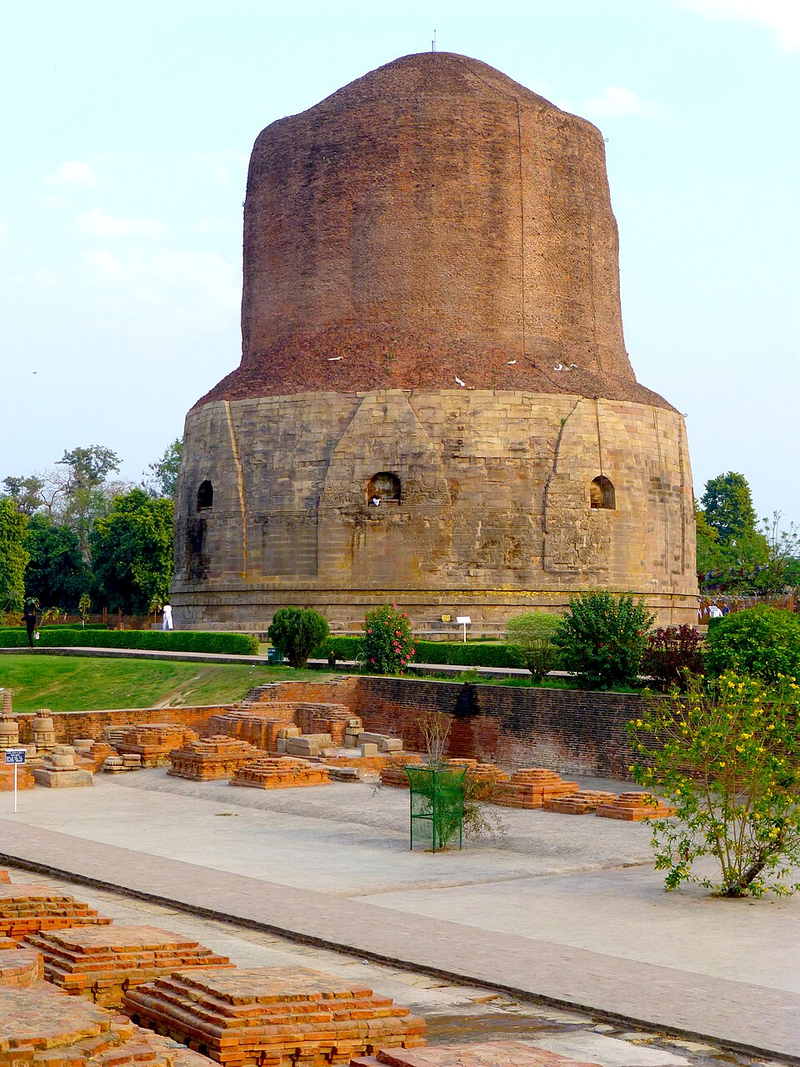
It marks the spot where Buddha gave his first sermon to his five disciples.
Asked in SSC CGL 2018
Practice (1)
Q40सारनाथ मŐ İ̾ थत ______ ˑूप का िनमाŊण महान मौयŊ सŲाट अशोक ने िकया था, यह भारत मŐ İ̾ थत<br>Ůमुख बौȠ संरचनाओं मŐ से एक है।
Show answer
Correct answer: D — ['4', 'धमेख']
Answer: (D)
The correct option is (D).