
🎭 Art & Culture कला और संस्कृति
801 exam-ready facts · 758 MCQs
-
741
The novel 'Half the Night is Gone' (2018), which won the DSC Prize, was written by computer science professor and author Amitabha Bagchi.
Half the Night Is Gone (2018) is a novel by Amitabha Bagchi , a professor of computer science at IIT Delhi. It won the DSC Prize for South Asian Literature in 2019. The book is his, so the author the stem asks for is …
Asked in SSC CGL 2025 (19 Sep, Shift 1)
Practice (1)
Q717'Half the Night is Gone' is written by which Sahitya Akademi winner?
Show answer
Correct answer: D — Amitabha Bagchi
Answer: (D)Half the Night Is Gone (2018) is a novel by Amitabha Bagchi, a professor of computer science at IIT Delhi.
It won the DSC Prize for South Asian Literature in 2019. The book is his, so the author the stem asks for is Amitabha Bagchi → option (d).
Why the others are wrong(a)Amitav Ghosh: Amitav Ghosh did win the Sahitya Akademi Award, in 1989 for The Shadow Lines, but he did not write Half the Night Is Gone.(b)Amit Chaudhuri: Amit Chaudhuri won the Sahitya Akademi Award in 2002 for A New World. Half the Night Is Gone is Amitabha Bagchi's novel.(c)Anuradha Roy: Anuradha Roy won the Sahitya Akademi Award in 2022 for All the Lives We Never Lived. She is not the author of this novel. -
742
The Hojagiri folk dance, where women balance bottles and lamps while moving the lower half of their body, is associated with the Reang tribe of Tripura.
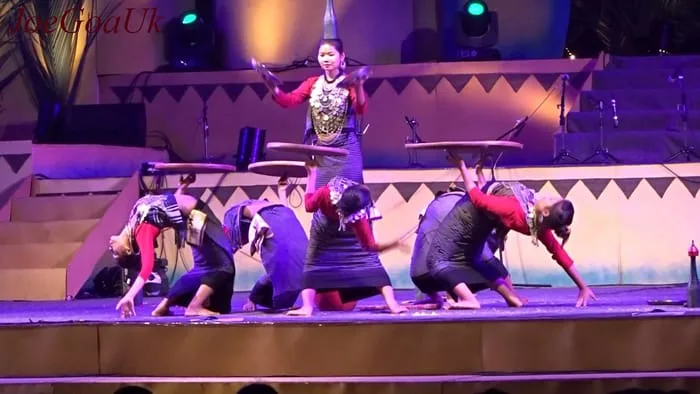
Hojagiri belongs to the Reang community of Tripura . It is danced by young women in teams of four to six. They balance a bottle or an earthen pitcher on the head and hold lamps in their hands, moving only the lower ha…
Asked in SSC CGL 2025 (19 Sep, Shift 1)
Practice (1)
Q718Hojagiri dance, performed by women balancing bottles and lamps, is associated with which tribe and state?
Show answer
Correct answer: B — Reang – Tripura
Answer: (B)Hojagiri belongs to the Reang community of Tripura.
It is danced by young women in teams of four to six. They balance a bottle or an earthen pitcher on the head and hold lamps in their hands, moving only the lower half of the body, while the men sing and play the instruments.
Reang – Tripura → option (b).
Why the others are wrong(a)Bodo – Assam: The Bodos are a tribe of Assam, but Hojagiri is not their dance. The Bodo women's dance is Bagurumba, also called the butterfly dance.(c)Angami – Nagaland: The Angami are a Naga tribe of Nagaland, known for their Sekrenyi festival. Hojagiri is not a Naga dance. It belongs to the Reang community of Tripura.(d)Mishing – Arunachal Pradesh: The Mishing live mainly in Assam and Arunachal Pradesh, but Hojagiri is not their dance. It belongs to the Reang community of Tripura. -
743
The most notable feature of the Rouf folk dance of Kashmir, performed by women facing each other, is its intricate footwork.
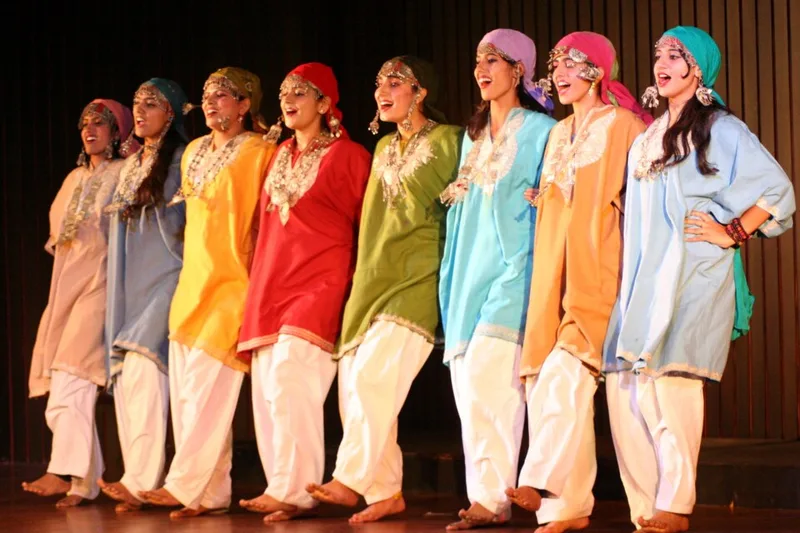
Rouf is a folk dance of Kashmir performed by women in groups that stand facing each other . What carries it is the footwork : its simple, rhythmic steps are the dance's best-known feature, and the dancers sing as…
Asked in SSC CGL 2025 (19 Sep, Shift 1)
Practice (1)
Q719What is the most notable feature of the Rouf dance of Kashmir?
Show answer
Correct answer: C — Footwork of dancers
Answer: (C)Rouf is a folk dance of Kashmir performed by women in groups that stand facing each other.
What carries it is the footwork: its simple, rhythmic steps are the dance's best-known feature, and the dancers sing as they move.
Footwork of dancers → option (c).
Why the others are wrong(a)Colorful costumes: Costume is not the defining trait. Rouf is known for the dancers' steps. Long colourful robes and tall conical caps are associated with Dumhal, the men's dance of the Wattal community.(b)Hand gestures: Hand gestures are not Rouf's signature. Its defining trait is the dancers' simple, rhythmic footwork. Expressive hand gestures are central to classical forms such as Kathakali.(d)Musical instruments: Rouf is known for its dancers, not its instruments. Its defining feature is the rhythmic footwork, and the dancers themselves sing the verses. -
744
The sacred masked dances (cham) performed by monks at Hemis Monastery in Ladakh represent various guardian divinities of the Drugpa (Drukpa) lineage.
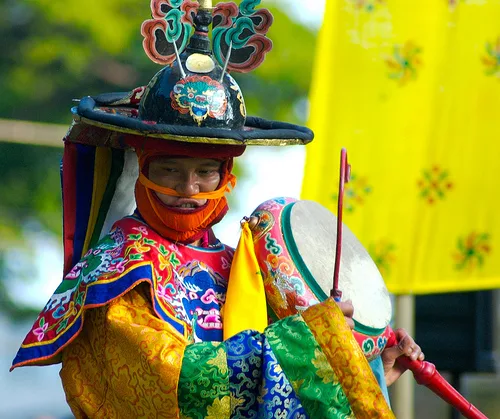
The masks worn by the monks in the Hemis dances represent guardian divinities of the Drugpa (Drukpa) order, of which Hemis is the leading establishment in Ladakh. That is the description on the government festival por…
Asked in SSC CGL 2025 (19 Sep, Shift 3)
Practice (1)
Q720Fill in the blank:<br>The sacred masked dances performed by monks at Hemis represent various ______ of the Drugpa lineage.
Show answer
Correct answer: C — guardian divinities
Answer: (C)The masks worn by the monks in the Hemis dances represent guardian divinities of the Drugpa (Drukpa) order, of which Hemis is the leading establishment in Ladakh. That is the description on the government festival portal, utsav.gov.in.
The dances, called cham, belong to the tantric Vajrayana tradition and are staged at the festival honouring Padmasambhava. The blank takes 'guardian divinities' → option (c).
Why the others are wrong(a)reincarnated lamas: The dancers are monks, but the masks do not depict reincarnated lamas. The government festival portal utsav.gov.in says they represent guardian divinities of the Drugpa order.(b)ancient kings: Hemis was re-established under the Ladakhi king Sengge Namgyal in 1672, but the dances do not portray ancient kings. The masks stand for divinities in a religious rite.(d)ancestral spirits: Ancestral spirits belong to ancestor worship, which a cham does not enact. Its masked figures are divinities, and the dances depict the triumph of good over evil. -
745
In Nagara-style temples, the amalaka sits atop the shikhara, whereas in Drāviḍa-style temples, the vimana refers to the sanctum tower (not the gopuram gateway).
Test each statement against the part it names. Statement 1 holds. The amalaka , a notched stone disc ridged at the rim, sits on top of the shikhara of a Nagara temple, and a kalasha finial crowns it. Statement 2 fails…
Asked in SSC CGL 2025 (19 Sep, Shift 3)
Practice (1)
Q721Read the following statements and choose the correct option:<br>Statement 1: The amalaka sits atop the shikhara in Nagara-style temples.<br>Statement 2 : In Drāviḍa-style temples, the vimana refers to the gateway tower (gopuram).
Show answer
Correct answer: C — Statement 1 is correct, but Statement 2 is incorrect
Answer: (C)Test each statement against the part it names.
Statement 1 holds. The amalaka, a notched stone disc ridged at the rim, sits on top of the shikhara of a Nagara temple, and a kalasha finial crowns it.
Statement 2 fails. The vimana is the structure over the garbhagriha, the sanctum. The gateway tower is a different structure, the gopuram.
One correct, one incorrect → option (c).
Why the others are wrong(a)Both Statement 1 and Statement 2 are correct: Statement 2 is wrong, so both cannot be correct. It hands the vimana the role of the gopuram: the vimana rises over the sanctum, the gopuram over the gateway.(b)Both Statement 1 and Statement 2 are incorrect: Statement 1 is right: the amalaka does sit atop the Nagara shikhara, beneath the kalasha. So 'both incorrect' fails on the first statement.(d)Statement 1 is incorrect, but Statement 2 is correct: This reverses the two. The amalaka statement is the correct one, and calling the vimana a gateway tower is the error. -
746
In Haryana, folk songs are popularly known as 'Ragani', although they have no direct connection with the classical Raga-Ragini system.
In Haryana the folk songs themselves are popularly called Raganis . The name recalls the classical raga–ragini scheme, but the songs have nothing in common with it, which is the point of the stem's 'despite&…
Asked in SSC CGL 2025 (19 Sep, Shift 3)
Practice (1)
Q722Which type of folk song in Haryana is popularly known as 'Ragani', despite having no connection with the classical Raga–Ragini system?
Show answer
Correct answer: C — Folk Songs
Answer: (C)In Haryana the folk songs themselves are popularly called Raganis. The name recalls the classical raga–ragini scheme, but the songs have nothing in common with it, which is the point of the stem's 'despite'.
As a performance form, Ragini was popularised by Pandit Lakhmi Chand. The popular name covers Haryana's folk songs as a class, not one occasion's songs → option (c).
Why the others are wrong(a)Seasonal Songs: Seasonal songs are one category, tied to a time of year. Ragani is the popular name for Haryana's folk songs as a whole, not for one season's songs.(b)Marriage Ritual Songs: Marriage ritual songs are ceremonial songs for a single occasion. The name Ragani attaches to Haryana's folk songs in general, not to wedding songs.(d)Lullabies: Lullabies are sung to put a child to sleep, a narrow household genre. Ragani is the popular name for Haryanvi folk songs as a body. -
747
The novel 'Sleeping on Jupiter' (2015), which was longlisted for the Booker Prize, was written by acclaimed author Anuradha Roy.
Sleeping on Jupiter (2015) is the third novel of Anuradha Roy . It was longlisted for the Man Booker Prize in 2015 and won the DSC Prize for South Asian Literature in 2016. Her later novel All the Lives We Never Lived…
Asked in SSC CGL 2025 (19 Sep, Shift 3)
Practice (1)
Q723Who is the author of 'Sleeping on Jupiter', a novel longlisted for the Booker Prize in 2015?
Show answer
Correct answer: B — Anuradha Roy
Answer: (B)Sleeping on Jupiter (2015) is the third novel of Anuradha Roy. It was longlisted for the Man Booker Prize in 2015 and won the DSC Prize for South Asian Literature in 2016.
Her later novel All the Lives We Never Lived (2018) won the Sahitya Akademi Award in 2022. The author the stem asks for is Anuradha Roy → option (b).
Why the others are wrong(a)Kiran Desai: Kiran Desai won the 2006 Booker Prize for The Inheritance of Loss. Sleeping on Jupiter is Anuradha Roy's novel, not hers.(c)Jhumpa Lahiri: Jhumpa Lahiri won the Pulitzer Prize for Interpreter of Maladies, and The Lowland was shortlisted for the 2013 Man Booker. She did not write Sleeping on Jupiter.(d)T.N. Ninan: T.N. Ninan is an economic journalist, long the editor of Business Standard. His 2015 book The Turn of the Tortoise is non-fiction on India's economy and politics, not a novel. -
748
Tamasha is a traditional Marathi folk theatre form featuring singing and dancing, mainly performed in Maharashtra.
Tamasha is a traditional form of Marathi theatre, with singing and dancing, performed by local and travelling troupes in Maharashtra . Tamasha troupes present Lavani , sung to the beat of the dholki, as one of their m…
Asked in SSC CGL 2025 (19 Sep, Shift 3)
Practice (1)
Q724Fill in the Blank:<br>Tamasha is a folk theatre form mainly found in _____.
Show answer
Correct answer: C — Maharashtra
Answer: (C)Tamasha is a traditional form of Marathi theatre, with singing and dancing, performed by local and travelling troupes in Maharashtra.
Tamasha troupes present Lavani, sung to the beat of the dholki, as one of their main sections. Maharashtra fills the blank → option (c).
Why the others are wrong(a)Kerala: Kerala's classical stage forms are Kathakali and Koodiyattam. Tamasha is Marathi theatre and belongs to Maharashtra.(b)Karnataka: Karnataka's traditional theatre is Yakshagana, from its coastal districts. Tamasha is a separate, Marathi tradition.(d)Odisha: Odisha is known for the classical dance Odissi. Tamasha is performed in Marathi by Maharashtra's troupes. -
749
In the traditional storytelling performance of Burrakatha in Andhra Pradesh, the main narrator plays a hollow stringed instrument called the tambura.
In Burrakatha the main storyteller plays the tambura , a stringed instrument with a hollow shell, and dances as he narrates. The name points to it: burra refers to the tambura's hollow shell, which is likened to…
Asked in SSC CGL 2025 (19 Sep, Shift 2)
Practice (1)
Q725What is the primary instrument used in the performance of Burrakatha in Andhra Pradesh?
Show answer
Correct answer: B — Tambura
Answer: (B)In Burrakatha the main storyteller plays the tambura, a stringed instrument with a hollow shell, and dances as he narrates.
The name points to it: burra refers to the tambura's hollow shell, which is likened to a skull. The co-performers keep rhythm on earthen drums → option (b).
Why the others are wrong(a)Dholak: Burrakatha does use drums, but they belong to the co-performers: gummeta, two-headed earthen drums. The lead holds the tambura, and the dholak is not the form's instrument.(c)Noot: The noot is a rounded earthen pot played as percussion in Kashmiri music, far from the Telugu storytelling of Burrakatha.(d)Rabab: The rabab is a lute that came from Afghanistan and is central to Kashmir's musical heritage. Burrakatha's stringed instrument is the tambura. -
750
The simple Nagara-style shikhara is characterized by a square base with walls that curve or slope inward, known as the latina or rekha-prasada type.
NCERT's account of Nagara temples describes the simple shikhara as one that is square at the base and whose walls curve or slope inward to a point on top. That form is called the latina or rekha-prasada type → op…
Asked in SSC CGL 2025 (19 Sep, Shift 2)
Practice (1)
Q726What is the typical base design of the simplest Nagara-style shikhara?
Show answer
Correct answer: B — Square base with curving walls
Answer: (B)NCERT's account of Nagara temples describes the simple shikhara as one that is square at the base and whose walls curve or slope inward to a point on top.
That form is called the latina or rekha-prasada type → option (b).
Why the others are wrong(a)Circular base with domes: A circular base with domes is not a Nagara form. The Nagara tower rises from a square plan and curves inward to a point, capped by an amalaka, not a dome.(c)Triangular base with garden: No Nagara shikhara has a triangular base, and a garden is no part of a tower. The option pairs an unrelated shape with a landscape feature.(d)Rectangular base with domes: A rectangular plan belongs to the valabhi type, whose roof rises into a wagon-vaulted chamber. That vault is not a dome, and valabhi is not the simple shikhara. -
751
The Kharchi festival of Tripura is dedicated to the worship of fourteen indigenous tribal deities and is held annually at Old Agartala.
Tripura's Department of Information and Cultural Affairs describes Kharchi as 'the festival associated with the indigenous tribal deities ', held in June-July at Old Agartala . What is worshipped are th…
Asked in SSC CGL 2025 (19 Sep, Shift 2)
Practice (1)
Q727The Kharchi festival is primarily associated with:
Show answer
Correct answer: B — Veneration of indigenous tribal deities
Answer: (B)Tripura's Department of Information and Cultural Affairs describes Kharchi as 'the festival associated with the indigenous tribal deities', held in June-July at Old Agartala.
What is worshipped are the head-images of fourteen deities, and the Chantai, the chief priest, chants the mantras → option (b).
Why the others are wrong(a)Worship of Lord Jagannath: Lord Jagannath is the deity of Puri in Odisha, honoured in the Rath Yatra. Kharchi's worship is of Tripura's fourteen deities.(c)Commemoration of Tripura's statehood day: Tripura became a state on 21 January 1972, and that is its statehood day. Kharchi is a June-July festival of the fourteen deities, not a political anniversary.(d)Worship of River Goddess Yamuna: Kharchi's object is the fourteen deities, worshipped as head-images with names such as Hara, Uma and Hari. It is not a festival of the river goddess Yamuna. -
752
Jhora is a traditional community folk dance of the Kumaon region in Uttarakhand where participants dance in a circle holding each other's arms.
Jhora is a community folk dance of the Kumaon region of Uttarakhand. The state-run Kumaon Mandal Vikas Nigam (KMVN) describes it plainly: 'The dancers dance in a circle by holding each other's arms .' A…
Asked in SSC CGL 2025 (19 Sep, Shift 2)
Practice (1)
Q728Fill in the Blank:<br>In Jhora dance, participants hold each other by the ______.
Show answer
Correct answer: B — Arms
Answer: (B)Jhora is a community folk dance of the Kumaon region of Uttarakhand.
The state-run Kumaon Mandal Vikas Nigam (KMVN) describes it plainly: 'The dancers dance in a circle by holding each other's arms.'
A circle with arms linked → option (b).
Why the others are wrong(a)Shoulders: Shoulders are not what the Kumaon source describes. It has the dancers form their circle by holding each other's arms.(c)Waist: A waist hold is not in the description. KMVN's account forms the circle with dancers holding each other's arms.(d)Wrists: Wrists is not the source's word. KMVN says the dancers hold each other's arms as they dance in a circle. -
753
Dumhal is a traditional Kashmiri dance performed exclusively by men of the Wattal community, who begin by planting a banner into the ground.
Dumhal is a dance of Kashmir that only the men of the Wattal community perform, on set occasions and at set places. The performers move in a ritual manner, dig a banner into the ground , and the dance usually begins w…
Asked in SSC CGL 2025 (19 Sep, Shift 3)
Practice (1)
Q729Which of the following statements correctly describes a unique feature of the Dumhal dance of Kashmir?
Show answer
Correct answer: C — Only Wattal men perform it around a banner planted into the ground.
Answer: (C)Dumhal is a dance of Kashmir that only the men of the Wattal community perform, on set occasions and at set places.
The performers move in a ritual manner, dig a banner into the ground, and the dance usually begins with the men dancing around it.
Wattal men around a planted banner → option (c).
Why the others are wrong(a)It is performed by women during harvest festivals.: Dumhal is danced by men, not women. Rouf is a Kashmiri dance performed by women in groups, on festive occasions such as Eid.(b)It is accompanied solely by string instruments and solo singing.: The dancers sing in chorus, and drums carry the music. That rules out solo singing with string instruments alone.(d)It allows spontaneous performance by any community on any occasion.: Dumhal is restricted to the Wattal community and to specific occasions, the reverse of open, spontaneous performance. -
754
In Drāviḍa-style architecture, the main tower over the sanctum is called the vimana, which rises geometrically as a stepped pyramid.
In a Drāviḍa temple, the main tower over the sanctum is the vimana . NCERT's An Introduction to Indian Art describes the vimana in Tamil Nadu as a stepped pyramid that rises up geometrically , rather than the cur…
Asked in SSC CGL 2025 (20 Sep, Shift 1)
Practice (1)
Q730What is the main tower of a Drāviḍa-style temple known as?
Show answer
Correct answer: D — Vimāna
Answer: (D)In a Drāviḍa temple, the main tower over the sanctum is the vimana.
NCERT's An Introduction to Indian Art describes the vimana in Tamil Nadu as a stepped pyramid that rises up geometrically, rather than the curving shikhara of North India.
Why the others are wrong(a)Shikhara: Shikhara is the curving main tower of a North Indian Nagara temple. In a South Indian temple, NCERT says, the word means only the crowning element at the top.(b)Vihāra: A vihāra is a Buddhist monastery, a residence for monks, not part of a Hindu temple. NCERT calls Nalanda a mahavihara.(c)Gopuram: The gopuram is the gateway tower in the compound wall. Each new enclosure got loftier gopurams, which is why a gopuram can look like the main tower. -
755
During the Nocte tribe's Loku festival, the Chamkatja day involves prayers at Chaatam, the Chamwangbong dance, and blank gunfire at the chief's house.
The Tirap district administration's account of Chalo Loku names the second day Chamkatja . That day everyone goes to Chaatam , on the outskirts of the village, where the chief leads prayers for the people's…
Asked in SSC CGL 2025 (20 Sep, Shift 1)
Practice (1)
Q731Which of the following best captures the key rituals and symbolism of the Nocte tribe's Loku festival?
Show answer
Correct answer: B — "Chamkatja" includes prayers at Chaatam, Chamwangbong dance, and gunfire at the chief’s house.
Answer: (B)The Tirap district administration's account of Chalo Loku names the second day Chamkatja.
That day everyone goes to Chaatam, on the outskirts of the village, where the chief leads prayers for the people's well-being and a better harvest.
After the meal they dance to the chief's house and fire blanks from their guns on arrival. That dance is the Chamwangbong.
Why the others are wrong(a)"Famlam" involves omen-reading by elders to determine jhum plots before the buffalo slaughter begins.: Famlam is the first day: collecting supplies, slaughtering buffaloes and pigs, making rice beer. The elders' omen-reading to choose jhum plots comes on the third day, Thanglangja.(c)"Thanglangja" features forest bonfires, rice-beer offerings, and blank firing by women elders.: Thanglangja, the third day, is when the elders and the chief break eggs to read omens and pick jhum plots. The blank firing happens on the second day, at the chief's house.(d)"Loku" derives from "Rang-Ku" meaning prosperity and is fixed by diviners on a lunar eclipse night.: The district's account derives Loku from Lofe (to drive out) and Rang-Ku (season): driving out the old season, not prosperity. The date is fixed by the village elders based on the waxing moon, not by diviners on an eclipse night. -
756
Lavani is a popular song-and-dance performance art from Maharashtra that is traditionally accompanied by the powerful rhythm of a dholki.
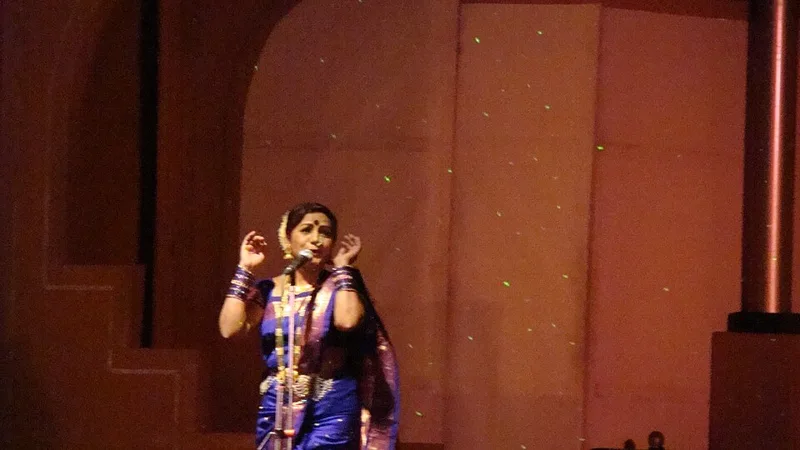
Lavani is the song-and-dance form of Maharashtra , and its traditional accompaniment is the dholki , a two-headed hand drum. The dholki's powerful rhythm sets the pace of the performance → option (c). Why the oth…
Asked in SSC CGL 2025 (21 Sep, Shift 1)
Practice (1)
Q732Lavani is a rhythmic and sensual folk dance form from Maharashtra. What is the traditional percussion instrument used to accompany it?
Show answer
Correct answer: C — Dholki
Answer: (C)Lavani is the song-and-dance form of Maharashtra, and its traditional accompaniment is the dholki, a two-headed hand drum.
The dholki's powerful rhythm sets the pace of the performance → option (c).
Why the others are wrong(a)Mridangam: The mridangam is the double-headed drum of Carnatic music and the principal accompaniment of Bharatanatyam. It belongs to South Indian classical performance, not to Lavani.(b)Tabla: The tabla is the pair of hand drums at the centre of Hindustani classical music. Lavani's traditional beat comes from the dholki instead.(d)Nagada: The nagada is a large kettledrum beaten with sticks. Lavani's percussion is the smaller, hand-played dholki. -
757
The urumi is a flexible, whip-like sword used in Kalaripayattu, the traditional martial art of Kerala, and is typically taught last.
The urumi is a sword with a flexible, whip-like blade , worn around the waist. The name is Malayalam, and in Kerala it is also called chuttuval, from the words for 'coiling' and 'sword'. It belongs…
Asked in SSC CGL 2025 (22 Sep, Shift 1)
Practice (1)
Q733Which Indian martial art involves the use of a flexible sword called "Urumi"?
Show answer
Correct answer: B — Kalaripayattu
Answer: (B)The urumi is a sword with a flexible, whip-like blade, worn around the waist. The name is Malayalam, and in Kerala it is also called chuttuval, from the words for 'coiling' and 'sword'.
It belongs to Kalaripayattu, Kerala's martial art, where it is almost always taught last because it needs both whip and sword skills → option (b).
Why the others are wrong(a)Silambam: Silambam is the martial art of Tamil Nadu, named after its main weapon, the bamboo staff. It is a staff discipline, not a flexible-sword one.(c)Gatka: Gatka, the Sikh martial art of Punjab, is a style of stick-fighting with wooden sticks that stand in for swords. Nothing in it is whip-like.(d)Thang-Ta: Thang-Ta is Manipur's Meitei martial art, and its name lists its weapons: thang is the sword and ta the spear. Neither is a flexible blade. -
758
Wangala is the post-harvest festival of the Garo people, celebrated to thank Misi Saljong, often referred to as the Hundred Drums festival.
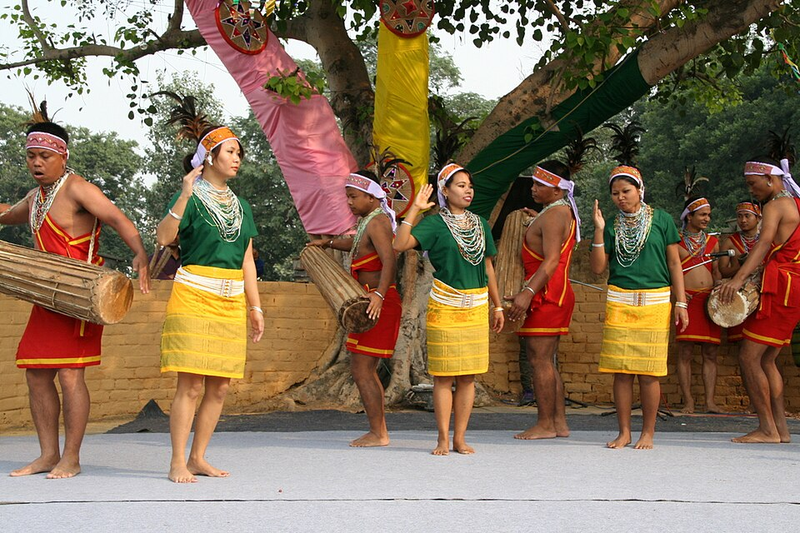
Wangala is the post-harvest festival of the Garo people, who live in Meghalaya, Assam and Nagaland, and in Bangladesh. It gives thanks to Misi Saljong, the sun god, for the harvest. Villages hold it on their own dates…
Asked in SSC CGL 2025 (22 Sep, Shift 1)
Practice (1)
Q734Which tribal community celebrates the "Wangala" festival?
Show answer
Correct answer: D — Garo
Answer: (D)Wangala is the post-harvest festival of the Garo people, who live in Meghalaya, Assam and Nagaland, and in Bangladesh.
It gives thanks to Misi Saljong, the sun god, for the harvest. Villages hold it on their own dates between September and December, and it is also called the Hundred Drums festival → option (d).
Why the others are wrong(a)Bodo: The Bodo of Assam mark their New Year with Bwisagu. Wangala belongs to the Garo, not the Bodo.(b)Santhal: The Santhal keep Sohrai, a harvest festival in which cattle are decorated and worshipped. Wangala is a Garo festival.(c)Mizo: The Mizo festival Chapchar Kut is held in March, after the forest is cleared for jhum cultivation. Wangala's drums and harvest thanksgiving belong to the Garo. -
759
Paika Nritya performance unfolds like a miniature battle, starting with the blowing of the war conch, followed by sword drills, acrobatics, and victory shouts.
The key reads the performance as a battle in miniature , in the order a fight unfolds: 1 the war conch calls the fighters 2 shield-sword sparring is the combat 3 acrobatic somersaults show off the fighters' skill…
Asked in SSC CGL 2025 (22 Sep, Shift 1)
Practice (1)
Q735Arrange the performance segments of Paika Nritya:<br>1. Blowing the war conch (shankha)<br>2. Shield-sword sparring drills<br>3. Acrobatic somersaults<br>4. Group victory shout of “Jai Jagannath”
Show answer
Correct answer: A — 1-2-3-4
Answer: (A)The key reads the performance as a battle in miniature, in the order a fight unfolds:
1 the war conch calls the fighters
2 shield-sword sparring is the combat
3 acrobatic somersaults show off the fighters' skill
4 the shout of 'Jai Jagannath' marks victoryCall, combat, display, victory → 1-2-3-4, option (a).
Why the others are wrong(b)2-1-3-4: Fighting before the call. Putting sparring (2) ahead of the conch (1) reverses the opening, since the conch is the call that starts the fight.(c)1-3-2-4: Acrobatics before the combat. Moving the somersaults (3) ahead of the sword-and-shield drills (2) breaks the call, combat, display, victory arc the key follows.(d)3-2-1-4: The call comes third. Opening with somersaults (3) and leaving the conch (1) until after the sparring puts the call to arms after the fighting it announces. -
760
In a Nagara style temple, the projecting central offset of the wall face is known as the bhadra.
A Nagara temple wall is not one flat face. Its plan steps out in vertical offsets , and the one at the centre of each face is the bhadra . Temple glossaries define the bhadra as a projection typically of the central p…
Asked in SSC CGL 2025 (23 Sep, Shift 1)
Practice (1)
Q736In the Nagara temple, which element is the projecting central offset of the wall face?
Show answer
Correct answer: D — Bhadra
Answer: (D)A Nagara temple wall is not one flat face. Its plan steps out in vertical offsets, and the one at the centre of each face is the bhadra.
Temple glossaries define the bhadra as a projection typically of the central part of the wall, often aligned to one of the cardinal directions → option (d).
Why the others are wrong(a)Karna Sringa: Karna names the corner offset, and a sringa is a miniature spire. Either way the term points to the corner, not to the centre of the wall face.(b)Pratiratha: Pratiratha is one of the intermediate offsets, set in pairs on either side of the centre, between it and the corner. It flanks the central projection rather than forming it.(c)Anuratha: Anuratha is another intermediate offset, also repeated in pairs on either side of the centre. It adds steps to the wall; the central step itself is the bhadra.