
🎭 Art & Culture कला और संस्कृति
801 exam-ready facts · 758 MCQs
-
721
Bissu Mela is a week-long harvest-thanking festival of the Jaunsari tribe in Chakrata, Dehradun, honoring Santoora Devi, an incarnation of Goddess Durga.
The Ministry of Tourism's Utsav portal describes Bissu Mela as a fair of the Jaunsari tribe, held in the Chakrata block of Dehradun. It lasts over a week, in thanks for a good harvest, and villagers gather to hon…
Asked in SSC CGL 2025 (17 Sep, Shift 2)
Practice (1)
Q697Which of the following best captures the cultural and historical essence of Uttarakhand's Bissu Mela?
Show answer
Correct answer: B — A week-long Jaunsari tribal fair in Chakrata, thanking for harvest and honoring Santoora Devi, a Durga form.
Answer: (B)The Ministry of Tourism's Utsav portal describes Bissu Mela as a fair of the Jaunsari tribe, held in the Chakrata block of Dehradun.
It lasts over a week, in thanks for a good harvest, and villagers gather to honour Santoora Devi, an incarnation of Goddess Durga. Community, place, harvest and deity all match → option (b).
Why the others are wrong(a)A three-day martial arts event by Gorkha settlers in Garhwal to worship Lord Kartikeya as the harvest god.: The fair belongs to the Jaunsari tribe, not to Gorkha settlers, and the deity it honours is Santoora Devi, not Kartikeya.(c)A pilgrimage where Pandavas are worshipped at stone altars through Himachali Brahmin rituals.: Bissu Mela is a harvest fair for Santoora Devi, not a pilgrimage to the Pandavas. The Pandavas enter only through the Jaunsari tribe's origin story.(d)A fasting-based fair restricting women from dancing due to ancestral customs.: The Utsav portal describes folk music, with men and women in bright traditional dress. It mentions no fast and no restriction on women. -
722
In Indian classical music, Sa and Pa are known as Achal (immovable) swaras because they maintain a fixed pitch, while the others are Chal swaras.
Achal means immovable. IGNOU's music course names Sa and Pa as the achal swaras, which always stay at their fixed place. The other five, Re, Ga, Ma, Dha and Ni, are chal swaras and can move. Re, Ga, Dha and Ni ha…
Asked in SSC CGL 2025 (17 Sep, Shift 2)
Practice (1)
Q698Which of the following best describes Achal and Chal swaras in Indian classical music?
Show answer
Correct answer: B — Sa and Pa are fixed; others have variants like Komal or Teevra
Answer: (B)Achal means immovable. IGNOU's music course names Sa and Pa as the achal swaras, which always stay at their fixed place.
The other five, Re, Ga, Ma, Dha and Ni, are chal swaras and can move. Re, Ga, Dha and Ni have komal (lowered) forms and Ma a teevra (raised) form → option (b).
Why the others are wrong(a)All swaras have fixed pitch in both systems: Only Sa and Pa are fixed. Re, Ga, Ma, Dha and Ni are chal swaras that can shift, so 'all swaras fixed' is false in either system.(c)Komal and Teevra swaras are used only in Carnatic music: Komal and teevra are Hindustani names for lowered and raised notes, and IGNOU's examples are ragas Bhairavi and Yaman. Carnatic music names its note variants differently.(d)Ga and Ni are always sung in Shuddha form in all styles: Ga and Ni both have komal forms. IGNOU notes that raga Bhairavi uses all four komal swaras, so neither is always sung shuddha. -
723
Shashi Tharoor. (Who wrote 'An Era of Darkness: The British Empire in India'?)
An Era of Darkness: The British Empire in India is by Shashi Tharoor . It grew out of his 2015 speech at the Oxford Union on whether Britain owed reparations to its former colonies. The book won him the Sahitya Akadem…
Asked in SSC CGL 2025 (17 Sep, Shift 2)
Practice (1)
Q699Who wrote 'An Era of Darkness: The British Empire in India'?
Show answer
Correct answer: A — Shashi Tharoor
Answer: (A)An Era of Darkness: The British Empire in India is by Shashi Tharoor. It grew out of his 2015 speech at the Oxford Union on whether Britain owed reparations to its former colonies.
The book won him the Sahitya Akademi Award for English for 2019 → option (a).
Why the others are wrong(b)Vikram Seth: Vikram Seth is a novelist and poet, best known for A Suitable Boy. He did not write this account of British rule.(c)Pavan Varma: Pavan Varma, a former diplomat, wrote The Great Indian Middle Class. This book on the British Empire is Tharoor's.(d)Romila Thapar: Romila Thapar is a historian of early India, not of the British Empire. The title belongs to Shashi Tharoor. -
724
Aravind Adiga authored his debut novel 'The White Tiger', which won the prestigious Man Booker Prize in 2008.
Aravind Adiga wrote The White Tiger , his debut novel, which won the 2008 Booker Prize . Its narrator, Balram Halwai , a village boy who becomes a driver, tells his story in a letter to the Chinese Premier written ove…
Asked in SSC CGL 2025 (17 Sep, Shift 3)
Practice (1)
Q700Who authored 'The White Tiger', winner of the 2008 Man Booker Prize?
Show answer
Correct answer: A — Aravind Adiga
Answer: (A)Aravind Adiga wrote The White Tiger, his debut novel, which won the 2008 Booker Prize.
Its narrator, Balram Halwai, a village boy who becomes a driver, tells his story in a letter to the Chinese Premier written over seven nights.
The novel takes on caste, corruption and poverty in a globalised India: option (a).
Why the others are wrong(b)Rohinton Mistry: Rohinton Mistry saw each of his three novels shortlisted for the Booker, among them A Fine Balance. The White Tiger is not his: it is Adiga's.(c)Arundhati Roy: Arundhati Roy won the Booker in 1997 for The God of Small Things, eleven years before The White Tiger.(d)Vikram Seth: Vikram Seth is the author of A Suitable Boy and The Golden Gate. The White Tiger is Adiga's. -
725
Tippani is a traditional women's folk dance from Saurashtra, Gujarat, where dancers use long wooden sticks to rhythmically pound the floor.
Tippani is a women's folk dance from the Chorwad and Veraval area of Saurashtra, Gujarat. The dancers beat the floor with the tippani itself: long wooden sticks with a block of wood or iron at the lower end. The…
Asked in SSC CGL 2025 (17 Sep, Shift 3)
Practice (1)
Q701Fill in the Blank:<br>Tippani dance uses _____ tools to pound the floor.
Show answer
Correct answer: B — Wooden sticks
Answer: (B)Tippani is a women's folk dance from the Chorwad and Veraval area of Saurashtra, Gujarat. The dancers beat the floor with the tippani itself: long wooden sticks with a block of wood or iron at the lower end.
The tool began as a work implement for pressing lime into floors and house foundations: option (b).
Why the others are wrong(a)Metal rods: The shaft is wood, not metal. The block at the foot of a tippani may be iron, which makes metal rods tempting, but the sticks the dancers hold are wooden.(c)Bamboo poles: Bamboo belongs to Cheraw, Mizoram's dance performed with crossed bamboo sticks. Tippani's tool is a long wooden stick used to pound the floor.(d)Stones: No stones in the dancers' hands. Tippani dancers strike the floor with the tippani, a long wooden stick, as workers once did when pressing lime into floors. -
726
Chhau is a syncretic Indian dance form recognized by UNESCO, combining indigenous tribal martial traditions with narratives from Hindu epics.
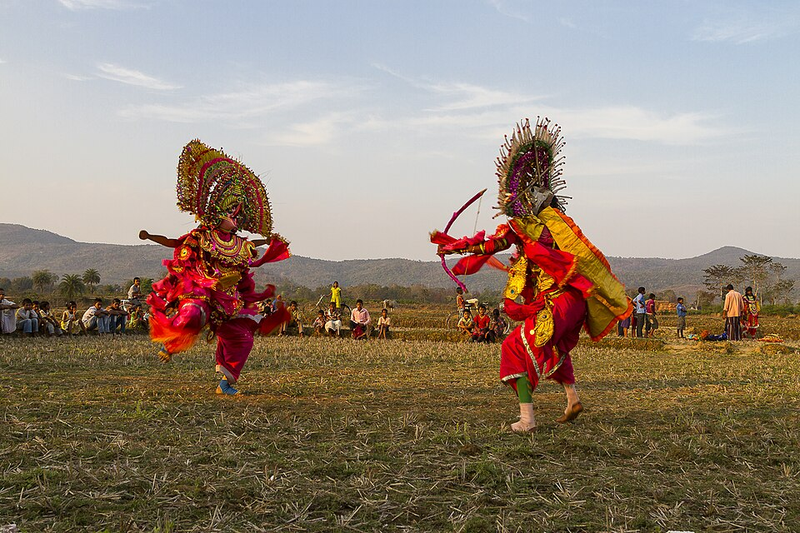
Syncretic means built from several traditions. UNESCO traces Chhau's origin to indigenous forms of dance and martial practices , while its stories come from the Mahabharata and Ramayana , local folklore and abstr…
Asked in SSC CGL 2025 (17 Sep, Shift 3)
Practice (1)
Q702What makes Chhau a syncretic Indian dance form?
Show answer
Correct answer: B — It merges tribal, folk, and classical Hindu elements
Answer: (B)Syncretic means built from several traditions. UNESCO traces Chhau's origin to indigenous forms of dance and martial practices, while its stories come from the Mahabharata and Ramayana, local folklore and abstract themes.
Indigenous and folk roots carrying Hindu epic themes is the blend option (b) describes.
Why the others are wrong(a)It uses Sanskrit-only chants in temple rituals: Chhau is not a chanted temple ritual. UNESCO describes it danced at night in an open space to folk melodies on the mohuri and shehnai, with drums leading.(c)It evolved purely from Vaishnav temple dance: 'Purely' is the giveaway. UNESCO traces Chhau's origin to indigenous dance and martial practices, so a single Vaishnav temple source would make it the opposite of syncretic.(d)It prohibits all forms of theatrical expression: Chhau is theatre. It enacts episodes from the Mahabharata and Ramayana, and two of its three styles use masks, so a ban on theatrical expression contradicts the form itself. -
727
Tippani folk dance originated among Saurashtra women working as labourers, who tamped lime floors using long wooden poles fitted with heavy blocks.
Statement 1 matches the accounts of the dance. Tippani began in the Chorwad and Veraval area of Saurashtra, among women labourers who pounded lime into floors and foundations with a tippani, a long pole ending in a wo…
Asked in SSC CGL 2025 (17 Sep, Shift 2)
Practice (1)
Q703Consider the statements about Tippani :<br>1. Originated among Saurashtra women tamping lime floors with wooden rods.<br>2. Male drummers provide dhol–nagara accompaniment.<br>Which is/are correct?
Show answer
Correct answer: C — Both 1 & 2 correct
Answer: (C)Statement 1 matches the accounts of the dance. Tippani began in the Chorwad and Veraval area of Saurashtra, among women labourers who pounded lime into floors and foundations with a tippani, a long pole ending in a wooden or iron block.
Statement 2: accounts of the dance name the dhol among its instruments, and the key accepts the statement. Both hold, so option (c).
Why the others are wrong(a)Only 1 correct: It drops statement 2, which the key accepts: drum accompaniment, with the dhol named among the dance's instruments, is part of Tippani.(b)Only 2 correct: It drops statement 1, the dance's defining origin: women ramming lime floors with the tippani in Saurashtra, the very tool that names the dance.(d)Neither 1 nor 2 correct: Statement 1 is plainly true, so 'neither' fails at once. Tippani is known above all for its origin among lime-pounding women of Saurashtra. -
728
Mumbai features two distinct UNESCO architectural ensembles: 19th-century Victorian Gothic buildings and early 20th-century Art Deco buildings, facing each other across the Oval Maidan.
UNESCO inscribed the Victorian Gothic and Art Deco Ensembles of Mumbai in 2018, and its description settles each statement. Statement 1 holds: the first ensemble was built in the Victorian Neo-Gothic style during the …
Asked in SSC CGL 2025 (17 Sep, Shift 3)
Practice (1)
Q704Which of the following statements about Mumbai's architectural heritage is/are correct?<br>1. Victorian Gothic buildings in Mumbai reflect colonial-era architecture with Neo-Gothic elements.<br>2. Art Deco buildings in Mumbai were part of the 19th-century colonial urban development.<br>3. The Oval Maidan distinctly separates the Victorian Gothic and Art Deco architectural styles.
Show answer
Correct answer: C — Only 1 and 3 are correct
Answer: (C)UNESCO inscribed the Victorian Gothic and Art Deco Ensembles of Mumbai in 2018, and its description settles each statement.
Statement 1 holds: the first ensemble was built in the Victorian Neo-Gothic style during the 19th-century expansion.
Statement 2 fails: the Art Deco buildings came in the early 20th century.
Statement 3 holds: the two ensembles face each other across the Oval Maidan. So 1 and 3: option (c).
Why the others are wrong(a)Only 1 and 2 are correct: Statement 2 misdates the Art Deco buildings. UNESCO places them in the early 20th century, on land from the Backbay Reclamation, not in the 19th-century plan.(b)Only 2 and 3 are correct: It drops the true statement 1. Mumbai's Victorian buildings are Neo-Gothic, and statement 2 is false because the Art Deco phase belongs to the 20th century.(d)All 1, 2, and 3 are correct: Statement 2 is wrong on the century. The 19th-century expansion produced the Gothic buildings, while the Art Deco ensemble followed in the early 20th century. -
729
The Hornbill Festival of Nagaland is named after the hornbill bird, which is admired in Naga folklore and tribal culture for its grandeur and alertness.
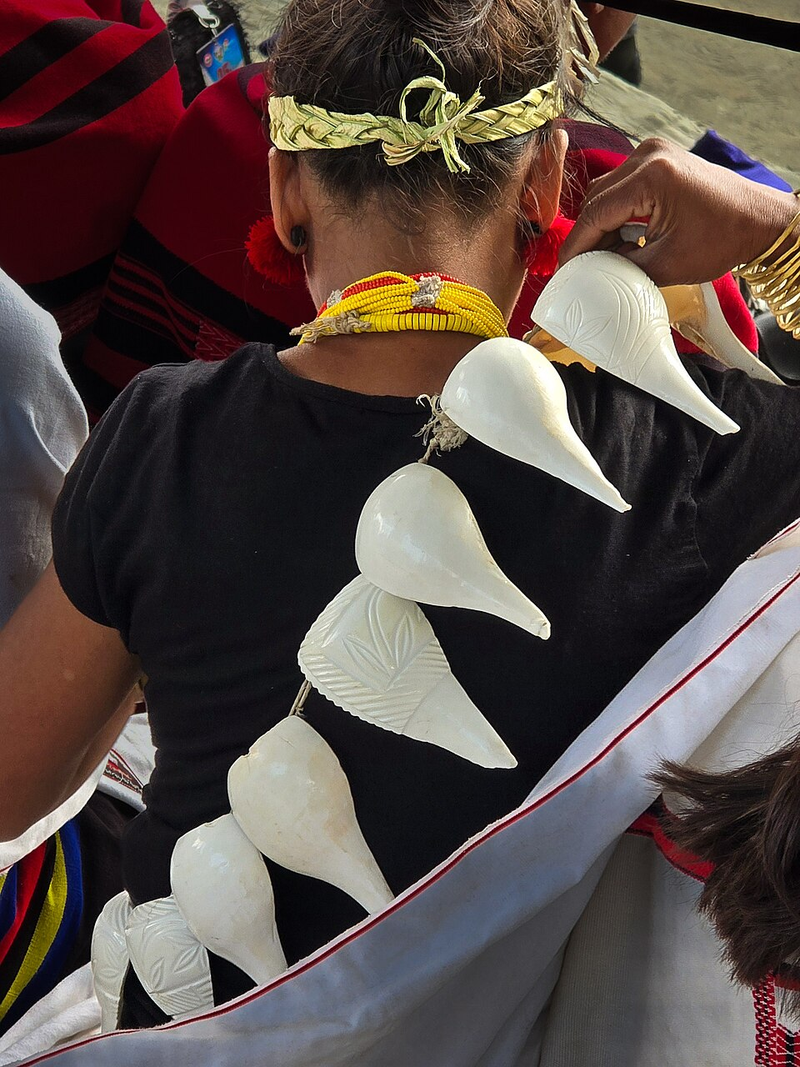
The festival is named after the hornbill , which the festival's official site calls 'the globally respected bird', displayed in the folklore of most of Nagaland's tribes. Accounts of the festival d…
Asked in SSC CGL 2025 (17 Sep, Shift 3)
Practice (1)
Q705Fill in the blank:<br>The hornbill bird, after which the festival is named, symbolizes boldness and _____ in Naga folklore.
Show answer
Correct answer: C — grandeur
Answer: (C)The festival is named after the hornbill, which the festival's official site calls 'the globally respected bird', displayed in the folklore of most of Nagaland's tribes.
Accounts of the festival describe the bird as admired by the Nagas for its grandeur and alertness. Grandeur is the word the blank needs: option (c).
Why the others are wrong(a)wisdom: Accounts of the festival credit the hornbill with grandeur and alertness, not wisdom.(b)prosperity: Many Naga festivals revolve around agriculture, which makes prosperity tempting. But the quality credited to the hornbill itself is grandeur.(d)peace: Peace is the dove's symbol in common usage. Accounts of the festival credit the hornbill with grandeur and alertness. -
730
Sangeet Ratnakara, composed in the 13th century by Sharangadeva in Devagiri (Maharashtra), is a foundational Sanskrit text in both Hindustani and Carnatic musicology.
Sangeet Ratnakara , 'Ocean of Music', is the Sanskrit treatise of Sharangadeva , written in the 13th century at the court of the Yadava king Simhana, whose capital was Devagiri in Maharashtra. Both the Hindu…
Asked in SSC CGL 2025 (17 Sep, Shift 3)
Practice (1)
Q706Which classical musical treatise, composed in the 13th century CE by Sharangadeva in Maharashtra, is considered a foundational text in Indian musicology?
Show answer
Correct answer: C — Sangeet Ratnakara
Answer: (C)Sangeet Ratnakara, 'Ocean of Music', is the Sanskrit treatise of Sharangadeva, written in the 13th century at the court of the Yadava king Simhana, whose capital was Devagiri in Maharashtra.
Both the Hindustani and Carnatic traditions regard it as a definitive text, the foundational role the stem describes: option (c).
Why the others are wrong(a)Natya Shastra: Natya Shastra is attributed to the sage Bharata and is far older: most scholars date its first complete version to between 200 BCE and 200 CE.(b)Sangeet Sudha: Sangeet Sudha is credited to Raghunatha Nayak of Thanjavur, who reigned from 1600 to 1634, centuries after Sharangadeva and far from Devagiri.(d)Abhinaya Darpana: Abhinaya Darpana, 'The Mirror of Gesture', is Nandikeshvara's treatise on gesture in dance and drama, not a 13th-century music text from Maharashtra. -
731
During the Nuakhai festival in Sambalpur, Odisha, the newly harvested rice (Nabanna) is first offered to Maa Samaleswari, the presiding deity of the region.
In Sambalpur, the head priest of the Samaleswari Temple offers the nua-anna, or nabanna , to the goddess Samaleswari at the auspicious moment (lagna) fixed for Nuakhai. Samaleswari is the presiding deity of Sambalpur…
Asked in SSC CGL 2025 (18 Sep, Shift 2)
Practice (1)
Q707The Nabanna (new rice) during the Nuakhai festival in Sambalpur, Odisha, is first offered to which deity?
Show answer
Correct answer: A — Maa Samaleswari
Answer: (A)In Sambalpur, the head priest of the Samaleswari Temple offers the nua-anna, or nabanna, to the goddess Samaleswari at the auspicious moment (lagna) fixed for Nuakhai.
Samaleswari is the presiding deity of Sambalpur, so the new rice goes to her first → option (a).
Why the others are wrong(b)Maa Mangala: Maa Mangala is worshipped at Kakatpur in Puri district, on the Prachi river, and is tied to the Jagannath Nabakalebara. Sambalpur's first offering does not go to her.(c)Maa Bhubaneswari: Maa Bhubaneswari is not the goddess Sambalpur's nabanna goes to. The first offering there is made at the Samaleswari Temple, whose goddess presides over the town.(d)Maa Budhi Thakurani: Maa Budhi Thakurani belongs to Brahmapur (Berhampur) in Ganjam district, where her Thakurani Jatra is the city's chief festival. Sambalpur offers to Samaleswari. -
732
Vesara architecture style belongs to the Deccan, Rekha-Deul style belongs to Odisha, and the Bhumija temple architecture style was invented in Malwa.
Check each pair against the region where the style grew. Vesara – Deccan holds: the hybrid style is common in the later Chalukya and Hoysala temples of the Deccan, particularly Karnataka. Rekha-Deul – Odisha holds: th…
Asked in SSC CGL 2025 (18 Sep, Shift 2)
Practice (1)
Q708Which of the following pairs of temple style & region are correctly matched?<br>1. Vesara – Deccan<br>2. Rekha-Deul – Odisha<br>3. Bhumija – Malwa<br>4. Kalinga – Tamil Nadu
Show answer
Correct answer: B — 1, 2 & 3 are correct
Answer: (B)Check each pair against the region where the style grew.
Vesara – Deccan holds: the hybrid style is common in the later Chalukya and Hoysala temples of the Deccan, particularly Karnataka.
Rekha-Deul – Odisha holds: the rekha deula is one of the three temple types of Kalinga architecture.
Bhumija – Malwa holds: the style was invented in Malwa under the Paramaras.
Kalinga – Tamil Nadu fails, because Kalinga is Odisha's style. So pairs 1, 2 and 3 → option (b).
Why the others are wrong(a)1 & 2 only: Stops at two. Pair 3 is also right: Bhumija was invented around the 10th century in the Malwa region under the Paramara dynasty.(c)2 & 4 only: Keeps the false pair 4. Kalinga architecture, with its rekha, pidha and khakhara deulas, belongs to Odisha, not Tamil Nadu.(d)only 1: Rejects two true pairs. The rekha deula is an Odisha temple type, and Bhumija is a Malwa style, so pairs 2 and 3 hold along with pair 1. -
733
Domkach is a traditional folk song-and-dance form of Jharkhand, predominantly performed during weddings in a semi-circular formation.
Domkach is a folk song-and-dance form of Jharkhand and Bihar. In Jharkhand it belongs to the Nagpuri tradition. The families perform it at weddings , standing in a semi-circle with arms around each other's waists…
Asked in SSC CGL 2025 (18 Sep, Shift 2)
Practice (1)
Q709Which of the following is a folk song form of Jharkhand that reflects the lived experiences, social unity, and often accompanies dance and drama performances?
Show answer
Correct answer: B — Domkach
Answer: (B)Domkach is a folk song-and-dance form of Jharkhand and Bihar. In Jharkhand it belongs to the Nagpuri tradition.
The families perform it at weddings, standing in a semi-circle with arms around each other's waists, and its songs are satirical and full of joy → option (b).
Why the others are wrong(a)Lavani: Lavani is a song-and-dance genre of Maharashtra, performed to the beats of the dholki. It is not a Jharkhand form.(c)Bhavai: Bhavai is a folk theatre form of Gujarat, also found in Rajasthan as the Bhavai dance. It is not from Jharkhand.(d)Baul: Baul is the song of the mystic minstrels of Bangladesh and West Bengal. UNESCO lists the Baul songs as intangible cultural heritage. -
734
'An Area of Darkness' (1964) is a notable non-fiction travelogue written by V.S. Naipaul detailing his early 1960s travels through India.
An Area of Darkness (1964) is V.S. Naipaul's non-fiction account of his travels through India in the early 1960s. It opens his India trilogy, followed by India: A Wounded Civilization (1977) and India: A Million …
Asked in SSC CGL 2025 (18 Sep, Shift 2)
Practice (1)
Q710An Area of Darkness is a travelogue by which Indian author?
Show answer
Correct answer: B — V.S. Naipaul
Answer: (B)An Area of Darkness (1964) is V.S. Naipaul's non-fiction account of his travels through India in the early 1960s.
It opens his India trilogy, followed by India: A Wounded Civilization (1977) and India: A Million Mutinies Now (1990) → option (b).
Why the others are wrong(a)Raja Rao: Raja Rao is a novelist, known for Kanthapura (1938) and The Serpent and the Rope (1960). This travelogue is not his.(c)R.K. Narayan: R.K. Narayan is the novelist of Malgudi, the fictional town of Swami and Friends (1935) and The Guide (1958). He did not write this book.(d)Vikram Seth: Vikram Seth did write a travel book, From Heaven Lake (1983), about Sinkiang and Tibet. An Area of Darkness is Naipaul's. -
735
During the Ladakhi New Year (Losar), households welcome the festival by placing symbolic dough models of the ibex, sun, and moon.
The Ministry of Tourism's Utsav portal describes Ladakhi Losar in these words: the new year is welcomed with dough models of ibex , sun and moon, and flour-painted lucky signs on the kitchen walls. The same page …
Asked in SSC CGL 2025 (18 Sep, Shift 1)
Practice (1)
Q711Fill in the blank:<br>Ladakhi new year (Losar) is welcomed with symbolic dough models of ______, sun, and moon placed in households.
Show answer
Correct answer: A — Ibex
Answer: (A)The Ministry of Tourism's Utsav portal describes Ladakhi Losar in these words: the new year is welcomed with dough models of ibex, sun and moon, and flour-painted lucky signs on the kitchen walls.
The same page says the celebrations include dances and songs in honour of the ibex. The blank takes Ibex.
Why the others are wrong(b)Yak: The yak is a Ladakhi herd animal, but the Losar dough figures the Tourism Ministry lists are the ibex, the sun and the moon.(c)Snow leopard: The snow leopard lives in Ladakh's mountains, yet it is not a Losar dough figure. The animal the festival honours in song and dance is the ibex.(d)Buddha: Losar is kept by Ladakh's Buddhists, which makes Buddha tempting, but the dough models placed in homes are of the ibex, the sun and the moon. -
736
Svarajati is a structured Carnatic musical composition featuring pallavi, anupallavi, and charanam, which is taught before varnam and used in dance.
The swarajati is a composed Carnatic form with a pallavi, sometimes an anupallavi, and at least one charanam. It is learnt before the varnam and sung in lessons and concerts. It is also performed in dance recitals. Op…
Asked in SSC CGL 2025 (18 Sep, Shift 1)
Practice (1)
Q712Which of the following correctly describes the musical form Svarajati?
Show answer
Correct answer: C — A vocal form later adapted for dance
Answer: (C)The swarajati is a composed Carnatic form with a pallavi, sometimes an anupallavi, and at least one charanam. It is learnt before the varnam and sung in lessons and concerts.
It is also performed in dance recitals. Option (c) alone describes a structured vocal form that belongs to both music and dance, so it is the keyed answer.
Why the others are wrong(a)A bhajan form used only in temples: The swarajati is not a bhajan and is not confined to temples. It is sung in music lessons and concerts and performed in dance recitals.(b)A dance item without fixed structure: It has a fixed structure: pallavi, often an anupallavi, and charanams. 'Without fixed structure' is the opposite of the form.(d)A film-based item with fast rhythm: The swarajati is a classical Carnatic form. Syama Sastri, who lived from 1762 to 1827, composed swarajatis long before film music existed. -
737
'The Argumentative Indian' (2005) is a renowned collection of essays by Nobel laureate Amartya Sen focusing on India's tradition of public debate.
The Argumentative Indian: Writings on Indian History, Culture and Identity is by Amartya Sen , published by Allen Lane in 2005. Its essays trace India's long tradition of public debate and intellectual pluralism,…
Asked in SSC CGL 2025 (18 Sep, Shift 1)
Practice (1)
Q713Who is the author of the book 'The Argumentative Indian'?
Show answer
Correct answer: A — Amartya Sen
Answer: (A)The Argumentative Indian: Writings on Indian History, Culture and Identity is by Amartya Sen, published by Allen Lane in 2005.
Its essays trace India's long tradition of public debate and intellectual pluralism, and argue that this tradition matters for democracy and secular politics today.
Why the others are wrong(b)Shashi Tharoor: Shashi Tharoor wrote An Era of Darkness and The Great Indian Novel. The Argumentative Indian is Amartya Sen's essay collection.(c)Ramachandra Guha: Ramachandra Guha is the historian of India After Gandhi. The Argumentative Indian is Sen's, not his.(d)Arvind Subramanian: Arvind Subramanian, a former Chief Economic Adviser, wrote Eclipse, on China's economic rise. The 2005 essay collection is Sen's. -
738
Tippani is a dynamic traditional women's folk dance originating from the Saurashtra region of Gujarat, originally performed while beating floors.
Tippani is a women's folk dance from the Veraval and Chorwad area of Saurashtra , the peninsula of south-western Gujarat. It grew out of work. The dancers beat the floor with the tippani, two long wooden sticks j…
Asked in SSC CGL 2025 (18 Sep, Shift 2)
Practice (1)
Q714Fill in the Blank:<br>Tippani arises from the ____ region of Gujarat.
Show answer
Correct answer: B — Saurashtra
Answer: (B)Tippani is a women's folk dance from the Veraval and Chorwad area of Saurashtra, the peninsula of south-western Gujarat.
It grew out of work. The dancers beat the floor with the tippani, two long wooden sticks joined by a block at the foot, once used to press lime into floors and foundations → option (b).
Why the others are wrong(a)Kutch: Kutch is a different region, north of Saurashtra across the Gulf of Kutch. Tippani belongs to the Veraval and Chorwad area of Saurashtra.(c)Surat: Surat lies in south Gujarat on the mainland, away from the Saurashtra peninsula. Tippani comes from the Veraval and Chorwad area of Saurashtra.(d)Vadodara: Vadodara is in central Gujarat, on the mainland. Tippani's home is the Veraval and Chorwad area of the Saurashtra peninsula. -
739
Kambala is a traditional annual buffalo race held in the slushy paddy fields of coastal Karnataka's Tulu-speaking districts during winter.
Kambala is an annual buffalo race of coastal Karnataka. Pairs of buffaloes, driven by a farmer, race down a track that is a slushy paddy field. It is held in the Tulu-speaking coastal districts such as Dakshina Kannad…
Asked in SSC CGL 2025 (19 Sep, Shift 1)
Practice (1)
Q715The Kambala Festival of coastal Karnataka is primarily associated with which of the following traditions?
Show answer
Correct answer: C — Buffalo racing
Answer: (C)Kambala is an annual buffalo race of coastal Karnataka. Pairs of buffaloes, driven by a farmer, race down a track that is a slushy paddy field.
It is held in the Tulu-speaking coastal districts such as Dakshina Kannada and Udupi, in a season that generally runs from November to March. The race is the event → option (c).
Why the others are wrong(a)Temple fairs: A few village Kambalas are tied to local deities, but what defines the event is the buffalo race, not a temple fair. The stem asks what it is primarily associated with.(b)Classical music: Kambala is a race run on a paddy-field track, not a performance tradition, so classical music does not describe it.(d)Tribal rituals: Kambala is traditionally sponsored by Tuluva landlords and households and run as a race, so tribal rituals misdescribe its core. -
740
The Hindustani classical composition 'Guru Bin Kaise Gun Gaaye' (Raag Yaman) is set to the 16-beat rhythmic cycle known as Teentaal.
'Guru Bin Kaise Gun Gaaye' is a chhota khayal in Raag Yaman . The SwarGanga bandish archive lists it, as 'guru bina kaise guna aave', in Teen Taal at medium tempo. Teentaal is the 16-beat cycle, di…
Asked in SSC CGL 2025 (19 Sep, Shift 1)
Practice (1)
Q716Fill in the blanks:<br>The composition “Guru Bin Kaise Gun Gaaye” is set to the rhythmic cycle known as ____.
Show answer
Correct answer: C — Teentaal
Answer: (C)'Guru Bin Kaise Gun Gaaye' is a chhota khayal in Raag Yaman. The SwarGanga bandish archive lists it, as 'guru bina kaise guna aave', in Teen Taal at medium tempo.
Teentaal is the 16-beat cycle, divided 4 + 4 + 4 + 4. The rhythmic cycle is Teentaal → option (c).
Why the others are wrong(a)Jhaptaal: Jhaptaal has 10 beats, divided 2 + 3 + 2 + 3. The bandish archive sets this composition in the 16-beat Teentaal instead.(b)Keharwa: Keharwa is an 8-beat cycle, divided 4 + 4. This Yaman khayal is listed in the 16-beat Teentaal, not in Keharwa.(d)Roopak: Roopak has 7 beats, divided 3 + 2 + 2, and some sources start it on khali. This composition is listed in Teentaal.