
🎭 Art & Culture कला और संस्कृति
801 exam-ready facts · 758 MCQs
-
681
Teentaal in Hindustani Classical Music consists of 16 matras, with the Khali marked on the 9th matra and the Sam on the 1st matra.
Teentaal has 16 matras in four vibhags of 4. Clap on matra 1, the sam . Clap on matra 5. Wave on matra 9 , the khali . Clap on matra 13. Three claps give the taal its name, and its one wave falls on the 9th matra, so …
Asked in SSC CGL 2025 (12 Sep, Shift 3)
Practice (1)
Q657Fill in the blanks:<br>In Teen Taal of Hindustani Classical Music, the Khali is marked on the _____ matra.
Show answer
Correct answer: C — 9
Answer: (C)Teentaal has 16 matras in four vibhags of 4.
Clap on matra 1, the sam.
Clap on matra 5.
Wave on matra 9, the khali.
Clap on matra 13.Three claps give the taal its name, and its one wave falls on the 9th matra, so option (c).
Why the others are wrong(a)1: Matra 1 is the sam, the first beat of the cycle, and in Teentaal it takes the first clap, not the khali's wave.(b)5: Matra 5 opens the second vibhag and takes the second clap. The wave does not come until the third vibhag.(d)13: Matra 13 opens the fourth vibhag and takes the third clap, the last before the cycle returns to sam. -
682
The Kalbelia dance of Rajasthan represents the movements of a serpent, performed by women in black skirts with instruments like the poongi.
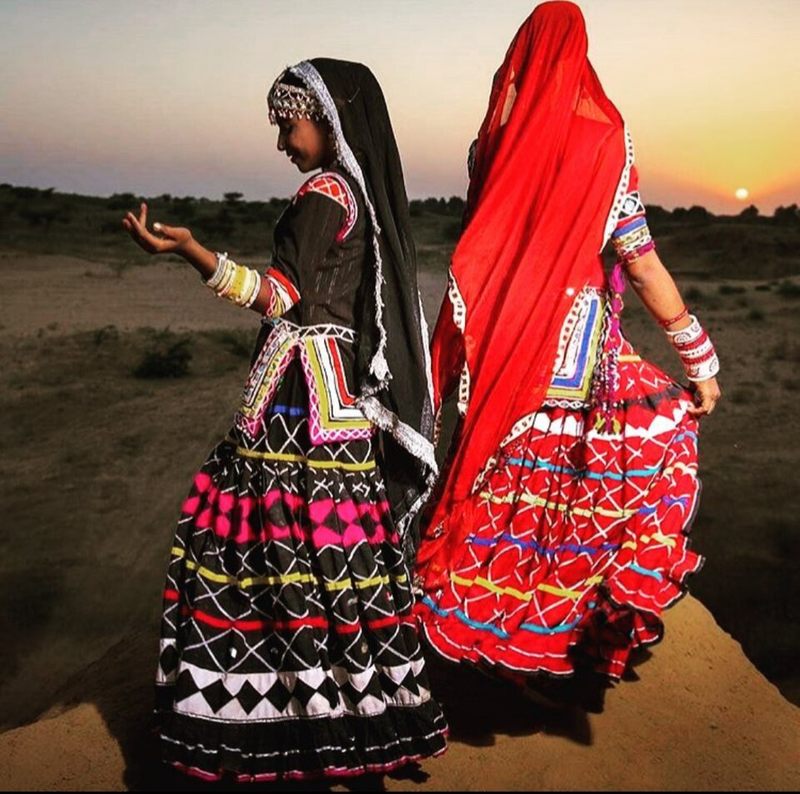
UNESCO's description of Kalbelia folk songs and dances of Rajasthan says women in flowing black skirts dance and swirl, replicating the movements of a serpent . The Kalbelias were once professional snake handlers…
Asked in SSC CGL 2025 (12 Sep, Shift 3)
Practice (1)
Q658Fill in the Blank:<br>Kalbelia dance represents the movement of _____.
Show answer
Correct answer: B — Snakes
Answer: (B)UNESCO's description of Kalbelia folk songs and dances of Rajasthan says women in flowing black skirts dance and swirl, replicating the movements of a serpent.
The Kalbelias were once professional snake handlers. Their music keeps that past alive through the poongi, a woodwind traditionally played to capture snakes, and the khanjari percussion.
Why the others are wrong(a)Camels: Camels are not the model. UNESCO describes the swirling movements as a serpent's, drawn from the Kalbelias' former work as snake handlers.(c)Birds: The movements are a serpent's, not a bird's. UNESCO's description of the dance names the serpent, and the community's identity rests on snake handling.(d)Horses: Horses belong to Kachchhi Ghodi, a folk dance from Rajasthan's Shekhawati region in which dancers wear dummy-horse costumes. Kalbelia is the serpent dance. -
683
The chronological development order of Buddhist sculpture sites is Bharhut (125-100 BCE), followed by Sanchi Stupa-1, and Mathura under Kushans.
The order is Bharhut → Sanchi Stupa-1 → Mathura , which is b-c-a. Bharhut first: its railing reliefs are dated to about 125–100 BCE , in the Shunga period. Sanchi Stupa-1 next: its carved gateways (toranas) were added…
Asked in SSC CGL 2025 (13 Sep, Shift 2)
Practice (1)
Q659Arrange the following sites in chronological order based on the stylistic development of Buddhist sculpture:<br>a) Mathura<br>b) Bharhut<br>c) Sanchi Stupa–1
Show answer
Correct answer: A — b-c-a
Answer: (A)The order is Bharhut → Sanchi Stupa-1 → Mathura, which is b-c-a.
Bharhut first: its railing reliefs are dated to about 125–100 BCE, in the Shunga period.
Sanchi Stupa-1 next: its carved gateways (toranas) were added from the 1st century BCE; an inscription credits artisans of the Satavahana king Satakarni II.
Mathura last: its school flourished under the Kushans, roughly the 1st to 3rd centuries CE.
Why the others are wrong(b)c-a-b: Puts Bharhut last, though its railing reliefs of about 125–100 BCE are older than both the Sanchi gateways and Kushan-period Mathura.(c)c-b-a: Swaps the first two. Sanchi Stupa-1 was founded by Ashoka, but its sculpture sits on gateways added from the 1st century BCE, after Bharhut's reliefs.(d)a-c-b: Puts Mathura first, but its school flourished under the Kushans from about the 1st century CE, after both Bharhut and the Sanchi gateways. -
684
During the Chithirai Festival in Madurai, Lord Kallazhagar travels from Alagar Kovil and enters the Vaigai river on a golden horse.
At the Chithirai festival, Kallazhagar , a form of Vishnu from the Alagar Kovil temple, travels to Madurai and enters the Vaigai river on a golden horse vahanam. That river entry is the high point of the festival'…
Asked in SSC CGL 2025 (13 Sep, Shift 2)
Practice (1)
Q660Which of the following statements about the Chithirai Festival of Madurai is correct?
Show answer
Correct answer: B — Lord Kallazhagar arrives on a golden horse
Answer: (B)At the Chithirai festival, Kallazhagar, a form of Vishnu from the Alagar Kovil temple, travels to Madurai and enters the Vaigai river on a golden horse vahanam.
That river entry is the high point of the festival's second half. The first half, at the Meenakshi Amman temple, celebrates Meenakshi's coronation and her wedding to Sundareswarar.
Why the others are wrong(a)The Chithirai Festival is celebrated in the tamil month of Margazhi: Wrong month. The festival is named after Chithirai, the Tamil month falling in April–May. Margazhi falls in December–January.(c)The festival is held exclusively in December: Wrong season. The festival runs in the Tamil month of Chithirai, around April–May, so it cannot be held in December, let alone exclusively.(d)The festival ends with a game of bullfight: A bullfight is not part of it. The bull-taming sport Jallikattu, held at villages around Madurai, belongs to Pongal in January. -
685
A Bandish is a fixed melodic composition in Hindustani classical music set in a specific raga with rhythmic accompaniment.
A bandish is a fixed, melodic composition in Hindustani vocal or instrumental music, set in a specific raga and performed with rhythmic accompaniment on tabla or pakhawaj. It opens with the sthayi , the first line or …
Asked in SSC CGL 2025 (13 Sep, Shift 2)
Practice (1)
Q661What is the term for a structured musical composition in Hindustani classical music?
Show answer
Correct answer: B — Bandish
Answer: (B)A bandish is a fixed, melodic composition in Hindustani vocal or instrumental music, set in a specific raga and performed with rhythmic accompaniment on tabla or pakhawaj.
It opens with the sthayi, the first line or phrase, and moves to the antara. Dhrupad bandishes may add the sanchari and abhog.
Why the others are wrong(a)Kriti: Kriti is the principal composition form of Carnatic music, the southern tradition of Tyagaraja and his contemporaries. It is not the Hindustani term.(c)Gamaka: Gamaka is ornamentation, the oscillation or graceful movement around a note. It decorates a composition; it is not one.(d)Rasa: Rasa is the aesthetic emotion a performance evokes, a concept set out in Bharata's Natyashastra. It names a mood, not a composition. -
686
Hola Mohalla is a Sikh martial festival initiated by Guru Gobind Singh at Anandpur Sahib featuring mock battles and langars.
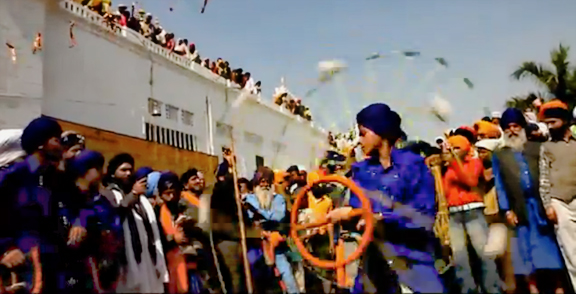
Hola Mohalla is the Sikh festival Guru Gobind Singh began at Anandpur , in Punjab. It is martial at heart. Nihang Singhs stage mock battles and displays of fighting skill, while pilgrims hear kirtan and poetry and eat…
Asked in SSC CGL 2025 (14 Sep, Shift 1)
Practice (1)
Q662Which of the following statements about Hola Mohalla festival of Punjab is correct?
Show answer
Correct answer: B — It showcases martial arts, langars, and Nihang mock battles at Anandpur Sahib.
Answer: (B)Hola Mohalla is the Sikh festival Guru Gobind Singh began at Anandpur, in Punjab.
It is martial at heart. Nihang Singhs stage mock battles and displays of fighting skill, while pilgrims hear kirtan and poetry and eat at langars.
Even the name says so: a mohalla is an organised procession in the form of an army column, with war drums and standard-bearers.
Why the others are wrong(a)It is celebrated mainly by women through crafts and songs in Patiala.: The festival's home is Anandpur Sahib, not Patiala, and Nihang martial displays, not women's crafts and songs, define it.(c)It is a harvest festival observed in Punjab just before Diwali.: Hola Mohalla comes in spring, usually the day after Holi. It is a martial gathering, not a harvest festival, and nowhere near Diwali.(d)Hola Mohalla is celebrated on the same day as Holi.: It usually falls on the day after Holi, the second day of the lunar month Chet, not on Holi itself. -
687
Mārgi Saṅgīta in ancient Indian music represents the sacred classical tradition rooted in the sung hymns of the Sāmaveda.
Sanskrit music treatises split music into mārga and deśī . Śārṅgadeva's 13th-century Saṅgītaratnākara describes mārga as the music Brahma discovered and Bharata first performed before Shiva : sacred, and bound by…
Asked in SSC CGL 2025 (14 Sep, Shift 1)
Practice (1)
Q663Mārgi Saṅgīta in ancient Indian music was rooted in:
Show answer
Correct answer: B — Vedic traditions
Answer: (B)Sanskrit music treatises split music into mārga and deśī.
Śārṅgadeva's 13th-century Saṅgītaratnākara describes mārga as the music Brahma discovered and Bharata first performed before Shiva: sacred, and bound by rule.
That sacred, classical strand is traced to the sung hymns of the Sāmaveda, the Vedic root option (b) names. Deśī, by contrast, is regional music suited to local taste.
Why the others are wrong(a)Folk music: Folk and regional music is the other half of the pair, deśī: song, instrument and dance that please people in different regions.(c)Courtly entertainment: Mārga is defined by its divine origin and its rules, not by court display. Music made to please local taste is deśī.(d)Western-influence: The mārga-deśī division is set out in Sanskrit treatises on Indian music, and mārga looks back to Vedic chant. Nothing Western enters it. -
688
Koli dance is traditionally performed by the Koli fisherfolk of coastal Maharashtra, featuring movements like rowing oars and casting nets.
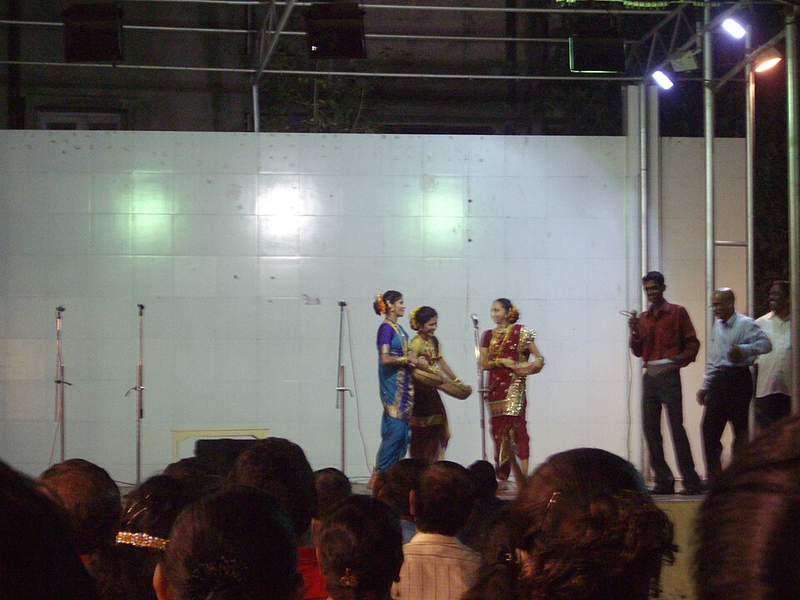
The Koli dance takes its name from the Koli fisherfolk of coastal Maharashtra, whose dance it is. Its movements come from the sea. Dancers hold oars and move together as if rowing a boat, and they mime waves and the c…
Asked in SSC CGL 2025 (14 Sep, Shift 1)
Practice (1)
Q664Fill in the Blank:<br>Koli dance is traditionally performed by the _____ community.
Show answer
Correct answer: A — Fisherfolk
Answer: (A)The Koli dance takes its name from the Koli fisherfolk of coastal Maharashtra, whose dance it is.
Its movements come from the sea. Dancers hold oars and move together as if rowing a boat, and they mime waves and the casting of nets.
A dance of rowing and nets belongs to a fishing community: option (a).
Why the others are wrong(b)Farmers: The dance's gestures are rowing, waves and nets, not sowing or harvest. It comes from the Koli fishing community of coastal Maharashtra.(c)Shepherds: Shepherds follow flocks overland. The Koli dance is a coastal dance: its dancers carry oars and mime a boat being rowed.(d)Weavers: No loom or thread appears in it. The Koli dance mimes the sea, with oars, waves and nets, because it is a fishing community's dance. -
689
The Konark Sun Temple chariot features 24 exquisitely carved stone wheels, which count as 12 pairs.
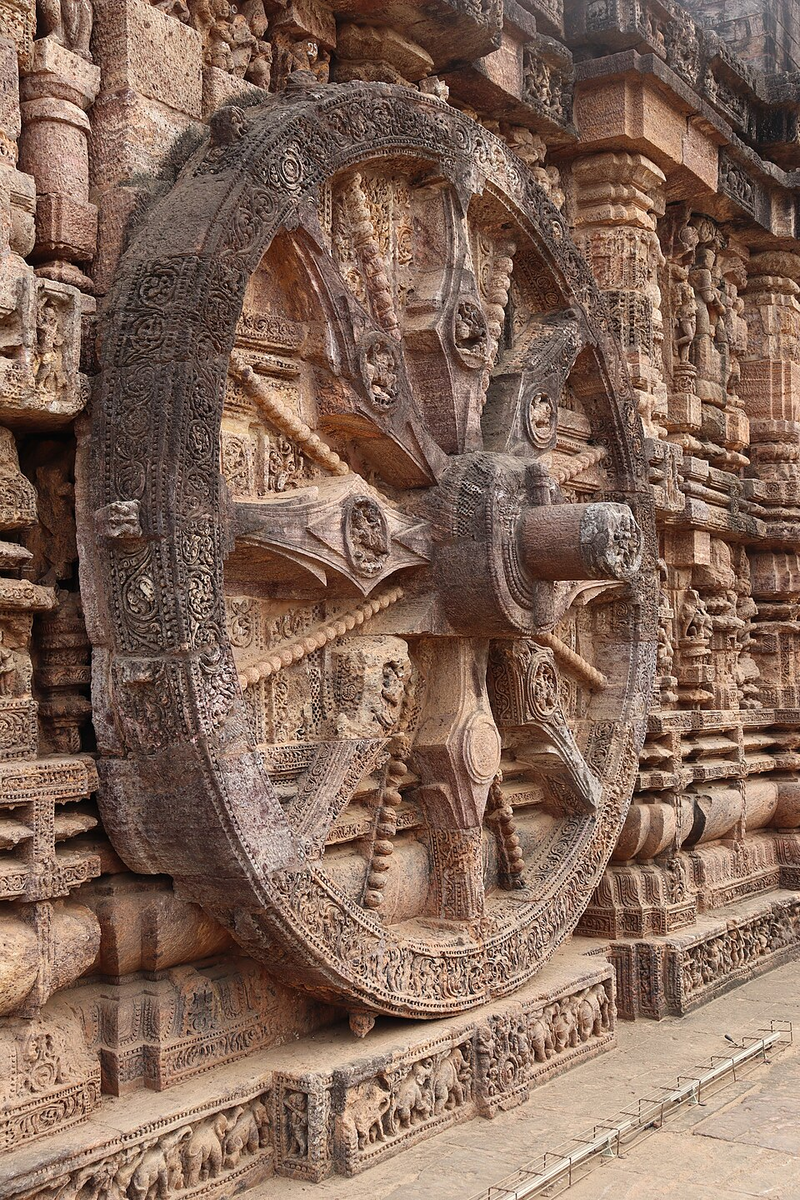
The Sun Temple at Konark is carved as the chariot of Surya, the Sun god, running on 24 stone wheels . Wheels on a chariot come in pairs: 24 ÷ 2 = 12 pairs → option (c). Why the others are wrong(a) 10 pairs : 10 pairs …
Asked in SSC CGL 2025 (15 Sep, Shift 1)
Practice (1)
Q665How many pairs of decorative wheels are found on the Konark Sun Temple chariot?
Show answer
Correct answer: C — 12 pairs
Answer: (C)The Sun Temple at Konark is carved as the chariot of Surya, the Sun god, running on 24 stone wheels.
Wheels on a chariot come in pairs: 24 ÷ 2 = 12 pairs → option (c).
Why the others are wrong(a)10 pairs: 10 pairs would mean 20 wheels. The temple's chariot runs on 24 carved wheels, and 24 halves to 12 pairs, not 10.(b)11 pairs: 11 pairs would mean 22 wheels, one pair short of the temple's 24. Halve the wheel count and you get 12 pairs.(d)13 pairs: 13 pairs would mean 26 wheels, one pair more than the temple has. The carved total is 24, which halves to 12 pairs. -
690
Baran's Dol Mela begins on Jaljhulani Gyaras, featuring processions of temple deities where idols of Shreeji and Raghunathji embrace.
Baran's Dol Mela begins on Jaljhulani Gyaras , the Ekadashi of Bhadrapada's bright fortnight, with a procession of the deities of the city's temples in their dols. The Government of India's Utsav f…
Asked in SSC CGL 2025 (15 Sep, Shift 1)
Practice (1)
Q666Which of the following best captures the cultural essence and rituals of Baran’s Dol Mela in Rajasthan?
Show answer
Correct answer: B — Lord Shreeji and Raghunathji’s processions on Jaljhulani Gyaras attract traders from several states.
Answer: (B)Baran's Dol Mela begins on Jaljhulani Gyaras, the Ekadashi of Bhadrapada's bright fortnight, with a procession of the deities of the city's temples in their dols.
The Government of India's Utsav festival portal says thousands of devotees gather every year to see Shreeji and Raghunathji embrace, and that traders come from Madhya Pradesh and Uttar Pradesh → option (b).
Why the others are wrong(a)The fair opens with Dev Viman stunts by akhada artists and concludes with an Amavasya night immersion across the city.: Amavasya is a new-moon night, and this fair is fixed to Jaljhulani Gyaras, an Ekadashi. Akhada feats with the Dev Vimans are real, but the fair opens with the deities' procession.(c)Known as Annapurna Gyaras, Baran’s Dol Mela is celebrated only in Madhya Pradesh after the monsoon harvest.: Only in Madhya Pradesh is wrong on its face, since the stem places the fair in Baran, Rajasthan. Madhya Pradesh supplies traders and visitors, not the venue.(d)Held between Shravan and Ashwin, the event is led by monks in caves, separate from temple traditions.: Separate from temple traditions is false: the fair is built on the processions of Baran's temple deities. Its month window is not the flaw, since Bhadrapada falls between Shravan and Ashwin. -
691
Timila and Maddalam are traditional Kerala drums still played today and are mentioned in the early Tamil epic Silappadikaram.
Timila and Maddalam are drums Kerala still plays: both belong to Panchavadyam , the temple ensemble of four percussion instruments and one horn. The statement also places them in the Silappadikaram , the early Tamil e…
Asked in SSC CGL 2025 (15 Sep, Shift 1)
Practice (1)
Q667Which of the following best reflects Kerala’s musical instrument heritage?
Show answer
Correct answer: D — Drums like Timila and Maddalam are mentioned in Silappadikaram and still used today
Answer: (D)Timila and Maddalam are drums Kerala still plays: both belong to Panchavadyam, the temple ensemble of four percussion instruments and one horn.
The statement also places them in the Silappadikaram, the early Tamil epic, and it is the option that describes an old tradition still in use → option (d).
Why the others are wrong(a)Ravana-Hatta originated in Kerala and spread northward: Ravana-Hatta (ravanahatha) is a bowed string instrument played by folk musicians of Rajasthan. It belongs to that region's folk music, not to Kerala's heritage.(b)Kerala’s music uses only wind instruments like Turi and Kombu: Only makes it false. Kerala's ensembles rest on drums such as the timila, maddalam and idakka. The kombu is a real Kerala horn, but wind instruments are not the whole of it.(c)Kerala’s instruments are recent and mostly Western-influenced: Recent and Western-influenced is wrong. The timila is played in Kerala's temple rites, and the maddalam plays in Panchavadyam, Keli and the Kathakali orchestra. -
692
Jhora is a community folk dance of the Kumaon region in Uttarakhand, performed in mixed circles by men and women, accompanied by the hurka drum.
Jhora is a community folk dance of the Kumaon region of Uttarakhand, danced by men and women together in a large circle at fairs and festivals, especially in spring. Statement 1 holds. The songs are led on the hurka ,…
Asked in SSC CGL 2025 (15 Sep, Shift 1)
Practice (1)
Q668Consider the statements about Jhora:<br>1. It is danced in Kumaon by mixed circles of men and women during spring fairs.<br>2. The dance is accompanied primarily by the Hurka drum.<br>Which is/are correct?
Show answer
Correct answer: C — Both 1 & 2 correct
Answer: (C)Jhora is a community folk dance of the Kumaon region of Uttarakhand, danced by men and women together in a large circle at fairs and festivals, especially in spring. Statement 1 holds.
The songs are led on the hurka, the small hourglass-shaped hand drum of the Uttarakhand hills. Statement 2 holds → option (c).
Why the others are wrong(a)Only 1 correct: Rejecting Statement 2 would need another lead instrument. The hurka is the drum Jhora is danced to, played by the lead singer.(b)Only 2 correct: Rejecting Statement 1 misses what defines Jhora: a mixed circle of men and women dancing together at Kumaon's spring fairs.(d)Neither 1 nor 2 correct: Both statements match the standard description of Jhora, a Kumaoni circle dance led on the hurka, so 'neither' has nothing to rest on. -
693
The carved wheels on the Konark Sun Temple represent time divisions, symbolising the 12 months of the year, driven by seven horses.
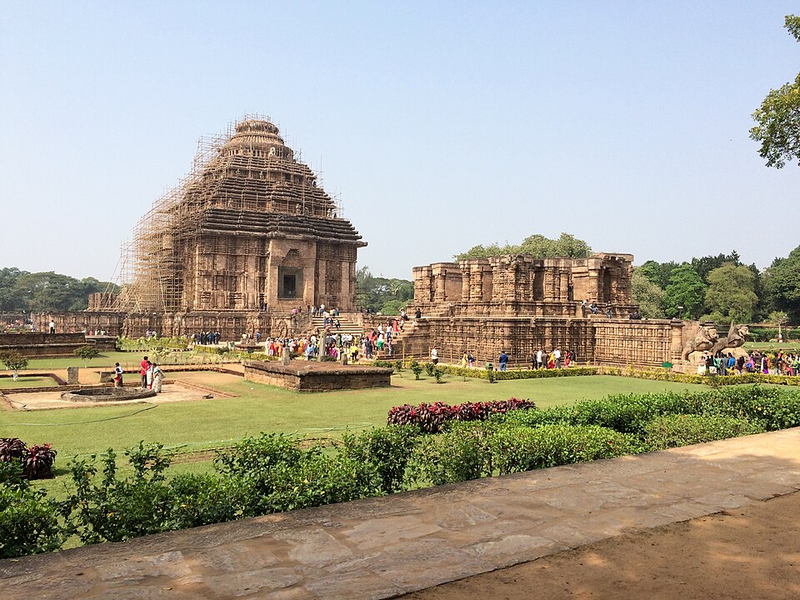
The Sun Temple at Konark is carved as the chariot of Surya . UNESCO counts twelve pairs of wheels, 24 in all, drawn by seven horses, and notes motifs on its sides referring to the cycle of the seasons and the months. …
Asked in SSC CGL 2025 (15 Sep, Shift 2)
Practice (1)
Q669What do the carved wheels on the Konark Sun Temple represent?
Show answer
Correct answer: B — Time divisions
Answer: (B)The Sun Temple at Konark is carved as the chariot of Surya. UNESCO counts twelve pairs of wheels, 24 in all, drawn by seven horses, and notes motifs on its sides referring to the cycle of the seasons and the months.
The Odisha government's Konark website said what the wheels stand for: they probably represent the 12 months of the year, and the horses the seven days of the week.
Wheels that mark the months are divisions of time → option (b).
Why the others are wrong(a)Planets: The navagraha, the nine planetary deities, are carved at Konark on a separate architrave, not on the wheels. The wheels belong to Surya's chariot and mark the calendar.(c)Festivals: The wheels stand for the months in the Odisha government's reading, and UNESCO links the temple's motifs to the seasons. That is the calendar itself, not the festivals held within it.(d)Weapons: These are chariot wheels, part of the vehicle that carries the Sun god across the sky. Nothing about them is a discus or any other weapon. -
694
Jawa is a festival celebrated simultaneously by unmarried tribal girls during the Karam festival in Jharkhand and eastern India.
The Jharkhand government's account of its tribal festivals says that at the same time as Karam , the unmarried tribal girls celebrate the Jawa festival, with songs and dances of its own. The girls decorate a smal…
Asked in SSC CGL 2025 (15 Sep, Shift 2)
Practice (1)
Q670What is the name of the festival celebrated simultaneously by unmarried tribal girls during the Karam celebrations in Jharkhand and eastern India?
Show answer
Correct answer: A — Jawa
Answer: (A)The Jharkhand government's account of its tribal festivals says that at the same time as Karam, the unmarried tribal girls celebrate the Jawa festival, with songs and dances of its own.
The girls decorate a small basket with germinating seeds, for good fertility and a better household. That girls' rite running alongside Karam is Jawa → option (a).
Why the others are wrong(b)Sohrai: Sohrai is a separate harvest festival, known as the cattle festival, held at Kartik Amavasya around Diwali. It is not the girls' rite that runs alongside Karam.(c)Karma: Karma is simply another name for Karam. The question asks for the festival the girls hold during Karam, so naming Karam itself answers nothing.(d)Madai: Madai is a Chhattisgarh festival of the Gond and other tribes, moving from place to place between December and March. It has no part in Karam. -
695
Traditional Rajasthani music is deeply tied to nature, daily life, and epic stories, performed by hereditary musicians like Manganiyars and Bhopas.
Rajasthan's traditional music is carried by hereditary performers, and their songs grow out of nature, daily life and long stories . The Manganiyar of the Thar desert are known for compositions about humans, natu…
Asked in SSC CGL 2025 (15 Sep, Shift 2)
Practice (1)
Q671Which of the following best describes traditional Rajasthani music?
Show answer
Correct answer: C — Tied to nature, life, and stories
Answer: (C)Rajasthan's traditional music is carried by hereditary performers, and their songs grow out of nature, daily life and long stories.
The Manganiyar of the Thar desert are known for compositions about humans, nature and salvation, and sing at births, weddings and deaths. The Bhopas sing the epic of the folk hero Pabuji in front of a painted cloth scroll, the phad.
That is option (c).
Why the others are wrong(a)Focuses only on temple rituals: The word only sinks it. Manganiyar and Langa musicians sing at births, weddings and deaths and in their patrons' gatherings, well beyond temple ritual.(b)Uses electric sounds as the base: Traditional here means acoustic: Manganiyar and Langa musicians play bowed instruments such as the kamaicha and the sarangi. An electric base belongs to modern fusion, not to the tradition.(d)Known only for classical ragas: Again the word only. Manganiyar musicians do sing ragas, but some of those ragas arose in the Thar and are absent from north Indian classical music, and their repertoire includes life-cycle songs and ballads. -
696
Thang-Ta is the armed martial art of the Meitei people of Manipur, featuring sword and spear combat and traditional dance movements.
Thang-Ta is the armed part of Huyen Langlon , the martial art of the Meitei people of Manipur → option (c). The name is its two weapons: thang is the sword and ta the spear. It is practised as ritual, as demonstration…
Asked in SSC CGL 2025 (13 Sep, Shift 2)
Practice (1)
Q672Thang-Ta is a traditional martial dance associated with which northeastern state of India?
Show answer
Correct answer: C — Manipur
Answer: (C)Thang-Ta is the armed part of Huyen Langlon, the martial art of the Meitei people of Manipur → option (c).
The name is its two weapons: thang is the sword and ta the spear. It is practised as ritual, as demonstration and as combat, which is why it also appears as a martial dance.
Why the others are wrong(a)Assam: Assam is known for Bihu and the classical Sattriya dance. Thang-Ta, the sword-and-spear art, belongs to the Meitei tradition of Manipur.(b)Nagaland: Nagaland has its own tribal dances, showcased at the Hornbill Festival. Thang-Ta, the sword-and-spear art, comes from the Meitei people of Manipur.(d)Tripura: Tripura is known for Hojagiri, a dance of the Reang community. Thang-Ta, practised with sword and spear, is Manipuri, part of Huyen Langlon. -
697
Panthi is a devotional dance of the Satnami community of Chhattisgarh, performed around a jaitkhamb to songs encoding Guru Ghasidas's teachings.
Statement 1 holds in substance. Panthi is the devotional dance of the Satnami community of Chhattisgarh, performed to songs that eulogise Guru Ghasidas and convey the spirit of his renunciation. Statement 2 is the one…
Asked in SSC CGL 2025 (15 Sep, Shift 2)
Practice (1)
Q673Which of the following statements is/are correct?<br>1. Panthi steps encode teachings from Guru Ghasidas’s Amritvani.<br>2. Masks representing Satpurush are worn in high ritual versions.
Show answer
Correct answer: A — Only 1
Answer: (A)Statement 1 holds in substance. Panthi is the devotional dance of the Satnami community of Chhattisgarh, performed to songs that eulogise Guru Ghasidas and convey the spirit of his renunciation.
Statement 2 is the one the key rejects. Panthi is described as dancers circling a jaitkhamb and building to acrobatics and human pyramids, with no mention of masks → option (a).
Why the others are wrong(b)Only 2: Statement 1 is true, so Only 2 cannot be right. Statement 2 is the one the key rejects.(c)1 and 2 both: Statement 2 is rejected by the key. Panthi is described as a dance around a jaitkhamb that builds to acrobatics and human pyramids, with no mention of masks for Satpurush.(d)Neither 1 nor 2: Statement 1 is true: Panthi is the Satnamis' devotional dance, performed to songs in praise of Guru Ghasidas. -
698
Kanuma is the third day of Sankranti in Andhra Pradesh and Telangana, specifically dedicated to honoring and worshipping cattle and farm animals.
In Andhra Pradesh and Telangana, Sankranti runs over four days: Bhogi , Pedda Panduga , Kanuma and Mukkanuma. Kanuma, the third day , is dedicated to cattle and other domestic animals. Cattle, especially cows, are dec…
Asked in SSC CGL 2025 (15 Sep, Shift 3)
Practice (1)
Q674Which of the following best reflects the cultural significance of the Kanuma Festival in Andhra Pradesh?
Show answer
Correct answer: B — It is dedicated to honoring cattle used in agriculture.
Answer: (B)In Andhra Pradesh and Telangana, Sankranti runs over four days: Bhogi, Pedda Panduga, Kanuma and Mukkanuma.
Kanuma, the third day, is dedicated to cattle and other domestic animals. Cattle, especially cows, are decorated, offered a special meal and worshipped → option (b).
Why the others are wrong(a)It marks the beginning of monsoon farming activities.: Sankranti is a mid-January harvest festival, so Kanuma falls after the crop is in, not at the start of monsoon farming.(c)It celebrates the victory of good over evil through bonfire rituals.: Bonfires belong to Bhogi, the first day, when unwanted old things are burnt. Kanuma, two days later, is kept for cattle.(d)It involves the worship of rivers to ensure good harvests.: River worship is not what Kanuma is known for. Its rite is for the animals that work the land: cattle are decorated, fed and worshipped. -
699
The Narsingha is an ornate S-shaped or crescent-shaped curved copper horn used in the traditional folk and ceremonial music of Himachal Pradesh.
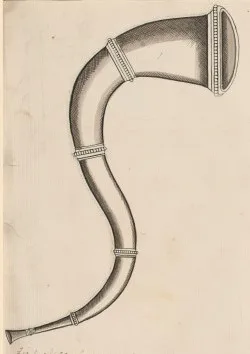
The Narsingha (also spelt narsinga or ransingha) is a curved horn of copper or copper alloy . Two curved tubes join into an S , or refit as a crescent. Himachal's Nati dance music uses it with the dhol, nagara, s…
Asked in SSC CGL 2025 (15 Sep, Shift 3)
Practice (1)
Q675Which traditional wind instrument, characterized by its ornate curved hornpipe design and ceremonial use in the folk music of Himachal Pradesh?
Show answer
Correct answer: B — Narsingha
Answer: (B)The Narsingha (also spelt narsinga or ransingha) is a curved horn of copper or copper alloy. Two curved tubes join into an S, or refit as a crescent.
Himachal's Nati dance music uses it with the dhol, nagara, shehnai and the straight karnal. The name carries singha, a modern form of Sanskrit śṛṅga, horn → option (b).
Why the others are wrong(a)Bhopal: Bhopal is best known as the capital of Madhya Pradesh. Nothing in it points to a horn, while Narsingha carries singha, the horn word.(c)Hulki: Hulki is not the curved copper horn the stem describes. That horn, heard with Himachal's Nati dances, is the Narsingha.(d)Kangarange: Kangarange is not the S-shaped copper horn of the stem. Match the description to the name built on singha, horn: Narsingha. -
700
Mim Kut is a harvest festival of the Kuki society in Mizoram and Nagaland, where 'Mim' refers to the last harvest of the year, symbolizing survival, love, and community resilience.
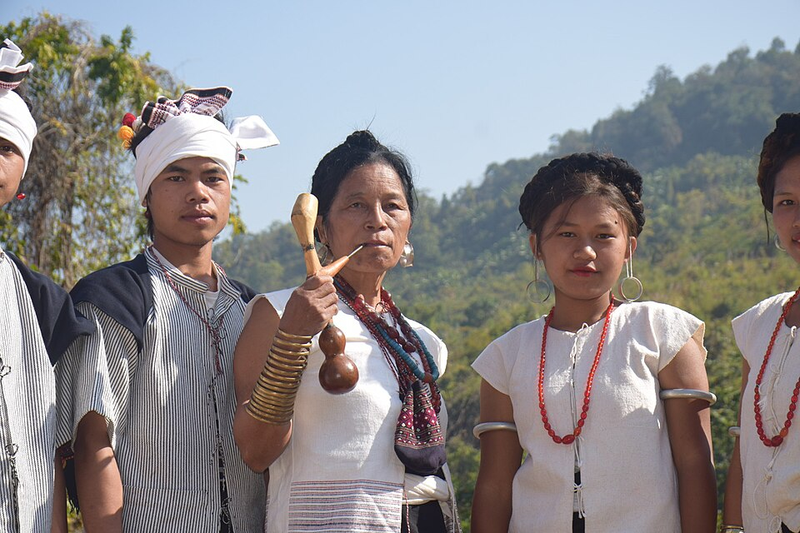
The Ministry of Tourism's Utsav portal, listing Tourism Nagaland's Mim Kut festival at Dimapur, says: "Mim is the last harvest of the year in the Kuki society." Its origin story is of Lendou and hi…
Asked in SSC CGL 2025 (14 Sep, Shift 2)
Practice (1)
Q676Which of the following best describes the cultural significance of "Mim" in the "Mim Kut festival"?
Show answer
Correct answer: C — The last harvest representing survival and love
Answer: (C)The Ministry of Tourism's Utsav portal, listing Tourism Nagaland's Mim Kut festival at Dimapur, says: "Mim is the last harvest of the year in the Kuki society."
Its origin story is of Lendou and his younger brother, abandoned by their mother, who shared mim when hungry. Mim "got them through these hard times, brought them closer and taught them love": survival and love, option (c).
Why the others are wrong(a)A rare millet stored for famine: The account the key follows calls mim the year's last harvest, not a rare grain kept against famine. Its meaning comes from the Lendou story: hunger survived and a bond of love.(b)The sacred herb for tribal healing: Mim is a food crop, harvested and eaten, not a healing herb. The Mizoram Tourism website calls Mim Kut the Maize Festival, and the Kuki story has two hungry brothers living on mim.(d)A mythological offering for spirits only: In the Utsav account, people offer their ancestors tokens of maize, jewelry, clothing, bread and rice wine, but only is the flaw. Mim is first a harvest that fed the living, as in the Lendou story.