
⚛️ Physics: Units, Instruments & Facts भौतिकी: मात्रक, उपकरण व तथ्य
326 exam-ready facts · 324 MCQs
-
301
The Doppler Effect describes the apparent change in frequency or pitch of a sound wave perceived by an observer moving relative to the source.
As a sound source approaches, waves compress, increasing the observed pitch.
Asked in SSC CGL 2025 (14 Sep, Shift 3)
Practice (1)
Q301A person standing on a railway platform notices that the sound of an approaching train's whistle changes in pitch (frequency) as the train passes by. This phenomenon is best explained by:
Show answer
Correct answer: C — Doppler effect
Answer: (C)The Doppler effect is the change in the frequency a listener receives when the source and the listener move relative to each other.
As the train approaches, each wave crest is sent from a little closer than the last, so crests arrive more often and the pitch sounds higher. Once the train passes, they arrive less often and the pitch drops. That is option (c).
Why the others are wrong(a)Refraction of sound: Refraction bends sound where its speed changes, for example between air layers at different temperatures. It changes direction and wavelength, not the frequency a listener receives.(b)Diffraction of sound: Diffraction is sound bending around obstacles and through openings, which is why you can hear someone round a corner. It changes where sound reaches, not its pitch.(d)Resonance: Resonance is a body vibrating strongly when driven at its own natural frequency. It builds up amplitude at one frequency and does not make a pitch slide as a train passes. -
302
Burns from 100°C steam are more severe than from 100°C boiling water because steam contains additional latent heat of vaporization.
Upon contact with skin, steam releases this huge amount of stored energy during condensation.
Asked in SSC CGL 2025 (15 Sep, Shift 1)
Practice (1)
Q302Why is it generally more severe to be burnt by steam at 100°C than by boiling water at 100°C?
Show answer
Correct answer: B — Steam contains more latent heat of vaporization.
Answer: (B)Both are at 100°C, so neither is hotter. Steam carries extra energy: the latent heat of vaporisation it absorbed to become steam, about 2260 J for every gram.
On skin, steam first condenses and releases all of that heat, then cools as boiling water would. Water at 100°C has no such store to give up → option (b).
Why the others are wrong(a)Steam is hotter than boiling water.: The question fixes both at 100°C, so 'hotter' cannot be the reason. Steam's extra harm comes from energy it holds without any rise in temperature.(c)Steam has a higher specific heat capacity.: Steam's specific heat is about 2.0 J/g°C, roughly half of liquid water's 4.18, so the claim is false. Specific heat governs temperature change, not the heat released on condensing.(d)Steam molecules are moving faster.: At the same temperature the average kinetic energy of molecules is the same, so steam molecules are not faster on average. Steam's extra energy went into pulling the molecules apart. -
303
The Laser Retroreflector Array (LRA) on India's Chandrayaan-3 mission was provided by the American space agency NASA.
It functions as a passive optical device used for precise distance measurements via lunar laser ranging.
Asked in SSC CGL 2025 (15 Sep, Shift 2)
Practice (1)
Q303The Laser Retroreflector Array (LRA) onboard Chandrayaan-3 was supplied by which space agency?
Show answer
Correct answer: C — NASA
Answer: (C)ISRO's Chandrayaan-3 page lists, among the Vikram lander's payloads, a passive Laser Retroreflector Array from NASA, carried for lunar laser ranging.
NASA's Goddard Space Flight Center built it: eight corner-cube reflectors that send a laser beam back the way it came. On 12 December 2023, NASA's Lunar Reconnaissance Orbiter ranged a laser off it from lunar orbit → option (c).
Why the others are wrong(a)ESA: ESA helped on the ground: its ESTRACK tracking network supported Chandrayaan-3. The reflector on the Vikram lander is NASA's.(b)JAXA: JAXA is ISRO's partner in a later mission, the planned Lunar Polar Exploration Mission (LUPEX), also called Chandrayaan-5. The LRA on Chandrayaan-3 came from NASA.(d)ROSCOSMOS: Roscosmos flew its own south-pole lander, Luna 25, which crashed on 19 August 2023, four days before Vikram landed. The LRA on Vikram is NASA's. -
304
When a sound wave travels from air into water, its frequency remains unchanged while its speed and wavelength increase.
Since sound travels much faster in water than in air, the resulting wavelength becomes proportionally longer.
Asked in SSC CGL 2025 (15 Sep, Shift 2)
Practice (1)
Q304What change occurs when sound passes from air into water?
Show answer
Correct answer: A — Frequency remains unchanged, but wavelength varies
Answer: (A)The frequency of a wave is set by its source, so it does not change when sound crosses from air into water.
The speed does change. NCERT's Class 9 table gives 1498 m/s in distilled water and 346 m/s in air at 25 °C, so sound is over four times as fast in water.
Wavelength = speed ÷ frequency.
Why the others are wrong(b)Frequency increases while wavelength stays constant: Frequency cannot increase at the boundary, because the vibrating source fixes it. And with speed rising in water, v = f × λ forces the wavelength to change, not stay constant.(c)Both frequency and wavelength decrease: Frequency stays fixed, so it cannot decrease. The wavelength does change, but it increases, because sound speeds up in water and λ = v ÷ f.(d)Speed decreases while frequency increases: Both halves are wrong. Sound travels faster in water than in air, not slower, and its frequency stays the same across the boundary instead of increasing.
Speed rises and frequency is fixed, so the wavelength grows by the same factor → option (a). -
305
When light travels from one medium to another, its frequency remains unchanged while its speed and wavelength change.
The frequency of light is determined by its source and remains constant across all media.
Asked in SSC CGL 2025 (13 Sep, Shift 2)
Practice (1)
Q305When light enters from air into a medium, its speed changes. Which of the following properties of light remains constant during this transition?
Show answer
Correct answer: B — Frequency
Answer: (B)Frequency is set by the source, not by the medium the light travels through.
At the boundary, every crest that arrives from the air must continue into the new medium, so the number of crests passing per second cannot change → option (b).
What changes follows from v = fλ: with f fixed, a lower speed means a proportionally shorter wavelength.
Why the others are wrong(a)Wavelength: Wavelength changes with speed. With f fixed in v = fλ, light entering glass (n ≈ 1.5) slows to about 2 × 10⁸ m/s and its wavelength shrinks by the same factor, 1.5.(c)Speed: Speed is the property the stem itself says changes. In a medium v = c⁄n, so in water (n ≈ 1.33) light travels at about 2.25 × 10⁸ m/s instead of 3 × 10⁸ m/s.(d)Amplitude: Amplitude is not protected at a boundary. Part of the light is reflected at the surface and part absorbed inside the medium, so the transmitted wave usually has a smaller amplitude. -
306
An electric bell operates using the magnetic effect of electric current through an electromagnet.
The electric bell uses an electromagnet that repeatedly attracts and releases a striker to ring.
Asked in SSC CGL 2025 (16 Sep, Shift 1)
Practice (1)
Q306Which of the following pairs is correctly matched regarding electromagnetic devices?
Show answer
Correct answer: D — Electric Bell : Uses the magnetic effect of electric current.
Answer: (D)An electric bell works on an electromagnet. Current in the coil magnetises it, it pulls an iron strip, and the hammer on the strip strikes the gong.
The pull breaks the circuit, the coil stops being a magnet and the strip springs back. Contact is remade and the cycle repeats → option (d).
Why the others are wrong(a)Electric Generator : Converts electrical energy to mechanical energy.: An electric generator converts mechanical energy into electrical energy. The reverse, electrical to mechanical, is what an electric motor does.(b)Transformer : Operates on DC current to change voltage.: A transformer needs alternating current. Only a changing current in one coil induces a voltage in the other, so a steady DC gives no induced voltage.(c)Electromagnet : A permanent magnet.: An electromagnet is a temporary magnet. It is magnetic only while current flows, which is exactly what lets a bell's circuit switch on and off. -
307
The least distance of distinct vision for a normal human eye is approximately 25 cm.
This minimum distance allows a normal human eye to focus on an object without strain.
Asked in SSC CGL 2025 (15 Sep, Shift 3)
Practice (1)
Q307The least distance of distinct vision for a normal human eye is approximately:
Show answer
Correct answer: B — 25 cm
Answer: (B)The least distance of distinct vision is the minimum distance at which the eye sees an object most distinctly without strain. It is also called the near point.
NCERT's Class 10 chapter on the human eye puts it at about 25 cm for a young adult with normal vision. The far point is infinity, so a normal eye sees clearly from 25 cm outwards: option (b).
Why the others are wrong(a)2.5 cm: 2.5 cm is a tenth of the near point. A page held that close blurs, because the eye lens cannot shorten its focal length below a certain minimum.(c)2.5 m: 2.5 m lies inside the range a normal eye already sees clearly, 25 cm to infinity. It is ten times the near point, not the near point itself.(d)25 m: 25 m sits well inside the clear range of a normal eye, which runs from the near point, about 25 cm, out to infinity. It is no limit at all. -
308
ASPEX (Aditya Solar wind Particle Experiment) is the payload on Aditya-L1 that monitors solar wind.
ASPEX measures solar wind protons and heavier ions in situ at the Lagrange point L1.
Asked in SSC CGL 2025 (15 Sep, Shift 3)
Practice (1)
Q308Which payload monitors solar wind at L1?
Show answer
Correct answer: A — ASPEX
Answer: (A)Aditya-L1 carries seven payloads: four view the Sun remotely, and three study particles and fields in situ at the L1 point.
ASPEX, the Aditya Solar wind Particle Experiment, is one of the in-situ three. ISRO lists it as a solar wind and particle analyser for protons and heavier ions, so it monitors the solar wind: option (a).
Why the others are wrong(b)SUIT: SUIT, the Solar Ultraviolet Imaging Telescope, is a remote-sensing payload. It images the photosphere and chromosphere in near ultraviolet rather than sampling wind at L1.(c)SoLEXS: SoLEXS is a soft X-ray spectrometer that observes the Sun as a star. It reads the Sun's light, not the particles of the solar wind.(d)HEL1OS: HEL1OS is a hard X-ray spectrometer, another remote-sensing payload, which has recorded solar flares in high-energy X-rays. It does not sample the solar wind. -
309
According to Ohm's law, if resistance is doubled at constant potential difference, the current is halved.
Current is inversely proportional to resistance when voltage remains constant (I = V/R).
Asked in SSC CGL 2025 (16 Sep, Shift 2)
Practice (1)
Q309If the resistance of a conductor is doubled while keeping the potential difference across its ends constant, what will happen to the current flowing through it?
Show answer
Correct answer: B — It will halve
Answer: (B)Use Ohm's law, V = IR, rearranged as I = V⁄R.
Before: I = V⁄R
Double R, keep V: I′ = V⁄(2R)
Compare: I′ = ½ × V⁄R = I⁄2The current falls to half → option (b).
Why the others are wrong(a)It will double: Double is what happens if the potential difference doubles at fixed resistance. Here R went up with V fixed, so I = V⁄R must go down.(c)It will remain unchanged: Unchanged would need V to double along with R. Only R changed, so I = V⁄R changes with it.(d)It will quadruple: Quadruple has no route here. Current depends on R to the first power, not squared, and R went up, so the current can only fall. -
310
The relationship between speed, frequency, and wavelength of a wave is given by the formula v = fλ.
Wavelength is calculated by dividing the wave speed by its frequency.
Asked in SSC CGL 2025 (16 Sep, Shift 3)
Practice (1)
Q310If the speed of sound in a medium is 340 m/s and a sound wave has a frequency of 680 Hz, what is its wavelength?
Show answer
Correct answer: A — 0.5 m
Answer: (A)Speed, frequency and wavelength are linked by v = fλ.
Rearrange for wavelength: λ = v ÷ f
Substitute: λ = 340 ÷ 680
Divide: λ = 0.5 m → option (a)Check: 680 waves a second, each 0.5 m long, cover 680 × 0.5 = 340 m each second.
Why the others are wrong(b)2 m: 2 m comes from dividing the wrong way, 680 ÷ 340. That quotient is f ÷ v = 1⁄λ, the number of waves per metre, not the wavelength.(c)20 m: 20 m does not follow from these numbers. At 340 m/s a 20 m wavelength would need a frequency of 340 ÷ 20 = 17 Hz, not 680 Hz.(d)50 m: 50 m would need a frequency of 340 ÷ 50 = 6.8 Hz. It looks like 0.5 with the decimal point moved two places. -
311
The James Webb Space Telescope observes in the infrared spectrum and orbits at Lagrange Point L2.
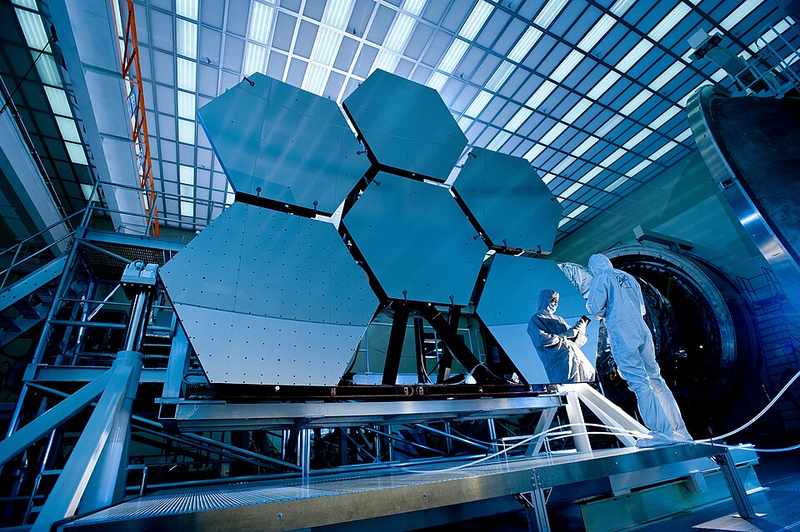
JWST is equipped with coronagraphs to block starlight and detect exoplanets.
Asked in SSC CGL 2025
Practice (1)
Q311Consider the following statements about the James Webb Space Telescope (JWST):<br>1. It observes in the near-infrared and mid-infrared spectrum.<br>2. It is positioned at the Sun-Earth Lagrange Point L2.<br>3. It carries a coronagraph for exoplanet detection.<br>Which of the above statements is/are correct?
Show answer
Correct answer: D — All 1, 2 and 3
Answer: (D)Statement 1 is true. Webb observes from red visible light through the near- and mid-infrared, about 0.6 to 28.5 micrometres.
Statement 2 is true. It works in a halo orbit around the Sun–Earth L2 point, about 1.5 million km from Earth.
Statement 3 is true. Its NIRCam and MIRI instruments carry coronagraphs that block starlight to image faint planets near bright stars. All three hold: option (d).
Why the others are wrong(a)Only 1 and 2: Drops statement 3. Webb does carry coronagraphs, on NIRCam and MIRI, built to block a star's glare so that nearby planets and disks can be seen.(b)Only 1 and 3: Drops statement 2. Webb works around the Sun–Earth L2 point, about 1.5 million km away, not in low Earth orbit like Hubble.(c)Only 2 and 3: Drops statement 1. Webb is an infrared telescope, covering the near- and mid-infrared, and its sunshield keeps it cold enough to pick up that faint heat. -
312
According to the principle of continuity and Bernoulli's equation, fluid speed increases and pressure decreases in a narrowing pipe.
As the cross-sectional area decreases, fluid velocity increases, causing a drop in static pressure.
Asked in SSC CGL 2025 (17 Sep, Shift 2)
Practice (1)
Q312What happens when an ideal fluid flows through a narrowing horizontal pipe?
Show answer
Correct answer: B — Speed increases, Pressure decreases
Answer: (B)Two laws settle it.
Continuity: an ideal fluid is incompressible, so the same volume passes every section each second.
A₁v₁ = A₂v₂, so a smaller area means a higher speed.Bernoulli: in a horizontal pipe, P + ½ρv² stays constant.
Why the others are wrong(a)Speed decreases, Pressure increases: It reverses both effects. By continuity a narrower section must carry the same flow faster, so speed cannot fall where the pipe narrows.(c)Both Speed and Pressure increases: Both cannot rise together. In a horizontal pipe P + ½ρv² is constant, so a gain in the speed term must be paid for by a fall in pressure.(d)Both speed and pressure decreases: Speed cannot fall here. By continuity, A₁v₁ = A₂v₂, so a smaller area forces a higher speed, and the pressure falls alone.
If ½ρv² rises, P must fall. So speed increases and pressure decreases: option (b). -
313
Aditya-L1 is placed in a halo orbit around the Sun-Earth Lagrangian point L1.
Lagrangian points are positions where the gravitational pull of two large masses equals the centripetal force required.
Asked in SSC CGL 2025 (18 Sep, Shift 1)
Practice (1)
Q313Aditya-L1 is placed in a halo orbit around which type of gravitationally balanced point in space?
Show answer
Correct answer: B — Lagrangian
Answer: (B)Aditya-L1, launched on 2 September 2023 on PSLV-C57, was inserted on 6 January 2024 into a halo orbit around the Sun–Earth L1 point, about 1.5 million km from Earth.
L1 is a Lagrange point: a spot where the combined gravity of two large bodies, here the Sun and Earth, lets a small spacecraft keep its position relative to both → option (b).
Why the others are wrong(a)Polar: A polar orbit is a path around Earth that passes over or near both poles. It is a kind of Earth orbit, not a balance point between two bodies.(c)Sun-synchronous: A sun-synchronous orbit is a near-polar Earth orbit that passes over each place at the same local solar time. Despite the name, it circles Earth.(d)Geostationary: A geostationary orbit lies about 35,786 km above the equator and keeps pace with Earth's rotation. Aditya-L1 is about 1.5 million km away, far beyond it. -
314
The POLIX instrument on XPoSat measures X-ray polarization in the 8–30 keV energy band.
XPoSat is India's dedicated polarimetry mission to study bright astronomical X-ray sources.
Asked in SSC CGL 2025 (18 Sep, Shift 1)
Practice (1)
Q314Which instrument description on XPoSat is correct?
Show answer
Correct answer: D — POLIX measures X-ray polarization (8–30 keV) to study black holes.
Answer: (D)XPoSat, launched by ISRO on 1 January 2024, carries two instruments. POLIX (Polarimeter Instrument in X-rays) measures the degree and angle of polarisation of X-rays in the 8–30 keV band.
Its targets include black hole X-ray binaries, pulsars, neutron stars and active galactic nuclei, so option (d) describes it correctly.
Why the others are wrong(a)XSPECT extends POLIX’s polarimetry range to 0.5–20 keV.: XSPECT is not a polarimeter. It does X-ray spectroscopy and timing in the 0.8–15 keV band and extends nothing of POLIX's range.(b)POLIX performs X-ray spectroscopy and timing.: Spectroscopy and timing is XSPECT's job. POLIX, as its name says, is the polarimeter.(c)XSPECT measures X-ray polarization.: Polarisation is POLIX's measurement. XSPECT records the spectra and timing of soft X-rays. -
315
Ideal gas molecules have negligible volume and undergo perfectly elastic collisions with no intermolecular forces.
The kinetic theory of gases forms the foundation of ideal gas behavior assumptions.
Asked in SSC CGL 2025 (18 Sep, Shift 1)
Practice (1)
Q315Consider the given statements regarding the behavior of ideal gases:<br>1. Ideal gas molecules have negligible volume compared to the total volume of the container.<br>2. There are strong intermolecular attractive forces between ideal gas molecules.<br>3. Collisions between ideal gas molecules are perfectly elastic.<br>Which of the statements given above is/are correct?
Show answer
Correct answer: B — 1 and 3 only
Answer: (B)An ideal gas is the kinetic-theory model built on a few assumptions:
Statement 1 is true: molecules are point masses, their own volume negligible beside the container's.
Statement 2 is false: ideal gas molecules exert no intermolecular forces, attractive or repulsive.
Statement 3 is true: collisions are perfectly elastic, so total kinetic energy is conserved.1 and 3 only → option (b).
Why the others are wrong(a)1 and 2 only: Statement 2 fails. Strong attractions are exactly what the ideal gas model assumes away. They are why real gases deviate from ideal behaviour and can liquefy.(c)2 and 3 only: It keeps the false statement 2 and drops the true statement 1. Negligible molecular volume is a core ideal-gas assumption, while strong attraction is not.(d)1, 2 and 3: Not all three hold. The ideal gas model assumes no forces between molecules, so strong attraction describes a real gas, not an ideal one. -
316
The Gaganyaan mission is India's human spaceflight program aimed at sending a crew to a 400 km orbit.
Gaganyaan focuses on human spaceflight capability and R&D advancement, not on altering global climate parameters.
Asked in SSC CGL 2025 (19 Sep, Shift 2)
Practice (1)
Q316Which of the following is NOT a benefit of the Gaganyaan mission?
Show answer
Correct answer: D — Reduction in Earth's temperature
Answer: (D)Gaganyaan is ISRO's human spaceflight programme. Its stated aim is to launch a crew of three to a 400 km orbit for a three-day mission and bring them back safely to Earth.
Lowering Earth's temperature is a climate goal, pursued by cutting greenhouse-gas emissions. A crewed orbital flight does nothing of the kind, so it is the one listed item that is not a benefit → option (d).
Why the others are wrong(a)Increased global collaborations in space science: ISRO describes the programme as drawing on cutting-edge technologies available with international agencies, so global collaboration is part of it, not the odd one out.(b)Advancement in space-related R&D and technology: ISRO lists the new technology areas the programme opens up, among them life support systems, human factors engineering and bioastronautics. Advancing R&D is a real benefit.(c)Boost to India's human spaceflight capability: Human spaceflight capability is the programme's core objective: a crewed launch, three days in orbit and a safe return. It is the headline benefit. -
317
The efficiency of a Carnot engine depends only on reservoir temperatures, and heat flows from cold to hot only with external work.
Quasi-static expansion yields the maximum possible work compared to irreversible expansion processes.
Asked in SSC CGL 2025 (19 Sep, Shift 2)
Practice (1)
Q317Which statements about thermodynamic processes and heat engines is/are correct?<br>1. Work done in irreversible expansion is greater than in quasi-static expansion.<br>2. Efficiency of an ideal heat engine depends only on reservoir temperatures.<br>3. Heat flows from cold to hot only with external work.
Show answer
Correct answer: B — 2 and 3 only
Answer: (B)Test each statement.
Statement 1 is false. For the same isothermal expansion, the quasi-static (reversible) path delivers the most work. An irreversible expansion pushes against a smaller opposing pressure and does less.
Statement 2 is true. An ideal (Carnot) engine has efficiency η = 1 − T₂⁄T₁, fixed by the reservoir temperatures in kelvin.
Statement 3 is true. This is the Clausius statement: heat goes from cold to hot only when external work is done, as in a refrigerator.
2 and 3 only → option (b).
Why the others are wrong(a)1 and 2 only: It keeps statement 1, which reverses the rule: the quasi-static path does the most work. It also drops statement 3, the Clausius statement.(c)1 and 3 only: It keeps statement 1, which is false: irreversible expansion does less work than quasi-static. It also drops statement 2, the Carnot result.(d)1, 2 and 3: Statement 1 is false, so all three cannot stand. Free expansion into a vacuum is the extreme case: it is irreversible and does no work at all. -
318
Spark Torch Igniters provide reliable and repeatable ignition in vacuums, enabling reusable rocket stages.
Engine restarts in space and during booster recovery demand highly dependable vacuum-compatible ignition systems.
Asked in SSC CGL 2025 (21 Sep, Shift 1)
Practice (1)
Q318Read the following statements marked as Assertion (A) and Reason (R). Choose the correct option.<br>Assertion (A): The development of Spark Torch Igniters is essential for the feasibility of fully reusable rocket booster stages and spacecraft requiring multiple engine firings in orbit.<br>Reason (R): Spark Torch Igniters provide highly reliable and repeatable ignition capability in vacuum conditions, a critical requirement for successive engine restarts during complex mission profiles.
Show answer
Correct answer: A — Both A and R are true, and R is the correct explanation of A
Answer: (A)The key reads both statements as true and R as the reason for A.
R: a spark torch igniter uses an electric spark to light a small torch flame, which then lights the engine. It can do this again and again, in vacuum, which is what successive restarts demand.
R explains A: a reusable booster must relight its engines to fly back and land, and a spacecraft must relight for each burn in orbit. Repeatable ignition serves both → option (a).
Why the others are wrong(b)Both A and R are true, but R is not the correct explanation of A: Treats R as a separate truth, but R names the capability A rests on (repeatable ignition for multiple restarts) so the key counts R as A's explanation.(c)A is true, but R is false: R is not false. Torch igniters relight from a spark, and Raptor uses them in its preburners while needing none of Merlin's consumable igniter fluid.(d)A is false, but R is true: The key holds A true: stages that fly back to land and spacecraft that fire repeatedly in orbit both need reliable restarts, the need A ties to torch igniters. -
319
Concave mirrors converge parallel rays of sunlight to a single point, making them ideal for solar furnaces.
The converging property of concave mirrors helps concentrate solar energy to achieve extremely high temperatures.
Asked in SSC CGL 2025 (21 Sep, Shift 1)
Practice (1)
Q319Which mirror type is used in solar furnaces to focus sunlight?
Show answer
Correct answer: C — Concave
Answer: (C)To focus sunlight, a mirror must make parallel rays meet at a point, and the concave mirror is the type that converges them.
A solar furnace concentrates sunlight with parabolic mirrors, which are concave, often fed by flat heliostats. At the Odeillo furnace in France, the focus can reach about 3,500 °C → option (c).
Why the others are wrong(a)Convex: A convex mirror makes reflected rays spread apart, so they never meet. Its wide field of view suits a vehicle's rear-view mirror, not a furnace.(b)Plane: A plane mirror redirects light without converging it. Odeillo uses flat mirrors to steer sunlight onto its large curved mirror, but the focusing is done by the curved one.(d)Biconvex: Biconvex describes a lens, not a mirror. A convex lens does converge light, by refraction, but the stem asks for a mirror type. -
320
Electrical energy consumption is calculated in kilowatt-hours (kWh), where 1 kWh equals 1 unit of electricity.
Multiplying appliance power in kilowatts by total operating hours gives energy consumed in units.
Asked in SSC CGL 2025 (20 Sep, Shift 1)
Practice (1)
Q320A 60 W electric lamp is used for 5 hours daily. Calculate the energy consumed in 'units' (kilowatt-hours) in 30 days.
Show answer
Correct answer: A — 9 units
Answer: (A)Convert the lamp's power to kilowatts, then multiply by the hours of use.
Power = 60 W ÷ 1,000 = 0.06 kW
Why the others are wrong(b)30 units: 30 units would need 1 kWh a day, which is a 200 W lamp run for 5 hours. A 60 W lamp uses only 0.3 kWh a day.(c)0.3 units: 0.3 units is the energy for one day. The question asks for 30 days, so it still has to be multiplied by 30.(d)90 units: 90 units is ten times the answer. It comes from dividing 9,000 Wh by 100 instead of 1,000 when converting watt-hours to kilowatt-hours.
Energy per day = 0.06 kW × 5 h = 0.3 kWh
Energy in 30 days = 0.3 × 30 = 9 kWh
1 unit = 1 kWh, so the lamp uses 9 units → option (a)