
🏺 History इतिहास
1077 exam-ready facts · 1001 MCQs
-
481
Gautamiputra Satakarni was the greatest king of the Satavahana dynasty.
He revived the Satavahana power and defeated the Saka ruler Nahapana.
Asked in SSC CGL 2024 (10 Sep, Shift 2)
Practice (1)
Q447Gautamiputra Satakarni titled Rajaraja and Maharaja is related to which of the following dynasties?
Show answer
Correct answer: A — Satavahana
Answer: (A)
Gautamiputra Satakarni was the greatest Satavahana king. -
482
Portuguese rule in India ended in December 1961 following Operation Vijay, though Goa was formally integrated later.
Goa, Daman, and Diu were liberated and incorporated into India.
Asked in SSC CGL 2018
Practice (1)
Q448The ‘Instrument of Surrender’ which ended the Portuguese rule in India was signed on<br>_____.
Show answer
Correct answer: B — ['2', '15th August 1947']
Answer: (B)
The correct option is (B). -
483
Prabhavatigupta, the daughter of Chandragupta II, was married to the Vakataka king Rudrasena II.
This matrimonial alliance secured the Gupta empire's southern flank against potential threats.
Asked in SSC CGL 2024 (10 Sep, Shift 3)
Practice (1)
Q449Rudrasena II of which of the following dynasties married Prabhavatigupta, the daughter of Chandragupta II of the Gupta dynasty?
Show answer
Correct answer: A — Vakataka
Answer: (A)
Prabhavatigupta married the Vakataka king Rudrasena II. -
484
Fatehabad was founded in the 14th century by Firoz Shah Tughlaq, who named it after his son Fateh Khan.
He established several new towns and irrigation canals during his reign.
Asked in SSC CGL 2020 (9 Mar, Shift 1)
Practice (1)
Q450Fatehabad district derives its name from the eponymous headquarters town founded by ______ in the 14th century, who named it after his son Fateh Khan.
Show answer
Correct answer: A — Firoz Shah Tughlaq
Answer: (A)
Firoz Shah Tughlaq founded Fatehabad in the 14th century and named it after his son Fateh Khan. -
485
Vallabhbhai Patel led the Bardoli Satyagraha in 1928, earning the title 'Sardar' from the women of Bardoli.
The movement was a major success against unjust revenue hikes.
Asked in SSC CGL 2018
Practice (1)
Q451The movement of the local farmers of Bardoli in Gujarat against the British in 1928 was<br>led by _____.
Show answer
Correct answer: C — ['3', 'Vallabhbhai Patel']
Answer: (C)
The correct option is (C). -
486
Valabhi was the capital of the Maitraka dynasty from the 5th to the 8th century CE.
Valabhi served as an important center of Buddhist learning and trade in ancient western India.
Asked in SSC CGL 2024 (11 Sep, Shift 1)
Practice (1)
Q452Valabhi, a city of ancient India was the capital of the _________ dynasty from the 5th to 8th Century CE.
Show answer
Correct answer: B — Maitraka
Answer: (B)
Valabhi was the capital of the Maitraka dynasty from the 5th to the 8th century CE. -
487
The historical text 'Ain-i-Akbari' was written by the Mughal court historian Abu'l Fazl.
It is the third volume of the Akbarnama and details the administration of Akbar.
Asked in SSC CGL 2020 (9 Mar, Shift 1)
Practice (1)
Q453Name the author of the book ‘Ain-i-Akbari’?
Show answer
Correct answer: C — Abu’l Fazl
Answer: (C)
Ain-i-Akbari is by Abu'l Fazl. -
488
Savitribai Phule, a pioneer of modern Indian feminism and social reformer, hailed from Maharashtra.
She founded India's first school for girls in Pune along with her husband Jyotirao Phule.
Asked in SSC CGL 2020 (3 Mar, Shift 1)
Practice (1)
Q454Veteran freedom fighter, social reformer and feminist Savithribai Phule hailed from which of the following states of India?
Show answer
Correct answer: D — Maharashtra
Answer: (D)
Savitribai Phule was born in Naigaon, Satara district, Maharashtra. -
489
According to the Ashrama system in Vedic life, Vanaprastha is the third stage of life.
The four stages are Brahmacharya, Grihastha, Vanaprastha, and Sanyasa.
Asked in SSC CGL 2024 (11 Sep, Shift 2)
Practice (1)
Q455According to the Ashrama system of Vedic life, which of the following was the third stage of life?
Show answer
Correct answer: A — Vanaprastha
Answer: (A)
The order is Brahmacharya, Grihastha, Vanaprastha, Sanyasa, so the third stage is Vanaprastha. -
490
Al-Biruni wrote 'Kitab-ul-Hind', providing an incisive description of early 11th-century India.
He traveled to India alongside Mahmud of Ghazni during his military campaigns.
Asked in SSC CGL 2021 (13 Aug, Shift 1)
Practice (1)
Q456Who among the following had written Kitab-ul-Hind that gave an incisive description of early 11th Century India?
Show answer
Correct answer: B — Al-Biruni
Answer: (B)
Al-Biruni, who came with Mahmud of Ghazni, wrote Kitab-ul-Hind (Tahqiq-i-Hind) in Arabic, describing India in the early 11th century. -
491
The foundation stone for the Gateway of India in Bombay was laid on 31 March 1913 to commemorate the visit of King George V.
The monument is located on the waterfront at the Apollo Bunder pier in Mumbai.
Asked in SSC CGL 2020 (3 Mar, Shift 2)
Practice (1)
Q457In which year was the foundation stone for the Gateway of India laid in Bombay (now Mumbai)?
Show answer
Correct answer: A — 1913
Answer: (A)
The foundation stone of the Gateway of India was laid on 31 March 1913. -
492
The Mughal empire was established by Babur in the year 1526.
This foundation was laid after Babur defeated Ibrahim Lodi at the First Battle of Panipat.
Asked in SSC CGL 2021 (13 Aug, Shift 2)
Practice (1)
Q458In which of the following years was the Mughal empire established by Babur?
Show answer
Correct answer: A — 1526
Answer: (A)
Babur founded the Mughal empire after defeating Ibrahim Lodi at the First Battle of Panipat in 1526. -
493
Vasudeva I was a Kushana king who issued gold and copper coins.
His coinage reflects the continued economic prosperity of the late Kushana empire.
Asked in SSC CGL 2024 (11 Sep, Shift 3)
Practice (1)
Q459Vasudeva I who issued coins in gold (dinars and quarter dinars) and copper (single denomination) was a _________king.
Show answer
Correct answer: D — Kushana
Answer: (D)
Vasudeva I was a Kushana king. -
494
Harshavardhana wrote Nagananda, Ratnavali, and Priyadarshika.
Vikramorvasiyam was written by the classical Sanskrit poet and dramatist Kalidasa.
Asked in SSC CGL 2024 (12 Sep, Shift 1)
Practice (1)
Q460Which of the following plays was NOT written by Harshavardhana?
Show answer
Correct answer: A — Vikramorvasiyam
Answer: (A)
Harsha wrote Nagananda, Ratnavali and Priyadarshika. Vikramorvasiyam is by Kalidasa. -
495
The Mysore Palace served as the official residence of the Wodeyar dynasty.
The Wodeyars ruled the Kingdom of Mysore for centuries.
Asked in SSC CGL 2021 (13 Aug, Shift 2)
Practice (1)
Q461The Mysore Palace was the residence of the ______.
Show answer
Correct answer: D — Wodeyars
Answer: (D)
Mysore Palace was the official residence of the Wodeyar dynasty, rulers of Mysore. -
496
The Jhanda Satyagraha or Flag Satyagraha of 1923 was successfully held in Nagpur.
This peaceful campaign focused on the right to hoist the national flag.
Asked in SSC CGL 2020 (4 Mar, Shift 2)
Practice (1)
Q462In which city was the Jhanda Satyagraha or Flag Satyagraha of 1923 held?
Show answer
Correct answer: B — Nagpur
Answer: (B)
The Flag Satyagraha of 1923 was held in Nagpur. -
497
The Konark Sun Temple in Odisha was built in the 12th century by Narasimha Deva I.
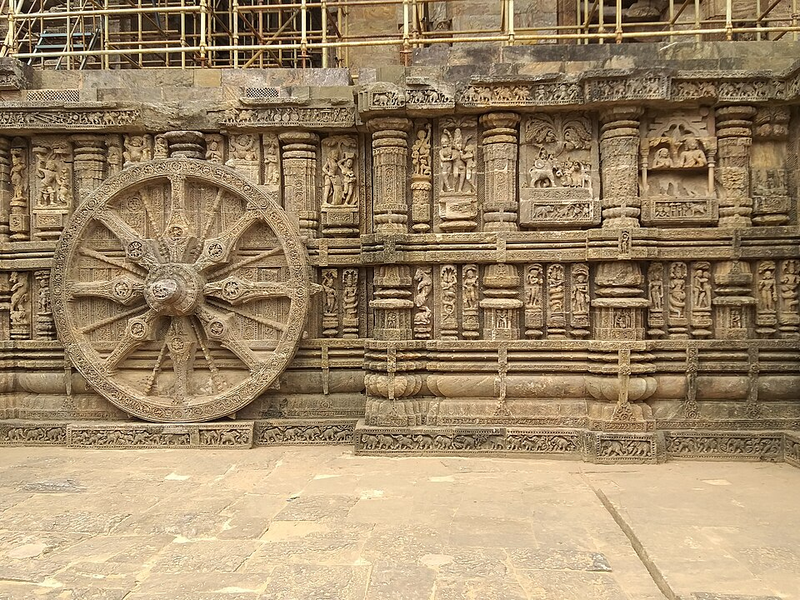
He belonged to the Eastern Ganga dynasty and constructed the temple as a chariot.
Asked in SSC CGL 2020
Practice (1)
Q463The Sun Temple of Odisha was built in the 12th Century AD by which of the following emperors?
Show answer
Correct answer: B — Narasimha Deva I
Answer: (B)
The Konark Sun Temple in Odisha was built by King Narasimha Deva I of the Eastern Ganga dynasty. -
498
The Currency Building in the BBD Bagh or Dalhousie area of Kolkata was constructed in 1833.
It served as an important financial institution during the colonial period.
Asked in SSC CGL 2020 (5 Mar, Shift 1)
Practice (1)
Q464In which year was the Currency Building in the BBD Bagh or Dalhousie area of Kolkata constructed?
Show answer
Correct answer: D — 1833
Answer: (D)
The Currency Building in Kolkata was built in 1833. -
499
There are six Vedangas which are Hindu auxiliary disciplines linked to the study of the Vedas.
The six Vedangas are Shiksha, Kalpa, Vyakarana, Nirukta, Chhanda, and Jyotisha.
Asked in SSC CGL 2024 (12 Sep, Shift 2)
Practice (1)
Q465The Vedangas are Hindu auxiliary disciplines that originated in ancient times and are linked to the study of the Vedas. These are _________ in number.
Show answer
Correct answer: C — six
Answer: (C)
Six Vedangas: Shiksha, Kalpa, Vyakarana, Nirukta, Chhanda and Jyotisha. -
500
Nawab Abdul Latif Khan is widely recognized as the 'father of Muslim renaissance' in Bengal.
He made immense contributions to modern education and social reform among Muslims.
Asked in SSC CGL 2020 (4 Mar, Shift 3)
Practice (1)
Q466Who among the following is known as the 'father of Muslim renaissance' in Bengal?
Show answer
Correct answer: C — Nawab Abdul Latif Khan
Answer: (C)
Nawab Abdul Latif is called the father of Muslim renaissance in Bengal.