
🕌 Medieval India मध्यकालीन भारत
340 exam-ready facts · 339 MCQs
-
321
Sher Shah Suri defeated Mughal emperor Humayun and founded the Second Afghan Empire in India.
Sher Shah defeated Humayun at Chausa in 1539 and at Kannauj in 1540.
Asked in SSC CGL 2025 (17 Sep, Shift 3)
Practice (1)
Q321Fill in the blank:<br>After defeating the Mughal emperor, _______ declared himself the ruler and founded the Second Afghan Empire.
Show answer
Correct answer: B — Sher Shah Suri
Answer: (B)Sher Shah Suri defeated the Mughal emperor Humayun at Chausa in 1539 and again at Kannauj in 1540, forcing him to flee.
Sher Shah was then crowned ruler of Hindustan and reigned until 1545.
The Afghan Lodis had been the last dynasty of the Delhi Sultanate, so his Sur empire was the second Afghan power in Delhi, the stem's Second Afghan Empire: option (b).
Why the others are wrong(a)Humayun: Humayun is the defeated Mughal emperor of the stem. He lost at Chausa and Kannauj, fled, and founded no Afghan empire.(c)Bahlul Lodi: Bahlul Lodi founded the Afghan Lodi dynasty in 1451, the last line of the Delhi Sultanate. He died in 1489, decades before the Mughals arrived.(d)Sikandar Lodi: Sikandar Lodi, Bahlul's son, was crowned in 1489 and shifted the capital from Delhi to Agra. He ruled before the Mughals reached India. -
322
Rajendra Chola I built the grand Brihadisvara temple at Gangaikonda Cholapuram after defeating the Palas.
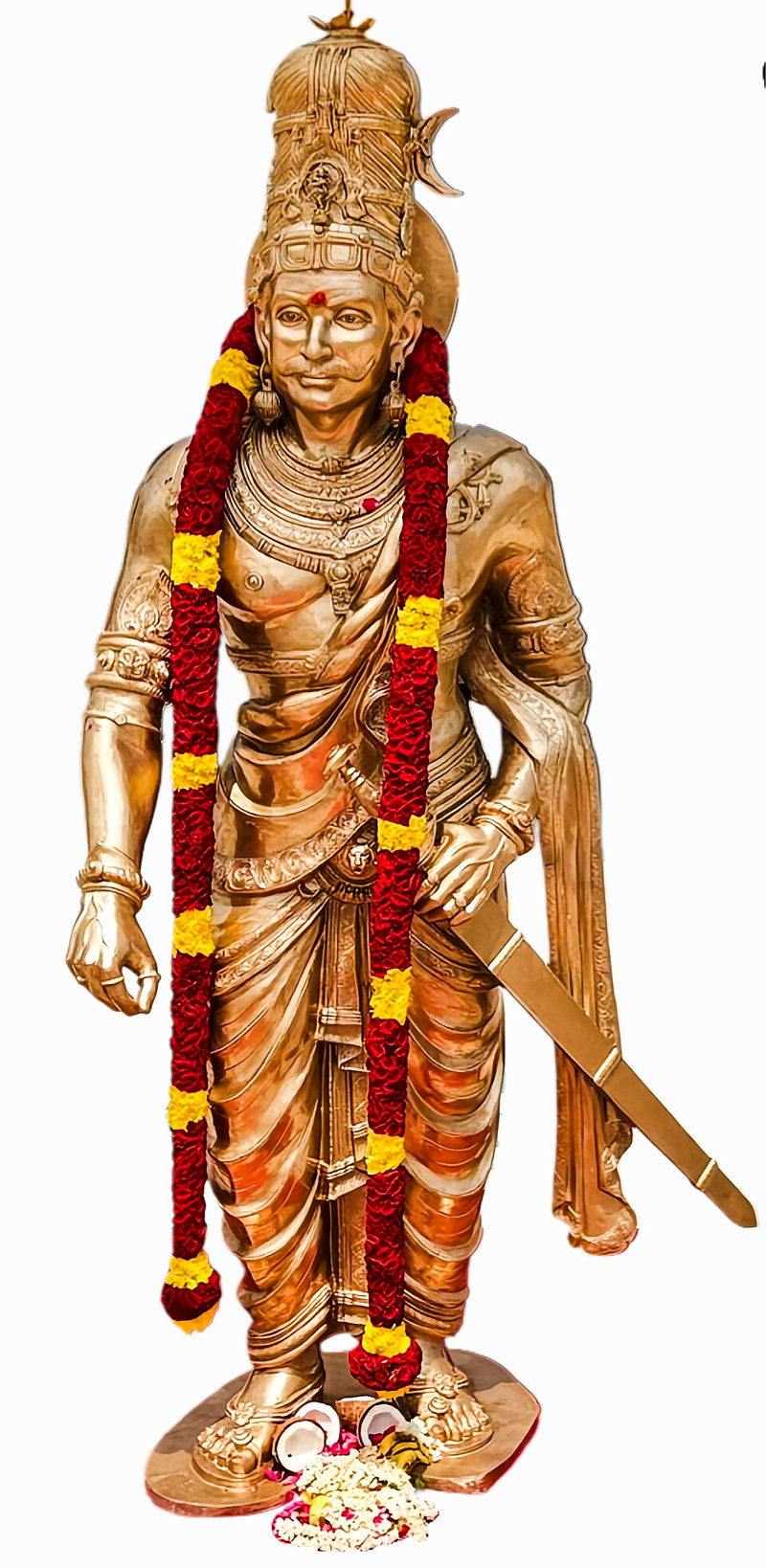
He moved the Chola capital to Gangaikonda Cholapuram and completed the temple around 1035 CE.
Asked in SSC CGL 2025
Practice (1)
Q322Who among the following Chola emperors constructed the grand temple at Gangaikonda Cholapuram?
Show answer
Correct answer: B — Rajendra Chola I
Answer: (B)Rajendra Chola I founded Gangaikonda Cholapuram to commemorate his victory over the Pala dynasty and moved the Chola capital there from Thanjavur.
The Brihadisvara temple he built there was completed in 1035 CE → option (b).
Why the others are wrong(a)Rajaraja Chola I: Rajaraja Chola I built the Brihadisvara temple at Thanjavur between 1003 and 1010 AD. Gangaikonda Cholapuram was his son's city.(c)Rajadhiraja Chola I: Rajadhiraja I was Rajendra's son and successor, sole ruler from 1044, nine years after the temple was completed. He died at the battle of Koppam in 1052.(d)Kulothunga Chola I: Kulothunga I ruled from 1070 to 1122, decades after 1035. He was Rajendra I's grandson through his mother, a Chola princess. -
323
Hindu Beg served as a provincial governor and Mughal noble who constructed the Sambhal Jama Masjid under Babur's orders.
His name includes a Turkic military title of rank, and he operated as a regional administrator.
Asked in SSC CGL 2025 (18 Sep, Shift 1)
Practice (1)
Q323What position did Hindu Beg hold during Humayun’s reign?
Show answer
Correct answer: C — Provincial governor
Answer: (C)Hindu Beg was a Mughal noble and commander, not a chief, a scholar or a saint.
An inscription in the Jama Masjid at Sambhal says Babur's general Mir Hindu Beg built it on Babur's orders by 6 December 1526. Historian Catherine Asher reads it as Babur's permission to a regional governor to build a mosque. A governing noble is what option (c) describes.
Why the others are wrong(a)Rajput chief: 'Hindu' in the name misleads. Beg is a Turkic title of rank, and Hindu Beg built a mosque on Babur's orders. He was a Mughal noble, not a Rajput chief.(b)Court scholar: He appears in the record as Babur's general, a man of arms and administration, not a scholar at court.(d)Spiritual guide: He was a military noble, Babur's general, not a Sufi or a spiritual guide to the emperor. -
324
The chronological order of construction is Agra Fort (completed 1573), Jahangir Mahal in Orchha (early 17th century), and Red Fort in Delhi (completed 1648).
Akbar's Agra Fort was finished earlier than Shah Jahan's Red Fort.
Asked in SSC CGL 2025 (19 Sep, Shift 1)
Practice (1)
Q324Arrange the following historical structures in chronological order of their completion (earliest to latest):<br>(a) Red Fort, Delhi<br>(b) Jahangir Mahal, Orchha<br>(c) Agra Fort (Akbar)
Show answer
Correct answer: B — (c) → (b) → (a)
Answer: (B)Date each building, then sort.
Agra Fort, item (c): Akbar's rebuilding was completed in 1573.
Jahangir Mahal, Orchha, item (b): built by Bir Singh Deo in the early 17th century to receive Jahangir.
Red Fort, Delhi, item (a): Shah Jahan's fort was completed in 1648.Earliest to latest is (c) → (b) → (a), which is option (b).
Why the others are wrong(a)(a) → (b) → (c): This runs the list backwards. The Red Fort, completed in 1648, is the latest of the three, and Akbar's Agra Fort, completed in 1573, the earliest.(c)(b) → (c) → (a): It puts the Jahangir Mahal first. Akbar finished Agra Fort in 1573, and the Orchha palace is a 17th-century building, so it comes second.(d)(c) → (a) → (b): It swaps the last two. The Red Fort was completed only in 1648, under Shah Jahan, after the Orchha palace raised for his father Jahangir. -
325
The Rashtrakuta king Krishna III defeated Chola forces at the Battle of Takkolam in 948–949 CE.
He earned the title 'conqueror of Tanjore' following this decisive victory.
Asked in SSC CGL 2025 (19 Sep, Shift 1)
Practice (1)
Q325Which Rashtrakuta king defeated Parantaka I of the Chola dynasty?
Show answer
Correct answer: C — Krishna III
Answer: (C)The Rashtrakuta king Krishna III defeated the Chola forces of Parantaka I at the Battle of Takkolam, fought in 948–949.
The Chola crown prince Rajaditya was killed there, struck by an arrow from Krishna III's Western Ganga ally Butuga II. Krishna III took the epithet Tanjaiyunkonda, 'conqueror of Tanjore' → option (c).
Why the others are wrong(a)Krishna I: Krishna I (756–774) is the Rashtrakuta king who commissioned the Kailasa temple at Ellora, nearly two centuries before Takkolam.(b)Dantidurga: Dantidurga founded Rashtrakuta power in the 8th century by defeating the Badami Chalukya king Kirtivarman II, long before Parantaka I ruled the Cholas.(d)Govinda III: Govinda III (793–814) is known for northern campaigns against the Pratihara Nagabhata II and the Pala Dharmapala. He died nearly a century before Parantaka I's reign. -
326
The Sisodias were the ruling royal dynasty of Mewar in Rajasthan during the 15th century.
Rana Kumbha was a prominent Sisodia ruler who constructed the Vijaya Stambha at Chittor.
Asked in SSC CGL 2025 (19 Sep, Shift 3)
Practice (1)
Q326Which of the following kingdom was under the rule of the Sisodia dynasty during the 15th century?
Show answer
Correct answer: C — Mewar
Answer: (C)The Sisodias were the ruling house of Mewar in Rajasthan, an offshoot of the Guhila dynasty. Rana Hammir established their rule in 1326.
In the 15th century Rana Kumbha (r. 1433–1468) ruled Mewar, and in 1448 he built the Vijaya Stambha at Chittor after defeating the Malwa army of Mahmud Khalji. The kingdom is Mewar → option (c).
Why the others are wrong(a)Gujarat: Gujarat was ruled in the 15th century by its own sultans, the Gujarat Sultanate, whose Ahmad Shah I founded Ahmedabad. It was not a Sisodia kingdom.(b)Malwa: Malwa was a sultanate and Mewar's rival. Rana Kumbha's Vijaya Stambha celebrates his victory over the Malwa army of Mahmud Khalji at Sarangpur.(d)Bengal: Bengal was ruled in the 15th century by the sultans of the Bengal Sultanate, far from Rajasthan. The Sisodias were a Rajput house of Mewar. -
327
Babur's memoir, the Baburnama, records his invasion of Bhira in 1519 during his initial campaigns in India.
This military expedition marked the beginning of his successful incursions into Hindustan.
Asked in SSC CGL 2025 (19 Sep, Shift 2)
Practice (1)
Q327Which region did Babur first conquer during his initial campaigns in India?
Show answer
Correct answer: D — Bhira
Answer: (D)Babur's own memoir, the Baburnama, describes his campaign of 1519 (925 AH).
His army took Bajaur by storm and then 'went on into Bhira'. In his words: 'Bhira we neither over-ran nor plundered; we imposed a ransom on its people.'
Bajaur is not an option. Of the four places offered, Bhira came first, in 1519 → option (d).
Why the others are wrong(a)Panipat: Panipat was the end of the road, not the start. Babur beat Ibrahim Lodi there in April 1526, on what he himself calls his fifth move on Hindustan.(b)Lahore: Lahore came later. Babur set out for Lahore in 1524, five years after he ransomed Bhira.(c)Sialkot: Sialkot was taken on a later expedition, after the 1519 campaign that went from Bajaur into Bhira. -
328
In Vijayanagara traditional texts, the ruling rayas are referred to as narapati (lord of men) and Deccan Sultans as ashvapati (lord of horses).
This categorization reflects the high strategic importance of cavalry in medieval warfare.
Asked in SSC CGL 2025 (20 Sep, Shift 1)
Practice (1)
Q328Which of the following statements is correct regarding Vijayanagara traditions?
Show answer
Correct answer: C — Rayas were called Narapati; Sultans were Ashvapati
Answer: (C)NCERT's Themes in Indian History, Part II, records that in the popular traditions of Vijayanagara the rayas are called narapati, or lord of men, and the Deccan Sultans ashvapati, or lord of horses.
Horses mattered because warfare then depended on effective cavalry. NCERT notes that their import from Arabia and Central Asia was very important for rival kingdoms.
Why the others are wrong(a)Rayas were called Ashvapati; Sultans were Narapati: This reverses the pair. In Vijayanagara tradition the rayas are narapati (lord of men) and the Sultans ashvapati (lord of horses).(b)Rayas were called Gajapati; Sultans were Rajguru: Gajapati, lord of elephants, was the name of a ruling lineage very powerful in Orissa in the fifteenth century, not a title of the rayas. Rajguru, a royal preceptor, is no title for Sultans.(d)Both Rayas and Sultan were called Rajadhiraj: The tradition gives the two powers different titles: narapati for the rayas, ashvapati for the Sultans. Rajadhiraj, king of kings, is a general royal title, not the pairing NCERT records. -
329
The Rashtrakutas launched several campaigns to control Kanauj, while the Pratiharas and Palas were based in western and eastern India respectively.
This conflict formed the classic Tripartite Struggle for supremacy over northern India.
Asked in SSC CGL 2025 (21 Sep, Shift 1)
Practice (1)
Q329Consider the following statements regarding political rivalries in early medieval India:<br>Statement I: The Rashtrakutas launched several campaigns to gain control over the region of Kanauj.<br>Statement II: The Pratiharas were primarily based in eastern India, while the Palas were established in the western and central regions.<br>Which of the statements given above is/are correct?
Show answer
Correct answer: A — Only Statement I is correct
Answer: (A)Statement I is correct. The Rashtrakutas of the Deccan were one of three powers in the tripartite struggle for Kanauj, and their kings Dhruva and Govinda III led campaigns into the north.
Statement II is wrong because it swaps the two dynasties. The Pratiharas were based in western India and the Palas in Bengal and Bihar, in the east. Only Statement I → option (a).
Why the others are wrong(b)Only Statement II is correct: Only Statement II picks the wrong statement. Statement II reverses the map: the Pratiharas held western India, and the Palas held Bengal and Bihar.(c)Both Statement I and II are correct: Both correct cannot stand, because Statement II puts the Pratiharas in the east and the Palas in the west, the reverse of the facts.(d)Neither Statement I nor Statement II is correct: Neither correct throws out Statement I, but the Rashtrakutas' northern campaigns for Kanauj are what made them a party to the tripartite struggle. -
330
The Bahmani kingdom was founded in the Deccan in 1347 by Alauddin Hasan Bahman Shah, independent of Chola or Chera involvement.
It originated from a revolt against the Delhi Sultanate under Muhammad bin Tughlaq.
Asked in SSC CGL 2025 (21 Sep, Shift 3)
Practice (1)
Q330Neither the Chola nor the Chera dynasty was directly responsible for the establishment of:
Show answer
Correct answer: D — Bahmani kingdom
Answer: (D)The Bahmani kingdom was founded in the Deccan in 1347 by Alauddin Hasan Bahman Shah, after a revolt against Muhammad bin Tughlaq. Its first capital was Gulbarga, later Bidar.
It was a Deccan sultanate born of a break with Delhi, with no link to the Tamil dynasties, so neither the Cholas nor the Cheras had a hand in it → option (d).
Why the others are wrong(a)Naval expeditions to Southeast Asia: Naval expeditions are a Chola achievement. Rajendra I, son of Rajaraja I, built a navy and raided Sri Lanka and Southeast Asia, including the Srivijaya kingdom.(b)Tamil literary renaissance: Tamil literature flourished under both houses. Sangam poems praise Chera and Chola kings, and Chola-era poets such as Kamban and Sekkizhar wrote major Tamil works.(c)Devadasi temple system: The devadasi system of temple women grew under Chola temple patronage. Inscriptions at Rajaraja I's Brihadisvara temple in Thanjavur record the women attached to its service. -
331
Mughal Emperor Shah Jahan popularized pietra dura stone inlay and the double dome in Indian architecture.
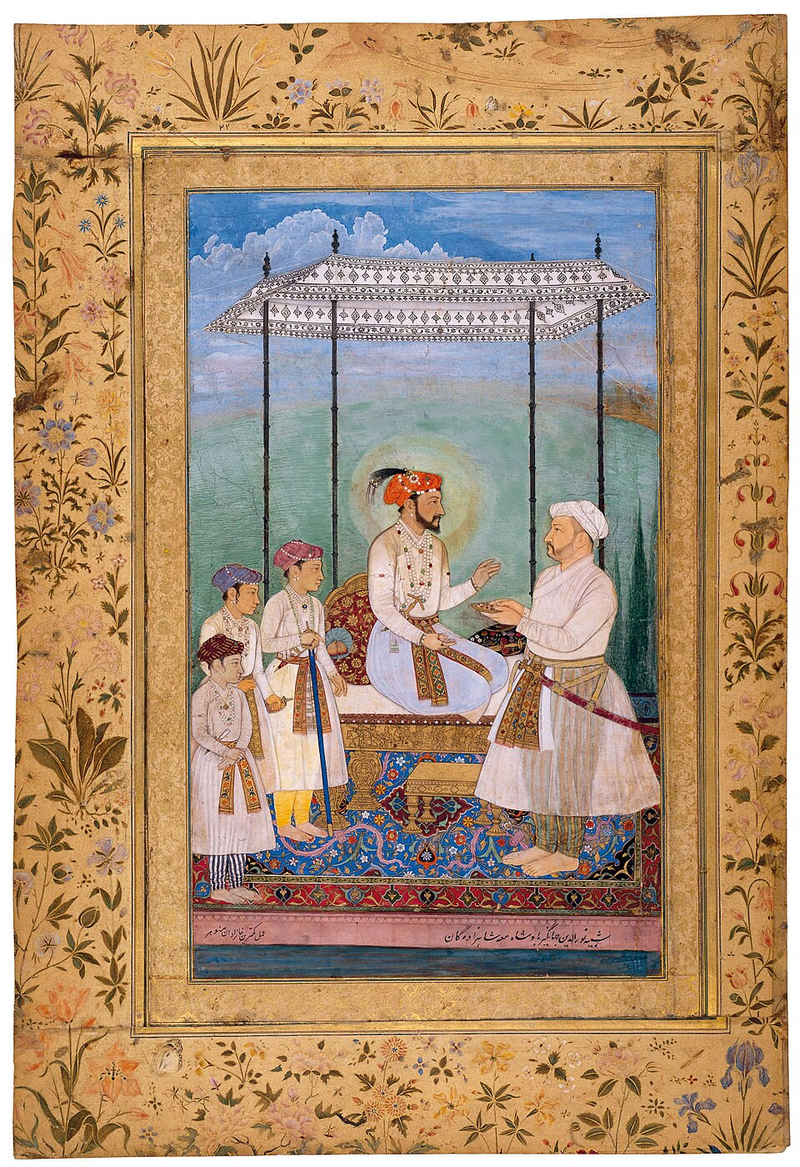
His iconic monuments like the Taj Mahal prominently feature these exquisite architectural elements.
Asked in SSC CGL 2025
Practice (1)
Q331Which Mughal Emperor is known for popularising pietra dura, or stone inlay technique, and the double dome in Indian architecture?
Show answer
Correct answer: C — Shah Jahan
Answer: (C)Shah Jahan (reigned 1628–1658) put both features on his most famous building. His Taj Mahal at Agra is white marble inlaid with coloured stone in pietra dura, and it is crowned by a double dome.
In the Red Fort at Delhi, pietra dura panels behind his throne show Orpheus playing the lute → option (c).
Why the others are wrong(a)Babur: Babur ruled in India only from 1526 to 1530. He is remembered for laying out formal gardens, not for marble inlay or domes.(b)Akbar: Akbar's signature buildings, Fatehpur Sikri and the Agra Fort, are mostly red sandstone. The marble inlay in the stem belongs to the next two reigns.(d)Aurangzeb: Aurangzeb built the Badshahi Mosque at Lahore and the small Moti Masjid in Delhi's Red Fort. The stem's pairing of inlay and dome is credited to his father, Shah Jahan. -
332
Chittorgarh Fort originally had 84 water bodies, including ponds, wells, and stepwells, of which 22 survive today.
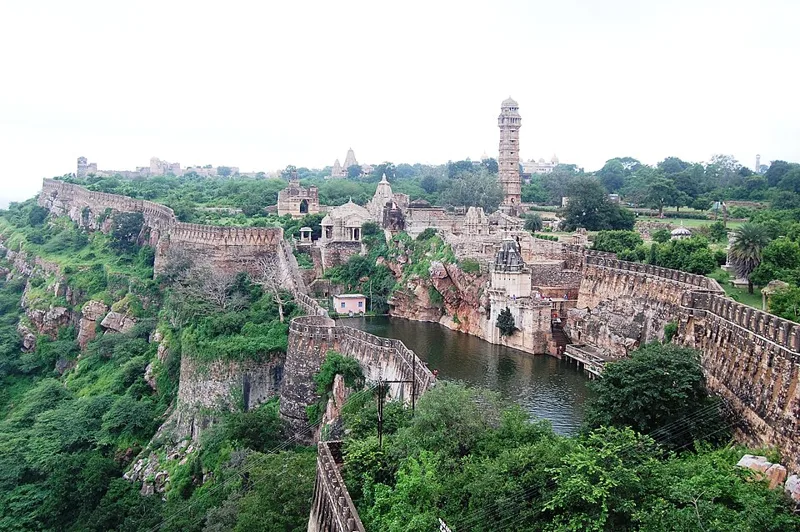
These traditional rainwater-harvesting structures sustained the fort's water requirements.
Asked in SSC CGL 2025
Practice (1)
Q332Approximately how many water bodies originally existed in Chittorgarh Fort?
Show answer
Correct answer: C — 84
Answer: (C)Chittorgarh Fort once had 84 water bodies, in the form of ponds, wells and stepwells fed by rainfall and natural catchment. Only 22 survive today.
The question asks how many existed originally, so the figure is 84 → option (c).
Why the others are wrong(a)22: 22 is how many water bodies survive today, not how many there were. The word 'originally' in the stem rules it out.(b)50: 50 is not a figure recorded for the fort. The record is 84 water bodies originally, of which 22 survive.(d)100: 100 overshoots. The recorded original count is 84, and only 22 of those survive. -
333
In early South Indian villages, the term 'ur' referred to a general village assembly or council of common residents.
Epigraphic records distinguish the ur from the sabha, which was an exclusive Brahmin assembly.
Asked in SSC CGL 2025 (22 Sep, Shift 1)
Practice (1)
Q333What does the term "Ur" refer to in the context of early South Indian villages?
Show answer
Correct answer: C — A village assembly or council
Answer: (C)The Uthiramerur inscriptions record two village assemblies: the sabha, an exclusively Brahmin body, and the ur, made up of people of all classes.
So in early South Indian villages the ur was the general assembly of an ordinary village, a collective body of villagers rather than a single officer → option (c).
Why the others are wrong(a)A tax official in the Chola kingdom: A tax official is a single appointed officer. Village bodies such as the ur, sabha and nagaram did assess and collect revenue, but as assemblies, not as officials.(b)A temple priest: A temple priest holds a religious office as one person. The ur was a civic assembly of villagers.(d)A military commander: A military commander is one officer of the army. The ur was a civic body, the assembly of an ordinary village. -
334
Sher Shah Suri's administrative system served as the model for Emperor Akbar's consolidation of the Mughal Empire.
Raja Todar Mal served under Sher Shah before designing Akbar's revenue system.
Asked in SSC CGL 2025 (23 Sep, Shift 1)
Practice (1)
Q334Whose administrative system later became the model for Emperor Akbar’s consolidation of the Mughal Empire?
Show answer
Correct answer: C — Sher Shah Suri
Answer: (C)Akbar reformed land revenue by adopting a system that Sher Shah Suri had used during his short reign (1540–45).
The link was a person as well as a method. Raja Todar Mal had served under Sher Shah before joining Akbar, and he devised Akbar's dahsala system, proclaimed in 1580 → option (c).
Why the others are wrong(a)Babar: Babar (Babur) founded the Mughal dynasty in India in 1526, but his four years there went on campaigns such as Panipat and Khanwa, not on a revenue system Akbar could copy.(b)Humayun: Humayun lost his empire to Sher Shah at Chausa (1539) and Kannauj (1540) and regained Delhi only in 1555. The model Akbar used was his father's rival's.(d)Jahangir: Jahangir was Akbar's son and successor. He ruled after Akbar, so his administration could not have been the model for Akbar's. -
335
The fourteenth-century Moroccan traveller Ibn Battuta described how Indian chieftains fortified themselves using bamboo groves and rugged terrains.
Ibn Battuta recorded his travels in his book Rihla during his time in India.
Asked in SSC CGL 2025 (23 Sep, Shift 3)
Practice (1)
Q335Which fourteenth-century traveller described how Indian chieftains fortified themselves using bamboo groves and rugged terrains for defence?
Show answer
Correct answer: B — Ibn Battuta
Answer: (B)Ibn Battuta, the Moroccan traveller, served the Delhi Sultan Muhammad bin Tughluq as a qadi (judge) and recorded his years in India in the Rihla, written in Arabic.
His account describes chieftains holding out in rugged country and bamboo groves. He is also the one traveller among the options whose Indian journey fell in the fourteenth century → option (b).
Why the others are wrong(a)Al-Biruni: Al-Biruni belongs to the 11th century. He lived at Ghazni under Mahmud, went with his campaigns into the subcontinent and wrote Kitab al-Hind around 1030.(c)Marco Polo: Marco Polo, the Venetian, travelled in the late 13th century. The stem's fourteenth-century date already rules him out.(d)Megasthenes: Megasthenes is some 1,600 years too early. He was Seleucus I Nicator's envoy to Chandragupta Maurya and wrote the Indica. -
336
The reign of Prithviraj Chauhan concluded with his defeat in the Second Battle of Tarain in 1192 CE.
Prithviraj Chauhan had previously defeated Muhammad of Ghor in the First Battle of Tarain in 1191.
Asked in SSC CGL 2025 (24 Sep, Shift 2)
Practice (1)
Q336The reign of Prithviraj Chauhan concluded in which year?
Show answer
Correct answer: B — 1192 CE
Answer: (B)Prithviraj Chauhan (Prithviraj III), the Chahamana king of Ajmer, defeated Muhammad of Ghor at the First Battle of Tarain in 1191.
Muhammad returned the next year and won the Second Battle of Tarain, 1192. Prithviraj was captured and later killed, and his reign ended → option (b).
Why the others are wrong(a)1175 CE: 1175 is near the start of his rule, not its end. Some lists, 16 Sep 2025, 09:00, GA Q.6 among them, start his reign in 1175, others about 1177. It ended with his defeat at Tarain in 1192.(c)1206 CE: 1206 is the year Muhammad of Ghor died and Qutbuddin Aybak began to rule, the start of the Delhi Sultanate. Prithviraj had fallen 14 years earlier.(d)1210 CE: 1210 is the year Qutbuddin Aybak died, after a fall while playing chaugan (polo) at Lahore. It ends Aybak's reign, not Prithviraj's. -
337
A primary objective of Alauddin Khilji's Market Control regulations was to keep essential commodity prices low so soldiers could be maintained on fixed salaries.
Ziauddin Barani noted that the threat of Mongols forced Alauddin to maintain a very large army.
Asked in SSC CGL 2025
Practice (1)
Q337Which of the following was a primary objective of Alauddin Khilji's ‘Market Control’ (Zawabit) regulations?
Show answer
Correct answer: C — To keep essential commodity prices low so soldiers could be maintained on fixed salaries.
Answer: (C)The main source for the reforms, the chronicler Ziauddin Barani, says the Mongol threat pushed Alauddin to raise a very large army. Such an army would drain the treasury unless soldiers could live on modest fixed salaries.
So the state fixed prices in Delhi, stored grain in its own granaries and punished traders who overcharged. Cheap essentials made low pay workable → option (c).
Why the others are wrong(a)To expand treasury revenue by encouraging unrestricted trade with neighboring regions.: The reforms did the opposite of unrestricted trade. Merchants were registered, prices were set by the state, and market superintendents punished anyone selling above the fixed rate.(b)To replace religious taxation with a uniform system of commercial levies across markets.: The regulations were price controls, not a tax reform. They fixed what goods sold for in Delhi's markets and did not swap religious dues for commercial levies.(d)To promote overseas trade by encouraging Indian textile exports to foreign empires.: The rules targeted supply and prices in Delhi, where the army was based. Delhi's merchants had to bring goods to the official market and sell at fixed rates, not ship them abroad. -
338
Shivaji began building the Sindhudurg sea fort on an island off Malvan, Maharashtra, in 1664.
Practice (1)
Q338Who built the Sindhudurg sea fort?
Show answer
Correct answer: D — Shivaji
Shivaji began it near Malvan in 1664. -
339
Kanhoji Angre, the Kolaba-based Maratha naval chief (Sarkhel) of the early 18th century, resisted the English, Dutch and Portuguese on the Konkan coast.
Practice (1)
Q339Who was the famous Maratha naval chief (Sarkhel)?
Show answer
Correct answer: B — Kanhoji Angre
Kolaba was his base. -
340
Ajayaraja of the Chahamana dynasty made Ajmer his capital.
SSC CPO 2023 Paper-I (3 Oct Shift 1), Oswaal solved key.