
🕌 Medieval India मध्यकालीन भारत
340 exam-ready facts · 339 MCQs
-
301
Ghiyas ud-din Balban established the military department known as 'Diwan-i-arz'.
This department was created to maintain strict control over the royal army.
Asked in SSC CGL 2024 (25 Sep, Shift 1)
Practice (1)
Q301Ghiyas ud-din Balban had set up a _________ department called 'Diwan-i-arz'.
Show answer
Correct answer: D — military
Answer: (D)
Balban set up Diwan-i-Arz, the military department. -
302
Pulakeshin II assumed the title of 'Dakshinapatheshvara' after defeating Harshavardhana of north India.
This historic battle took place on the banks of the Narmada River.
Asked in SSC CGL 2024 (25 Sep, Shift 1)
Practice (1)
Q302Pulakeshin II assumed the title of ‘Dakshinapatheshvara’ (lord of the south) after defeating which of the following rulers of north India?
Show answer
Correct answer: A — Harshavardhana
Answer: (A)
Pulakeshin II defeated Harshavardhana on the Narmada. -
303
Iltutmish introduced the silver tanka and the copper jital as standard coins of the Delhi Sultanate.
He was instrumental in laying the institutional foundations of the Sultanate.
Asked in SSC CGL 2024 (25 Sep, Shift 2)
Practice (1)
Q303Which of the following Delhi sultans introduced two coins, namely silver tanka and copper jital?
Show answer
Correct answer: C — Iltutmish
Answer: (C)
Iltutmish introduced the silver tanka and the copper jital. -
304
The Tripartite Struggle for the control of Kannauj was fought between the Pratiharas, Rashtrakutas, and Palas.
This prolonged conflict lasted for centuries over supremacy in northern India.
Asked in SSC CGL 2024 (25 Sep, Shift 3)
Practice (1)
Q304To gain control over Kannauj the Tripartite Struggle was fought between which of the following dynasties?
Show answer
Correct answer: B — Pratihara, Rashtrakuta and Pala
Answer: (B)
Pratiharas, Rashtrakutas and Palas fought the Tripartite Struggle over Kannauj. -
305
Muhammad bin Tughlaq founded the agricultural ministry known as 'Diwan-i Amir-i kohi'.
The department aimed to bring uncultivated land under tillage by offering state loans.
Asked in SSC CGL 2024 (26 Sep, Shift 1)
Practice (1)
Q305To promote agriculture, Muhammad Tughlaq founded which of the following new ministries?
Show answer
Correct answer: A — Diwan-i Amir-i kohi
Answer: (A)
Muhammad bin Tughlaq created Diwan-i-Amir-i-Kohi for agriculture. -
306
Narasimhavarman I occupied Vatapi and defeated the Chalukyas, earning the title Vatapikonda.
He was a powerful Pallava ruler who avenged earlier defeats inflicted by Pulakeshin II.
Asked in SSC CGL 2024 (26 Sep, Shift 1)
Practice (1)
Q306Who among the following Pallava kings occupied Vatapi (Badami) and defeated the Chalukyas?
Show answer
Correct answer: C — Narasimhavarman
Answer: (C)
Narasimhavarman I took Vatapi and was called Vatapikonda. -
307
Medini Rai, Hasan Khan, and Mahmud Lodi joined Rana Sanga to fight against the Mughal emperor Babur.
This alliance was defeated at the historic Battle of Khanwa in 1527.
Asked in SSC CGL 2024 (26 Sep, Shift 2)
Practice (1)
Q307Medini Rai of Chanderi, Hasan Khan of Mewat and Mahmud Lodi joined Rana Sanga with their forces to fight against which of the following Mughal rulers?
Show answer
Correct answer: C — Babur
Answer: (C)
They allied with Rana Sanga against Babur in the Battle of Khanwa (1527). -
308
The historic Tripartite Struggle was fought among the Palas, Pratiharas, and Rashtrakutas.
Control over the prosperous city of Kannauj was the main prize of this conflict.
Asked in SSC CGL 2024 (26 Sep, Shift 3)
Practice (1)
Q308The Tripartite struggle happened among the Palas, the Pratiharas and the _______.
Show answer
Correct answer: A — Rashtrakutas
Answer: (A)
The Tripartite Struggle was among the Palas, Pratiharas and Rashtrakutas. -
309
The Pushyabhuti dynasty strengthened its position in Punjab and Haryana after defeating the Hunas.
Prabhakarvardhana played a key role in expanding and securing these northern territories.
Asked in SSC CGL 2024 (26 Sep, Shift 3)
Practice (1)
Q309Pushyabhuti dynasty, after Prabhakarvardhana, strengthened its position in the regions of Punjab and Haryana after defeating which of the following dynasties?
Show answer
Correct answer: B — Hunas
Answer: (B)
Prabhakarvardhana defeated the Hunas. -
310
The First Battle of Panipat was a decisive battle in Indian history as it established Mughal rule.
Babur defeated Ibrahim Lodi in this battle, changing the political landscape of India.
Asked in SSC CGL 2024
Practice (1)
Q310Select the option that is true regarding the following two statements<br>labelled Assertion (A) and Reason (R).<br>A. The first battle of Panipat was one of the decisive battles of India.<br>R. It brought into power a new band of invaders called Mughals.
Show answer
Correct answer: B — Statements A and R are true, and R is the correct explanation of A.
Answer: (B)
The First Battle of Panipat (1526) was decisive because it established Mughal rule in India; R explains A. -
311
Muhammad bin Tughluq was the first recorded sultan to visit the shrine of Khwaja Muinuddin Chishti.
His visit is documented in the historical records of the Ajmer Dargah Sharif.
Asked in SSC CGL 2024
Practice (1)
Q311Who was the first sultan (in the recorded history of the Dargah Sharif) to visit the shrine of khwaja Muinuddin Chisti?
Show answer
Correct answer: D — Muhammad bin Tughluq
Answer: (D)
Muhammad bin Tughluq was the first sultan recorded to visit the Ajmer dargah. -
312
Humayun's Tomb was the first major Mughal garden tomb and directly inspired the design of the Taj Mahal.
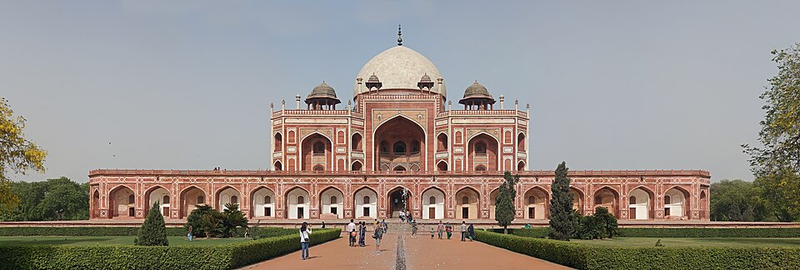
It introduced the classic charbagh layout and double-dome architecture to India.
Asked in SSC CGL 2025
Practice (1)
Q312Read the below statements marked as Assertion (A) and Reason (R). Mark the correct options:<br>Assertion (A): Humayun’s Tomb was the first major Mughal garden tomb and directly inspired the design of the Taj Mahal.<br>Reason (R): It introduced the charbagh garden layout and double-domed mausoleum style that became characteristic of later Mughal architecture.
Show answer
Correct answer: A — Both A and R are true, and R is the correct explanation of A.
Answer: (A)A is true. UNESCO calls Humayun's Tomb the first garden-tomb on the Indian subcontinent, and says it inspired innovations that culminated in the Taj Mahal.
R is true and explains A. The tomb stands at the centre of a charbagh, a four-part walled garden, under a marble-clad double dome. The Taj carries both features, so R names the link between the two → option (a).
Why the others are wrong(b)Both A and R are true, but R is not the correct explanation of A.: Both statements are true, but this option denies the link. R names the charbagh and the double dome, the features the Taj Mahal takes up, so R does explain A.(c)A is true, but R is false.: R is not false. The tomb stands in a charbagh of four quadrants divided by walkways and water channels, under a 42.5 m double dome clad in marble.(d)A is false, but R is true: A is not false. UNESCO calls the tomb the first garden-tomb on the subcontinent and traces the innovations it inspired to the Taj Mahal. -
313
The chronological order of early Delhi Sultanate rulers is Aibak, Iltutmish, Razia, and Balban.
Qutb al-Din Aibak founded the Slave Dynasty in 1206 AD.
Asked in SSC CGL 2025 (15 Sep, Shift 1)
Practice (1)
Q313Arrange the following rulers of the Delhi Sultanate in the correct chronological order of their reigns, starting from the earliest:<br>1.Razia Sultan<br>2.Ghiyas ud din Balban<br>3.Qutb al-Din Aibak<br>4.Iltutmish
Show answer
Correct answer: A — 3 - 4 - 1 - 2
Answer: (A)Place each ruler on the timeline.
Qutb al-Din Aibak (3): 1206–1210
Iltutmish (4): ruled until 1236
Razia Sultan (1): 1236–1240
Ghiyas ud din Balban (2): 1266–1287Earliest first, that is 3 - 4 - 1 - 2 → option (a).
Why the others are wrong(b)4 - 3 - 1 - 2: Iltutmish cannot come first. Aibak founded the line in 1206, and Iltutmish, once his slave and later his son-in-law, took the throne only after Aibak's death.(c)3 - 1 - 4 - 2: Razia before her own father is impossible. She became Sultan in 1236, after Iltutmish's death, so 1 cannot sit between 3 and 4.(d)1 - 3 - 4 - 2: Razia cannot open the list. Her reign, 1236–1240, came after both Aibak's and that of her father, Iltutmish. -
314
Mughal architecture is a unique Indo-Islamic aesthetic blending Persian, Islamic, Turkish, and Indian styles, using red sandstone and white marble.
Taj Mahal combines white Makrana marble with surrounding red sandstone structures.
Asked in SSC CGL 2025
Practice (1)
Q314Consider the following statements about Mughal architecture:<br>1.Mughal architecture is known for blending Persian, Islamic, Turkish, and Indian styles to create a unique Indo-Islamic aesthetic.<br>2.Red sandstone and white marble were the two most commonly used materials in Mughal construction.
Show answer
Correct answer: C — Both 1 and 2 are correct
Answer: (C)Statement 1 matches NCERT's Class XI text An Introduction to Indian Art: despite the obvious Saracenic, Persian and Turkish influences, it says, Indo-Islamic buildings were heavily shaped by Indian architectural and decorative forms.
Statement 2 matches the landmark buildings. At the Taj Mahal, NCERT notes, the white Makrana marble tomb is contrasted with the red sandstone of the surrounding structures. Both hold: option (c).
Why the others are wrong(a)Only 1 is correct: This rejects statement 2, but red sandstone and white marble are the pairing NCERT itself describes at the Taj Mahal, where the marble tomb stands against red sandstone structures.(b)Only 2 is correct: This rejects statement 1, yet NCERT describes Indo-Islamic buildings as carrying Saracenic, Persian and Turkish influences while heavily shaped by Indian forms: the blend the statement names.(d)Neither 1 nor 2 is correct: Both statements track NCERT's account, the blend of influences in statement 1 and the sandstone-marble pairing in statement 2, so rejecting both leaves nothing standing. -
315
The double-storeyed gates of Purana Qila are primarily built with red sandstone and decorated with marble inlay and blue tiles.
The three gates are Bara Darwaza, Humayun Gate, and Talaqi Gate.
Asked in SSC CGL 2025 (16 Sep, Shift 2)
Practice (1)
Q315What material were the double-storeyed gates of Purana Qila primarily built with?
Show answer
Correct answer: B — Red sandstone
Answer: (B)Purana Qila's three gates, the Bara Darwaza, the Humayun Gate and the Talaqi Gate, are double-storeyed sandstone structures, each flanked by two huge semicircular bastion towers.
So the building material is red sandstone. Marble and tiles are on the gates too, but as decoration: white and coloured marble inlay and blue tiles set into the stone.
Why the others are wrong(a)Marble: Marble appears on the gates as inlay, white and coloured marble set into the stone for decoration. The gates themselves are built of sandstone.(c)Glazed tiles: Glazed tiles are surface ornament here: blue tiles decorate the gates. A double-storeyed gateway flanked by bastions is not built of tiles, and its fabric is sandstone.(d)Rubble: Rubble means rough, undressed stone laid in mortar. The gates are recorded as sandstone structures, decorated with marble and tiles. -
316
The outer gate of Golconda Fort, the Fateh Darwaza, is studded with giant spikes to protect it from war elephants.
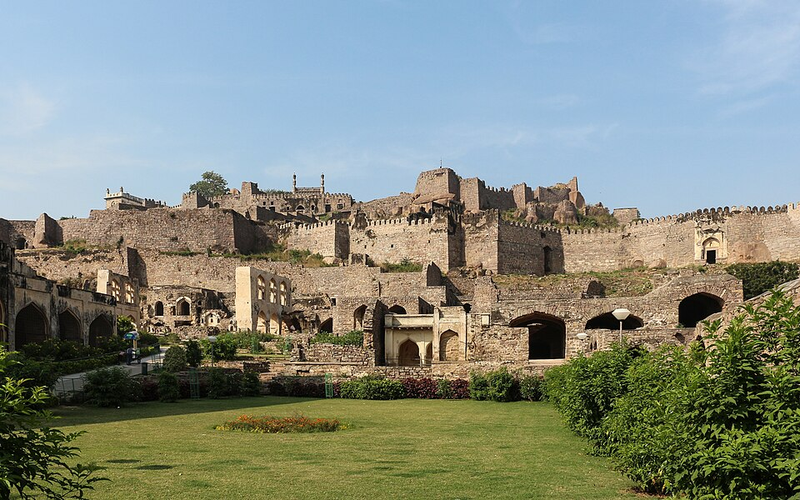
The spikes prevented war elephants from charging and battering down the doors.
Asked in SSC CGL 2025
Practice (1)
Q316What feature was used on Golconda Fort’s gates to protect it during attacks involving war elephants?
Show answer
Correct answer: C — Steel spikes on doors
Answer: (C)Golconda's outer gate, the Fateh Darwaza (Victory Gate), is studded with giant spikes so that war elephants could not batter it down.
The spikes kept an elephant's head off the door, and that is the defence the key names: spikes on the doors → option (c).
Why the others are wrong(a)Deep moat with water channels: A moat guards the approach to a fort, not the door itself. The question asks what was fixed on the gates, and at Golconda that was spikes.(b)Electrified spikes: Electrified spikes are an anachronism. The gate is named for Aurangzeb's army marching in through it, a 17th-century event, long before electricity could power a defence.(d)Stone cannon towers: Cannon towers would stand on the walls, not on the gates the stem asks about. The defence against elephants was fixed to the doors themselves. -
317
Key rulers of medieval India include Qutbuddin Aybak (1206–1210) and Alauddin Khalji (1296–1316).
Prithviraj Chauhan reigned from 1175 to 1192 and Muhammad Tughluq from 1324 to 1351.
Asked in SSC CGL 2025 (16 Sep, Shift 1)
Practice (1)
Q317Match each ruler listed in Column A with their respective period of reign given in Column B:<br><table><tr><td>Column A: Ruler</td><td>Column B: Reign Period</td></tr><tr><td>A. Qutbuddin Aybak</td><td>1. 1175–1192</td></tr><tr><td>B. Prithviraj Chauhan</td><td>2. 1206–1210</td></tr><tr><td>C. Alauddin Khalji</td><td>3. 1296–1316</td></tr><tr><td>D. Muhammad Tughluq</td><td>4. 1324–1351</td></tr></table>
Show answer
Correct answer: D — A → 2, B → 1, C → 3, D → 4
Answer: (D)Anchor each ruler by the year his reign ended.
Aybak (A) died in 1210 → 2 (1206–1210)
Prithviraj (B) lost the Second Battle of Tarain, 1192 → 1 (1175–1192)
Alauddin Khalji (C) died in 1316 → 3 (1296–1316)That leaves Muhammad Tughluq (D) → 4 (1324–1351).
Why the others are wrong(a)A → 1, B → 2, C → 3, D → 4: A → 1 puts Aybak on the throne in 1175, three decades before the Delhi Sultanate began. His reign was 1206–1210, and 1175–1192 is Prithviraj's.(b)A → 4, B → 1, C → 3, D → 2: A → 4 swaps Aybak and Muhammad Tughluq. Aybak ruled 1206–1210, more than a century before Tughluq's 1324–1351, so D → 2 is just as wrong.(c)A → 3, B → 1, C → 2, D → 4: A → 3 gives Aybak Alauddin Khalji's 1296–1316, and C → 2 gives Alauddin Aybak's. Aybak died in 1210, long before the Khaljis held Delhi.
A → 2, B → 1, C → 3, D → 4 → option (d). -
318
Akbar’s Tomb at Sikandra deviates from the typical square hasht-bihisht layout, rising as a stepped pyramid of five storeys.
The topmost storeys are made of white marble without a central dome.
Asked in SSC CGL 2025 (17 Sep, Shift 1)
Practice (1)
Q318Which of the following Mughal tombs deviates from the typical square 'hasht-bihisht' (eight-part) layout?
Show answer
Correct answer: B — Akbar’s Tomb (Sikandra)
Answer: (B)A hasht-bihisht ('eight paradises') plan sets a central chamber among eight rooms, four on the sides and four at the corners.
Akbar's tomb at Sikandra breaks from it. The main building rises as a stepped pyramid of five storeys, four of red sandstone and an open white-marble storey on top holding the cenotaph, with no central dome.
It was completed under Jahangir around 1613: option (b).
Why the others are wrong(a)Humayun’s Tomb: Humayun's Tomb is the model the question measures against. Its central chamber ringed by eight rooms is the classic hasht-bihisht plan.(c)Itimad-ud-Daulah: Itimad-ud-Daulah has no dome, but its plan keeps the grid: a central hall with four oblong side rooms and four square corner rooms.(d)Safdarjung’s Tomb: Safdarjung's Tomb (1754) follows the Humayun's Tomb model: eight rooms surround the square central chamber under its dome. -
319
Coins minted in Delhi under the Tomaras and Chauhans, known as 'dehliwal', had a wide circulation.
Delhi became an important commercial centre during the early medieval period under the Tomaras.
Asked in SSC CGL 2025 (17 Sep, Shift 1)
Practice (1)
Q319Which of the following dynasties minted the "Dehliwal" coins in Delhi?
Show answer
Correct answer: B — The Tomaras
Answer: (B)NCERT's Class 7 history text says Delhi became an important commercial centre under the Tomaras and the Chauhans, and that coins minted there, called dehliwal, had a wide circulation.
The Tomaras are the dynasty from that account on this list: option (b). Their successors, the Chauhans of Ajmer, are not offered.
Why the others are wrong(a)The Gahadavalas: The Gahadavalas ruled from Kannauj and Varanasi, not Delhi. NCERT ties the dehliwal to Delhi's own rulers, the Tomaras and the Chauhans.(c)The Khaljis: The Khaljis ruled the Delhi Sultanate from 1290 to 1320, well after Delhi's Tomara and Chauhan phase, when the dehliwal circulated.(d)The Lodis: The Lodis were the last Delhi Sultans (1451–1526), centuries after the dehliwal was minted under the Tomaras and Chauhans. -
320
Major early medieval dynasties include the Gurjara-Pratiharas in Rajasthan and Gujarat, Rashtrakutas in the Deccan, Palas in Bengal, and Cholas in Tamil Nadu.
These dynasties fought constantly for supremacy over the fertile region of Kannauj.
Asked in SSC CGL 2025 (16 Sep, Shift 3)
Practice (1)
Q320Match the dynasties listed in Column A with the regions they primarily ruled over, as given in Column B:<br><table><tr><td>Column A: Dynasty</td><td>Column B: Region</td></tr><tr><td>A. Gurjara-Pratiharas</td><td>1. Bengal</td></tr><tr><td>B. Rashtrakutas</td><td>2. Tamil Nadu</td></tr><tr><td>C. Palas</td><td>3. Gujarat and Rajasthan</td></tr><tr><td>D. Cholas</td><td>4. Western Deccan</td></tr></table>
Show answer
Correct answer: A — A → 3, B → 4, C → 1, D → 2
Answer: (A)Match each dynasty to its home region.
Gurjara-Pratiharas rose in Rajasthan and Gujarat before ruling from Kannauj → A-3.
Rashtrakutas ruled the Deccan from Manyakheta, in Karnataka → B-4.
Palas held Bengal and Bihar → C-1.
Cholas rose in the Kaveri valley of Tamil Nadu → D-2.A-3, B-4, C-1, D-2 → option (a).
Why the others are wrong(b)A → 4, B → 3, C → 1, D → 2: It swaps the first two. The Rashtrakutas were the Deccan power, with their capital at Manyakheta, and the Pratiharas the dynasty of Rajasthan and Gujarat.(c)A → 2, B → 3, C → 1, D → 4: Only the Palas-Bengal pair is right. It sends the Pratiharas to Tamil Nadu and the Cholas to the Deccan, but the Cholas' heartland was the Kaveri valley.(d)A → 4, B → 3, C → 2, D → 1: Every pair is wrong. It puts the Palas in Tamil Nadu and the Cholas in Bengal, and swaps the Pratiharas and the Rashtrakutas as well.