
🪐 Universe, Earth & Atmosphere ब्रह्मांड, पृथ्वी व वायुमंडल
77 exam-ready facts · 77 MCQs
-
41
The Moon features an extremely thin, fragile layer of gases surrounding it known as the lunar exosphere.
Because of this weak atmosphere, the Moon cannot retain heat or protect itself from meteoroids.
Asked in SSC CGL 2020 (4 Mar, Shift 1)
Practice (1)
Q41Planetary scientists call the thin gaseous envelope around the Moon as the _______.
Show answer
Correct answer: A — lunar exosphere
Answer: (A)
The Moon's thin gaseous envelope is called the lunar exosphere. -
42
Venus is the second planet from the Sun, positioned directly between Mercury and Earth.
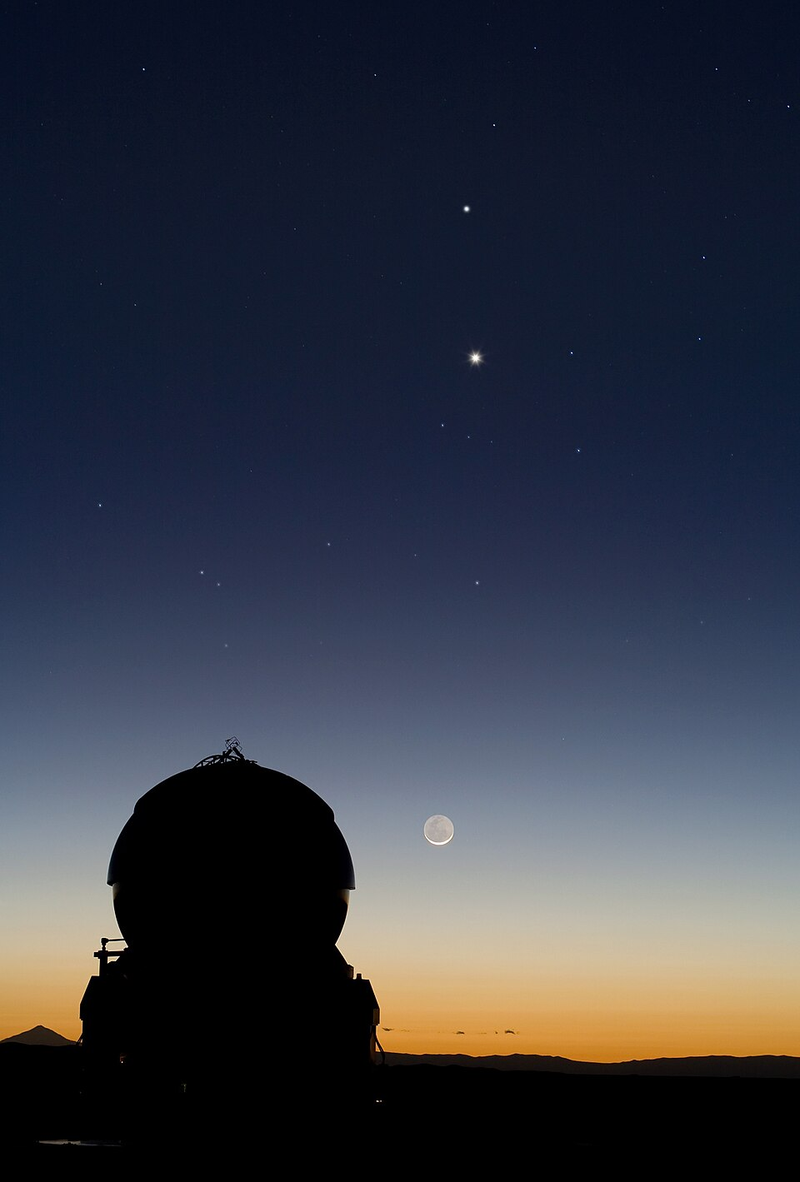
Venus is often called Earth's twin due to its similar size and mass.
Asked in SSC CGL 2019
Practice (1)
Q42In the sequence of planets in the Solar system, which planet comes in between Mercury and Earth?
Show answer
Correct answer: B — Venus
Answer: (B)
The order is Mercury, Venus, Earth: Venus lies between them. -
43
Water vapour is consistently the most abundant gas released during volcanic eruptions worldwide.
Volcanic gases also include significant amounts of carbon dioxide and sulfur dioxide.
Asked in SSC CGL 2020 (6 Mar, Shift 1)
Practice (1)
Q43Which of the following gases is consistently seen to be most abundant in a volcanic eruption?
Show answer
Correct answer: A — Water vapour
Answer: (A)
Water vapour is the most abundant volcanic gas, followed by CO₂ and SO₂. -
44
Earth completes one full 360-degree rotation on its axis approximately every 24 hours, translating to 15 degrees per hour.
This rotation rate is responsible for the cycle of day and night across the globe.
Asked in SSC CGL 2020 (6 Mar, Shift 2)
Practice (1)
Q44How many degrees does the Earth rotate about its own axis in one hour?
Show answer
Correct answer: A — 15
Answer: (A)
360° in 24 h = 15° per hour. -
45
The crust is the outermost solid layer of the Earth, accounting for less than 1 percent of Earth's total mass.
It forms the upper part of the lithosphere and supports all terrestrial life.
Asked in SSC CGL 2020 (7 Mar, Shift 3)
Practice (1)
Q45Which of the following is the outermost solid part of the Earth?
Show answer
Correct answer: B — Crust
Answer: (B)
The crust is the outermost solid layer of the Earth. -
46
Seismic waves are elastic waves generated by impulses such as earthquakes or explosions that travel through the Earth.
Seismographs are instruments used to record these waves and study Earth's interior.
Asked in SSC CGL 2021 (13 Aug, Shift 2)
Practice (1)
Q46An elastic wave generated by an impulse such as an earthquake or an explosion is called ______.
Show answer
Correct answer: D — seismic wave
Answer: (D)
Seismic waves are elastic waves generated by earthquakes or explosions travelling through the earth. -
47
Endogenic forces originate inside the Earth, causing phenomena like earthquakes, volcanic eruptions, and mountain building.
Sea waves are generated by wind action, making them an exogenic force.
Asked in SSC CGL 2021 (13 Aug, Shift 3)
Practice (1)
Q47Which of the following is NOT an outcome of endogenic forces?
Show answer
Correct answer: B — Sea waves
Answer: (B)
Endogenic forces originate inside the earth: earthquakes, volcanic eruptions (and associated landslides). Sea waves are caused by wind, an exogenic force. Official key: sea waves. -
48
Collision at convergent plate boundaries folds and uplifts the crust, resulting in mountain building processes like the formation of the Himalayas.
Compressional forces dominate at these boundaries, creating massive fold mountain ranges.
Asked in SSC CGL 2021 (16 Aug, Shift 1)
Practice (1)
Q48______ is created by the collision of convergent plate boundaries.
Show answer
Correct answer: D — Mountain building
Answer: (D)
Collision at convergent plate boundaries folds and uplifts the crust, building mountains (e.g. the Himalayas). -
49
Almost 98% of Earth's crust is made up of eight primary elements, excluding carbon, which is not among them.
Oxygen, silicon, and aluminum are the most abundant elements in the crust.
Asked in SSC CGL 2021 (17 Aug, Shift 1)
Practice (1)
Q49Almost 98% of Earth's crust is made up of eight elements. Which of the following does NOT figure among these elements?
Show answer
Correct answer: A — Carbon
Answer: (A)
The eight main crustal elements are O, Si, Al, Fe, Ca, Na, K and Mg. Carbon is not among them. -
50
Convergent boundaries occur when tectonic plates collide and one dense plate is pushed under the other in a process called subduction.
This subduction often leads to intense seismic activity and volcanic arcs.
Asked in SSC CGL 2021 (23 Aug, Shift 1)
Practice (1)
Q50______ boundaries occur when plates collide and one plate is pushed under the other.
Show answer
Correct answer: A — Convergent
Answer: (A)
At convergent boundaries plates collide and one is subducted beneath the other. -
51
Continental crust is predominantly composed of lower density felsic rocks, such as granite and andesite.
It is significantly thicker and less dense than oceanic crust.
Asked in SSC CGL 2021 (23 Aug, Shift 2)
Practice (1)
Q51______ is made of lower density felsic rocks, such as andesite and granite.
Show answer
Correct answer: A — Continental crust
Answer: (A)
Continental crust is made of lighter felsic rocks like granite and andesite. -
52
The constellation known as the Great Bear, or Saptarishi, is prominently made up of seven brightest stars.
It is easily recognizable in the night sky and helps locate the Pole Star.
Asked in SSC CGL 2021 (24 Aug, Shift 1)
Practice (1)
Q52How many brightest stars is the constellation called the Great Bear made up of?
Show answer
Correct answer: C — Seven
Answer: (C)
The Great Bear (Saptarishi) has seven bright stars.
Hence, the answer is option (C). -
53
Plate tectonics is the scientific theory describing large-scale motion of Earth's lithosphere over the asthenosphere.
Convection currents in the mantle drive the movement of these tectonic plates.
Asked in SSC CGL 2021 (24 Aug, Shift 1)
Practice (1)
Q53Through which of the following actions does the lithosphere move over the asthenosphere?
Show answer
Correct answer: B — Plate tectonics
Answer: (B)
Plate tectonics moves the lithosphere over the asthenosphere.
Hence, the answer is option (B). -
54
Ceres is a dwarf planet located in the main asteroid belt situated between the orbits of Mars and Jupiter.
It is the largest object in the asteroid belt and was the first dwarf planet to be visited by a spacecraft.
Asked in SSC CGL 2021
Practice (1)
Q54Which of the following dwarf planets lies in the main asteroid belt?
Show answer
Correct answer: C — Ceres
Answer: (C)
Ceres is the dwarf planet in the asteroid belt between Mars and Jupiter. -
55
The Van Allen radiation belts are giant zones of magnetically trapped, highly energetic charged particles surrounding Earth.
These belts protect the Earth's surface from dangerous solar wind radiation.
Asked in SSC CGL 2021
Practice (1)
Q55The ______ radiation belts are giant swaths of magnetically trapped highly energetic charged particles that surround Earth.
Show answer
Correct answer: A — Van Allen
Answer: (A)
The Van Allen belts are zones of charged particles trapped by Earth’s magnetic field. -
56
The theory of plate tectonics proposes that the Earth's lithosphere is divided into 7 major plates and several minor plates.
These plates constantly interact with each other, causing earthquakes and forming mountains.
Asked in SSC CGL 2022
Practice (1)
Q56The theory of plate tectonics proposes that the earth’s lithosphere is divided into ______ major and some minor plates.
Show answer
Correct answer: A — 7
Answer: (A)
The lithosphere is divided into 7 major plates and several minor plates. -
57
The Earth's crust makes up less than 1 percent of the planet's total mass by volume and weight.
Despite its small mass, it is the crucial layer that sustains all human activity.
Asked in SSC CGL 2022
Practice (1)
Q57The crust is the Earth's outermost layer that is less than _______ percent of Earth by mass, with oceanic crust and continental crust often consisting of more felsic rocks.
Show answer
Correct answer: B — 1
Answer: (B)
The crust makes up less than 1% of Earth’s mass, though it is the layer we live on. -
58
The asthenosphere is the highly viscous, mechanically weak, and ductile upper portion of the Earth's mantle.
It lies just below the lithosphere and facilitates tectonic plate movement.
Asked in SSC CGL 2022
Practice (1)
Q58The upper portion of the mantle is called ____.
Show answer
Correct answer: D — asthenosphere
Answer: (D)
As per the official key, the upper part of the mantle is the asthenosphere, a weak, partly molten zone on which the lithospheric plates move. -
59
The average thickness of the Earth's continental crust is approximately 30 kilometers.
In contrast, the oceanic crust is much thinner, averaging around 5 kilometers in thickness.
Asked in SSC CGL 2022
Practice (1)
Q59What is the average thickness of the continental crust of earth?
Show answer
Correct answer: C — 30 km
Answer: (C)
The continental crust is about 30 km thick on average (the oceanic crust about 5 km). -
60
James Hutton is widely recognized as the 'Father of Modern Geology' for his foundational contributions to the field.
He formulated the principle of uniformitarianism, changing how we understand Earth's age.
Asked in SSC CGL 2022
Practice (1)
Q60Who is known as the Father of Geology?
Show answer
Correct answer: C — James Hutton
Answer: (C)
James Hutton is called the Father of (modern) Geology.