
🏺 History इतिहास
1077 exam-ready facts · 1001 MCQs
-
781
While historians use the term Vijayanagara Empire, its contemporaries referred to it as Karnataka Samrajyamu.
This native designation reflects the linguistic and regional roots of the southern empire.
Asked in SSC CGL 2023 (25 Jul, Shift 3)
Practice (1)
Q747While historians use the term Vijayanagara Empire and contemporaries of this empire described it as the_______________.
Show answer
Correct answer: B — Karnataka Samrajyamu
Answer: (B)
Contemporaries called the Vijayanagara Empire the Karnataka Samrajyamu. -
782
Dadabhai Naoroji formulated his famous 'Drain Theory' critiquing British economic exploitation in his 1901 book 'Poverty and Un-British Rule in India'.
The book explained how Britain was draining wealth away from India.
Asked in SSC CGL 2022
Practice (1)
Q748Dadabhai Naoroji offered a scathing criticism of the economic impact of British rule through his book entitled ‘__________’.
Show answer
Correct answer: C — Poverty and Un-British Rule in India
Answer: (C)
Dadabhai Naoroji wrote "Poverty and Un-British Rule in India" (1901), setting out the drain theory. -
783
The Quwwat-ul-Islam mosque, commissioned by Qutb-ud-din Aibak, is located inside the Qutb complex in Delhi.
It is widely considered to be the oldest surviving mosque built by the Delhi Sultans.
Asked in SSC CGL 2023 (27 Jul, Shift 2)
Practice (1)
Q749In which of the following cities is the Quwwat ul-Islam mosque situated?
Show answer
Correct answer: D — Delhi
Answer: (D)The Quwwat-ul-Islam mosque was commissioned by Qutb-ud-din Aibak, the founder of the Delhi Sultanate, in the late twelfth century. It is located within the Qutb complex in Delhi.
Hence, the correct option is (4).
-
784
The Indian Arms Act of 1878 made it illegal for Indians to keep or bear arms without obtaining a valid government license.
This act was introduced during the viceroyalty of Lord Lytton.
Asked in SSC CGL 2022
Practice (1)
Q750The arms Act which disallowed Indians from having arms was passed in ______.
Show answer
Correct answer: A — 1878
Answer: (A)
The Indian Arms Act (1878) barred Indians from keeping arms without a licence. -
785
Basavanna was a 12th-century South Indian philosopher and Bhakti saint who initially served as a minister under the Kalachuris.
He founded the Lingayat sect and promoted social equality through vachanas.
Asked in SSC CGL 2023 (27 Jul, Shift 3)
Practice (1)
Q751Name the Bhakti Saint from South India who was initially a Jaina and a minister in the court of a Chalukya king in the twelfth century.
Show answer
Correct answer: B — Basavanna
Answer: (B)The Bhakti Saint from South India who was initially a Jaina and a minister in the court of a Chalukya king in the twelfth century is Basavanna (Option 2).
Basavanna was a prominent saint and social reformer during the 12th century. He is renowned for his revolutionary ideas and contributions to the Bhakti movement in Karnataka. Originally serving as a minister in the court of King Bijjala I of the Kalachuri dynasty, Basavanna later renounced his ministerial role and Jain faith to become a proponent of the Lingayatism sect within Hinduism. Basavanna's teachings emphasized equality, social justice, and devotion to Lord Shiva, rejecting ritualistic practices and the caste system. His literary works in the form of Vachanas remain significant in Kannada literature and devotional practices.
Thus, Basavanna played a crucial role in shaping the cultural and spiritual landscape of South India during his time.
-
786
The patriotic couplet 'Sarfaroshi ki tamanna ab hamare dil mein hai' was written by Bismil Azimabadi and famously chanted by Ram Prasad Bismil.
It became a rallying cry for freedom fighters during the Indian independence movement.
Asked in SSC CGL 2022
Practice (1)
Q752Who said the following words? “Sarfaroshi ki tamanna ab hamare dil me hai, dekhna hai zor kitna baazu-e-qaatil me hai”
Show answer
Correct answer: A — Ramprasad Bismil
Answer: (A)
"Sarfaroshi ki tamanna" is associated with Ram Prasad Bismil (written by Bismil Azimabadi). -
787
The Badshah Nama is the official historical chronicle documenting the reign of Mughal Emperor Shah Jahan.
It was authored in Persian by the court historian Abdul Hamid Lahori.
Asked in SSC CGL 2023
Practice (1)
Q753Who among the following has written the 'Badshah Nama'?
Show answer
Correct answer: B — Abdul Hamid Lahori
Answer: (B)
The correct answer is Abdul Hamid Lahori.
The 'Badshah Nama' (also spelled Padshahnama) is the official chronicle of the reign of Mughal Emperor Shah Jahan, written in Persian by Abdul Hamid Lahori, a court historian patronised by the emperor.
It covers the first two decades of Shah Jahan's rule and is celebrated both as a historical record and for its lavishly illustrated imperial manuscripts.
Note on the other options:
- Babur wrote the Baburnama (Tuzk-i-Baburi), his own autobiography in Chagatai Turkic.
- Inayat Khan authored the Shah Jahan Nama, a separate abridged history of Shah Jahan's reign.
- Abul Fazl wrote the Akbarnama and Ain-i-Akbari, the official chronicles of Emperor Akbar's reign. -
788
The inaugural session of the Indian National Congress took place in Bombay in December 1885 under the presidency of W.C. Bonnerjee.
It was attended by 72 delegates from across the country.
Asked in SSC CGL 2022
Practice (1)
Q754The first session of Indian National congress was held at ______.
Show answer
Correct answer: A — Bombay
Answer: (A)
The first INC session was held in Bombay in December 1885 under W.C. Bonnerjee. -
789
Mahendravarman I was a prominent Pallava monarch known for his patronage of rock-cut temple architecture and arts.
He was also a playwright and authored the satirical Sanskrit drama Mattavilasa Prahasana.
Asked in SSC CGL 2024 (9 Sep, Shift 1)
Practice (1)
Q755Mahendravarman I was the ruler of which of the following dynasties?
Show answer
Correct answer: A — Pallava
Answer: (A)
Mahendravarman I (c. 600–630 CE) was a Pallava king. -
790
India's maiden passenger train journey occurred on 16 April 1853, running between Bori Bunder in Bombay and Thane.
The train covered a distance of 34 kilometers with fourteen carriages.
Asked in SSC CGL 2022
Practice (1)
Q756In which of the following years was the first train run in India?
Show answer
Correct answer: A — 1853
Answer: (A)
India's first passenger train ran from Bori Bunder (Bombay) to Thane on 16 April 1853. -
791
Malik Kafur led Alauddin Khilji’s successful military expedition against Devagiri in the Deccan region during 1307-08.
This campaign successfully defeated King Ramachandra and established Khilji influence in the south.
Asked in SSC CGL 2024 (9 Sep, Shift 2)
Practice (1)
Q757The first southern campaign of Alauddin Khilji in 1307-08 AD was led to which of the following regions?
Show answer
Correct answer: D — Devagiri
Answer: (D)
Malik Kafur's first southern campaign (1307–08) was against Ramachandra of Devagiri. -
792
Queen Elizabeth I granted a royal charter to the English East India Company on December 31, 1600, granting trade privileges in the East.
This charter provided the company with a monopoly on trade east of the Cape of Good Hope.
Asked in SSC CGL 2022
Practice (1)
Q758In 1600, the East India company acquired a charter from which ruler?
Show answer
Correct answer: B — Queen Elizabeth-I
Answer: (B)
The East India Company received its royal charter from Queen Elizabeth I on 31 December 1600. -
793
Siraj-ud-Daulah ascended the throne as the Nawab of Bengal in 1756, succeeding his maternal grandfather Alivardi Khan.
His reign as Nawab was cut short following his defeat at the Battle of Plassey.
Asked in SSC CGL 2022
Practice (1)
Q759Who became the Nawab of Bengal in 1756 after the death of Alivardi Khan?
Show answer
Correct answer: A — Siraj Ud Daulah
Answer: (A)
Siraj-ud-Daulah succeeded his grandfather Alivardi Khan as Nawab of Bengal in 1756. -
794
Mahabalipuram developed as a major architectural hub featuring monolithic rathas under the Pallava dynasty.
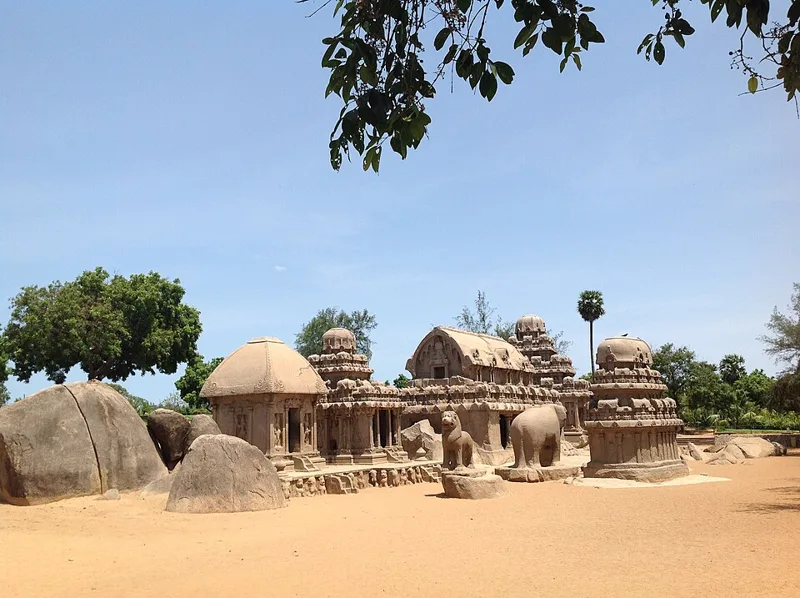
The famous Shore Temple here is a UNESCO World Heritage site reflecting early Dravidian style.
Asked in SSC CGL 2024
Practice (1)
Q760Mahabalipuram emerged as an important centre of temple architecture under which of the following kingdoms of south India?
Show answer
Correct answer: A — Pallava
Answer: (A)
Mahabalipuram’s rathas and Shore Temple were built under the Pallavas. -
795
Sultan Ghiyas-ud-din Balban reorganized the military department known as Diwan-i-Arz to secure the empire.
This department played a crucial role in maintaining internal security and defending against invasions.
Asked in SSC CGL 2024 (10 Sep, Shift 3)
Practice (1)
Q761Which of the following departments of Delhi Sultanate was reorganized by Balban?
Show answer
Correct answer: B — Diwan-i-Arz
Answer: (B)
Balban reorganised the military department, Diwan-i-Arz. -
796
Jonathan Duncan founded the Sanskrit College at Banaras in 1791 to promote the study of Hindu laws, literature, and philosophy.
The institution played a crucial role in oriental learning under British administration.
Asked in SSC CGL 2022
Practice (1)
Q762Which college was established in Banaras in 1791?
Show answer
Correct answer: D — Sanskrit College
Answer: (D)
Note: The official key marks Hindu College, but the college founded at Banaras in 1791 by Jonathan Duncan was the Sanskrit College.
Jonathan Duncan founded the Sanskrit College at Banaras (Varanasi) in 1791 to study Hindu law and philosophy. -
797
The Santhal rebellion of 1855-56 was a major tribal uprising against British colonial rule and oppressive landlords, spearheaded by Sidhu and Kanhu Murmu.
The Santhals fought bravely using traditional weapons against modern firearms.
Asked in SSC CGL 2022
Practice (1)
Q763Which of the following revolts was led by Kanhu and Sidhu?
Show answer
Correct answer: D — Santhal Revolt
Answer: (D)
The Santhal rebellion (1855-56) was led by Sidhu and Kanhu Murmu. -
798
Tansen was a legendary Hindustani classical musician and one of the prized Navratnas in Emperor Akbar's court.
He made immense contributions to North Indian classical music and invented several new ragas.
Asked in SSC CGL 2024 (11 Sep, Shift 1)
Practice (1)
Q764Who among the following was one of the Navratnas of Akbar?
Show answer
Correct answer: D — Tansen
Answer: (D)
Tansen, the musician, was one of Akbar’s Navratnas. -
799
Several important historical Persian chronicles document the political and cultural developments of the Delhi Sultanate.
These texts serve as primary sources for historians studying medieval Indian history.
Asked in SSC CGL 2024 (11 Sep, Shift 1)
Practice (1)
Q765Match the following books with their respective authors.<br><table border='1'><tr><th>Book</th><th>Author</th></tr><tr><td>a) Tajul Ma’asir</td><td>i) Yahya bin Ahmad Sirhindi</td></tr><tr><td>b) Khazain-ul Futuh</td><td>ii) Hasan Nizami</td></tr><tr><td>c) Tarikh-i-Firuzshahi</td><td>iii) Ziauddin Barani</td></tr><tr><td>d) Tarikh-i-Mubarakshahi</td><td>iv) Amir Khusrav</td></tr></table>
Show answer
Correct answer: C — a-ii; b-iv; c-iii; d-i
Answer: (C)
Tajul Ma’asir – Hasan Nizami; Khazain-ul Futuh – Amir Khusrau; Tarikh-i-Firuzshahi – Ziauddin Barani; Tarikh-i-Mubarakshahi – Yahya bin Ahmad Sirhindi. -
800
The Government of India Act 1858 transferred the administration and governance of India directly from the East India Company to the British Crown.
This change followed the widespread revolt of 1857.
Asked in SSC CGL 2022
Practice (1)
Q766The British Parliament transferred the powers of the East India company to the British crown in ______.
Show answer
Correct answer: B — 1858
Answer: (B)
The Government of India Act 1858 transferred the Company’s powers to the Crown.