
🕌 Medieval India मध्यकालीन भारत
340 exam-ready facts · 339 MCQs
-
141
The Council of Ministers assisting Chhatrapati Shivaji Maharaj was known as the Ashta Pradhan.
Each of the eight ministers held specific administrative responsibilities in the state.
Asked in SSC CGL 2020 (7 Mar, Shift 1)
Practice (1)
Q141The Council of Ministers during the time of Shivaji Maharaj was known as:
Show answer
Correct answer: A — Ashta Pradhan
Answer: (A)
Shivaji's council of eight ministers was the Ashta Pradhan. -
142
Fatehabad was founded in the 14th century by Firoz Shah Tughlaq, who named it after his son Fateh Khan.
He established several new towns and irrigation canals during his reign.
Asked in SSC CGL 2020 (9 Mar, Shift 1)
Practice (1)
Q142Fatehabad district derives its name from the eponymous headquarters town founded by ______ in the 14th century, who named it after his son Fateh Khan.
Show answer
Correct answer: A — Firoz Shah Tughlaq
Answer: (A)
Firoz Shah Tughlaq founded Fatehabad in the 14th century and named it after his son Fateh Khan. -
143
The historical text 'Ain-i-Akbari' was written by the Mughal court historian Abu'l Fazl.
It is the third volume of the Akbarnama and details the administration of Akbar.
Asked in SSC CGL 2020 (9 Mar, Shift 1)
Practice (1)
Q143Name the author of the book ‘Ain-i-Akbari’?
Show answer
Correct answer: C — Abu’l Fazl
Answer: (C)
Ain-i-Akbari is by Abu'l Fazl. -
144
Al-Biruni wrote 'Kitab-ul-Hind', providing an incisive description of early 11th-century India.
He traveled to India alongside Mahmud of Ghazni during his military campaigns.
Asked in SSC CGL 2021 (13 Aug, Shift 1)
Practice (1)
Q144Who among the following had written Kitab-ul-Hind that gave an incisive description of early 11th Century India?
Show answer
Correct answer: B — Al-Biruni
Answer: (B)
Al-Biruni, who came with Mahmud of Ghazni, wrote Kitab-ul-Hind (Tahqiq-i-Hind) in Arabic, describing India in the early 11th century. -
145
The Mughal empire was established by Babur in the year 1526.
This foundation was laid after Babur defeated Ibrahim Lodi at the First Battle of Panipat.
Asked in SSC CGL 2021 (13 Aug, Shift 2)
Practice (1)
Q145In which of the following years was the Mughal empire established by Babur?
Show answer
Correct answer: A — 1526
Answer: (A)
Babur founded the Mughal empire after defeating Ibrahim Lodi at the First Battle of Panipat in 1526. -
146
The Mysore Palace served as the official residence of the Wodeyar dynasty.
The Wodeyars ruled the Kingdom of Mysore for centuries.
Asked in SSC CGL 2021 (13 Aug, Shift 2)
Practice (1)
Q146The Mysore Palace was the residence of the ______.
Show answer
Correct answer: D — Wodeyars
Answer: (D)
Mysore Palace was the official residence of the Wodeyar dynasty, rulers of Mysore. -
147
The Konark Sun Temple in Odisha was built in the 12th century by Narasimha Deva I.
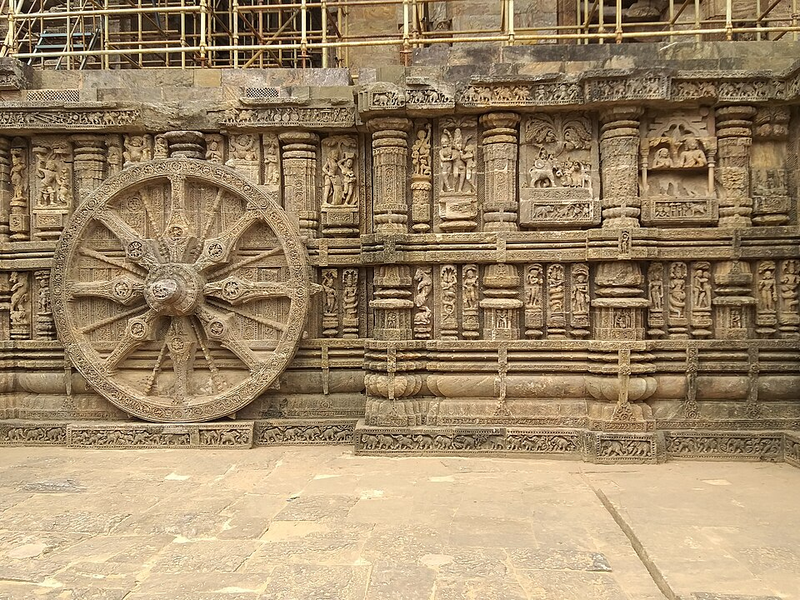
He belonged to the Eastern Ganga dynasty and constructed the temple as a chariot.
Asked in SSC CGL 2020
Practice (1)
Q147The Sun Temple of Odisha was built in the 12th Century AD by which of the following emperors?
Show answer
Correct answer: B — Narasimha Deva I
Answer: (B)
The Konark Sun Temple in Odisha was built by King Narasimha Deva I of the Eastern Ganga dynasty. -
148
The Telugu literary work 'Amuktamalyada' on statecraft was composed by Krishnadevaraya.
He was the famous ruler of the Vijayanagara Empire.
Asked in SSC CGL 2021 (16 Aug, Shift 1)
Practice (1)
Q148Which of the following is a work on statecraft written by Krishnadevaraya?
Show answer
Correct answer: B — Amuktamalyada
Answer: (B)
Amuktamalyada, a Telugu work by Krishnadevaraya, also discusses statecraft. -
149
In medieval Indo-Islamic architecture, 'Pishtaq' refers to a tall, projecting arched gateway.
It is a prominent feature used on the facades of grand monuments and mausoleums.
Asked in SSC CGL 2021 (16 Aug, Shift 1)
Practice (1)
Q149Which of the following is the meaning of ‘Pishtaq’ in the context of medieval Indo-Islamic architecture?
Show answer
Correct answer: A — Tall gateway
Answer: (A)
Pishtaq is the tall, projecting arched gateway or portal in Indo-Islamic architecture. -
150
The book 'Char Chaman' describing the Mughal nobility was written by Chandrabhan Brahman.
He served as a munshi during the reign of Emperor Shah Jahan.
Asked in SSC CGL 2021 (16 Aug, Shift 2)
Practice (1)
Q150Who among the following had written the book ‘Char Chaman’, during the reign of Shah Jahan, describing the Mughal nobility?
Show answer
Correct answer: A — Chandrabhan Brahman
Answer: (A)
"Char Chaman" was written by Chandrabhan Brahman, a munshi under Shah Jahan. -
151
Iltutmish organised his trusted nobles into a powerful group of forty known as Turkan-i-Chahalgani.
Later, Sultan Balban systematically broke the power of this noble group.
Asked in SSC CGL 2021 (16 Aug, Shift 2)
Practice (1)
Q151______ organised his trusted nobles into a group of forty known as Turkan-i-Chahalgani.
Show answer
Correct answer: C — Iltutmish
Answer: (C)
Iltutmish organised the Turkan-i-Chahalgani (group of forty nobles); Balban later broke their power. -
152
Sher Shah Suri’s efficient administration served as a model for Akbar when he consolidated the Mughal Empire.
Akbar adopted many of Sher Shah's revenue and administrative reforms.
Asked in SSC CGL 2021 (17 Aug, Shift 1)
Practice (1)
Q152Whose administration became a model that was followed by Akbar when he consolidated the Mughal Empire?
Show answer
Correct answer: D — Sher Shah Suri
Answer: (D)
Sher Shah Suri’s administration (revenue, coinage, roads) became the model for Akbar. -
153
Pushyabhuti founded the Pushyabhuti dynasty ruling from Thanesar, producing the ruler Harshavardhana.
The dynasty gained immense power and prominence during the 7th century AD.
Asked in SSC CGL 2021 (17 Aug, Shift 1)
Practice (1)
Q153Pushyabhuti, who ruled from Thaneswar, was the founder of ______ dynasty.
Show answer
Correct answer: C — Vardhana
Answer: (C)
Pushyabhuti founded the Pushyabhuti (Vardhana) dynasty of Thanesar; Harshavardhana was its famous ruler. -
154
Tarikh-i-Dilkusha was written by Bhimsen Saxena, a prominent Mughal-era historian.
He recorded important details of Aurangzeb's Deccan campaigns.
Asked in SSC CGL 2021 (17 Aug, Shift 3)
Practice (1)
Q154Who is the author of the book ‘Tarikh-i Dilkusha'?
Show answer
Correct answer: A — Bhimsen
Answer: (A)
Tarikh-i-Dilkusha was written by Bhimsen Saxena, a Mughal-era historian. -
155
The Sharqi dynasty ruled over the Jaunpur Sultanate from 1394 to 1479.
Jaunpur is often referred to as the Shiraz of the East.
Asked in SSC CGL 2021 (18 Aug, Shift 2)
Practice (1)
Q155The Sharqi dynasty ruled over ______.
Show answer
Correct answer: B — Jaunpur
Answer: (B)
The Sharqi dynasty ruled the Jaunpur Sultanate (1394–1479). -
156
Mughal emperor Aurangzeb assumed the title of Alamgir.
Alamgir translates to 'Conqueror of the World'.
Asked in SSC CGL 2021 (18 Aug, Shift 2)
Practice (1)
Q156Alamgir was the title of which Mughal emperor?
Show answer
Correct answer: D — Aurangzeb
Answer: (D)
Aurangzeb took the title Alamgir. -
157
Dantidurga was the founder of the Rashtrakuta dynasty.
He established his capital at Manyakheta.
Asked in SSC CGL 2021 (18 Aug, Shift 3)
Practice (1)
Q157Who among the following established the Rashtrakuta Kingdom?
Show answer
Correct answer: B — Dantidurga
Answer: (B)
Dantidurga founded the Rashtrakuta dynasty. -
158
Dara Shikoh translated fifty Upanishads into Persian under the title Sirr-i-Akbar in 1657.
He was the eldest son of Mughal Emperor Shah Jahan.
Asked in SSC CGL 2021 (17 Aug, Shift 2)
Practice (1)
Q158Which Mughal prince translated the Upanishads into Persian in 1657?
Show answer
Correct answer: A — Dara Shikoh
Answer: (A)
Dara Shikoh translated 50 Upanishads into Persian as Sirr-i-Akbar (1657). -
159
Razia Sultana was the first and only female ruler of the Delhi Sultanate.
She ruled from 1236 to 1240 AD.
Asked in SSC CGL 2021 (20 Aug, Shift 1)
Practice (1)
Q159Who was the first and last woman ruler of Delhi Sultanate?
Show answer
Correct answer: B — Razia Sultana
Answer: (B)
Razia Sultana was the first and only woman ruler of the Delhi Sultanate. -
160
The Virupaksha Temple is located in the Vijayanagara (formerly Ballari) district of Karnataka.
It is dedicated to Lord Shiva and is a UNESCO World Heritage site.
Asked in SSC CGL 2021 (20 Aug, Shift 3)
Practice (1)
Q160Virupaksha Temple is situated in which of the following districts of Karnataka?
Show answer
Correct answer: C — Ballari
Answer: (C)
Virupaksha Temple at Hampi was in Ballari district (now Vijayanagara).