
🗺️ Indian Geography भारत का भूगोल
154 exam-ready facts · 89 MCQs
-
61
Coniferous trees such as pine, deodar, and fir are found in the Himalayan state of Uttarakhand.
These cone-bearing trees thrive in cold climates at higher elevations.
Asked in SSC CGL 2022
Practice (1)
Q60In which of the following state of India, coniferous trees are found?
Show answer
Correct answer: A — Uttarakhand
Answer: (A)
Coniferous (montane) forests of pine, deodar and fir are found in the Himalayan state of Uttarakhand. -
62
Chir pine grows in mountain (Himalayan) forests, whereas Sundari is a mangrove tree, keekar a thorn-forest tree, and teak a deciduous tree.
Chir pine is a prominent conifer species found in the Himalayan mountain vegetation.
Asked in SSC CGL 2022
Practice (1)
Q61Which of the following is a tree found in Mountain vegetation?
Show answer
Correct answer: C — Chir
Answer: (C)
Chir pine grows in mountain (Himalayan) forests. Sundari is a mangrove tree, keekar a thorn-forest tree and teak a deciduous tree. -
63
A biome is a large ecological area defined by its climate, flora, and fauna, representing a set of similar ecosystems.
Biomes group ecosystems together based on distinct environmental conditions and vegetation types.
Asked in SSC CGL 2022
Practice (1)
Q62What is the set of ecosystem called?
Show answer
Correct answer: C — Biome
Answer: (C)
A biome is a large region made of similar ecosystems. -
64
Gorumara National Park is situated in the Dooars region of the Jalpaiguri district in northern West Bengal, famous for the great Indian one-horned rhinoceros.
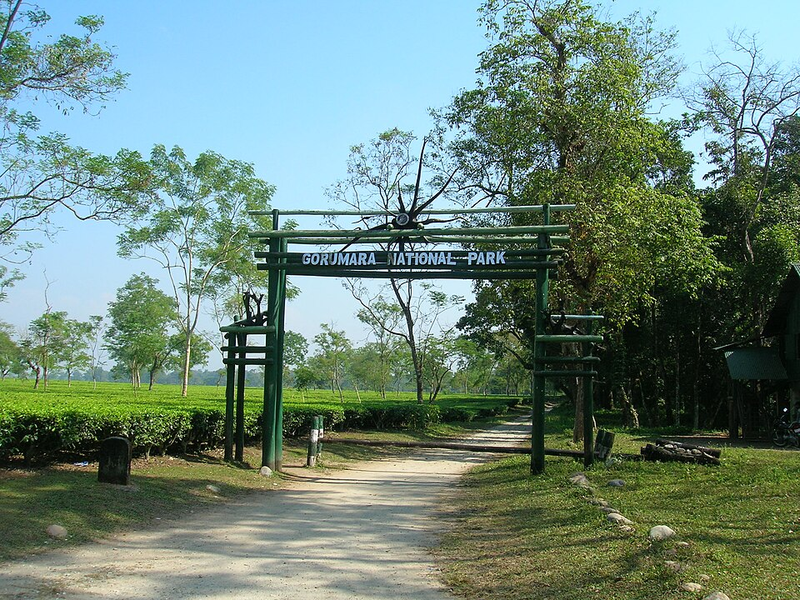
Gorumara was declared a wildlife sanctuary in 1949 and designated as a national park in 1994.
Asked in SSC CGL 2023
Practice (1)
Q63In which state is the Gorumara National Park located?
Show answer
Correct answer: B — West Bengal
Answer: (B)Gorumara National Park is situated in the Dooars region of the Jalpaiguri district in northern West Bengal, on the floodplains of the Murti and Raidak rivers. It was declared a wildlife sanctuary in 1949 and designated as a national park in 1994, primarily recognized for its population of the great Indian one-horned rhinoceros (Rhinoceros unicornis).
Hence, the correct option is (2).
-
65
Plant varieties like bamboo, epiphytes, aini, semul, gutel, and mundane are found in moist tropical forests in India.
Moist tropical forests support a dense and diverse canopy structure with various plant species.
Asked in SSC CGL 2023 (24 Jul, Shift 2)
Practice (1)
Q64Plant varieties like bamboo, epiphytes, aini, semul, gutel and mundane are found in which type of Indian forest?
Show answer
Correct answer: C — Moist tropical forest
Answer: (C)
Bamboo, epiphytes, aini, semul and gurjan are found in moist tropical forests. -
66
Gulf of Mannar Biosphere Reserve is home to the endangered marine mammal Dugong (Dugong dugon) and sea turtles.
The reserve is situated in the shallow coastal waters off the southeast coast of Tamil Nadu, India.
Asked in SSC CGL 2023 (25 Jul, Shift 3)
Practice (1)
Q65In which Biosphere Reserve is the largest endangered marine mammal Dugong i.e., Dugong dugon and sea turtles also found?
Show answer
Correct answer: D — Gulf of Mannar Biosphere Reserve
Answer: (D)
Gulf of Mannar Biosphere Reserve is home to the dugong and sea turtles. -
67
According to the India State of Forest Report 2019, the total forest cover in India was 21.67% of the geographical area.
ISFR is a biennial assessment published by the Forest Survey of India.
Asked in SSC CGL 2023 (25 Jul, Shift 1)
Practice (1)
Q66According to India State of Forest Report 2019, what is the total forest cover in India?
Show answer
Correct answer: B — 21.67%
Answer: (B)
ISFR 2019: total forest cover was 7,12,249 sq km, i.e. 21.67% of India's geographical area. -
68
The mangrove tree found in the Sundarbans of India and Bangladesh scientifically known as 'Heritiera fomes' is the Sundari tree.
The famous Sundarbans mangrove forest derives its name from the abundant Sundari trees.
Asked in SSC CGL 2023 (25 Jul, Shift 2)
Practice (1)
Q67Which species of mangrove tree found in the Sundarbans of India and Bangladesh is scientifically known as 'Heritiera fomes'?
Show answer
Correct answer: B — Sundari
Answer: (B)
Heritiera fomes is the Sundari tree, after which the Sundarbans are named. -
69
Orangutans are native to the rainforests of Borneo and Sumatra in Southeast Asia, not the Caribbean islands.
Kangaroos are endemic to Australia, lemurs to Madagascar, and ostriches to African savannas and deserts.
Asked in SSC CGL 2023 (25 Jul, Shift 4)
Practice (1)
Q68Which of the following combinations of “animal” and “area they found” is INCORRECT?
Show answer
Correct answer: B — Orangutan – Caribbean islands
Answer: (B)
Orangutans are found in Borneo and Sumatra, not the Caribbean islands. -
70
The Rajgir Zoo Safari is located in the state of Bihar, serving as a major wildlife conservation and tourism attraction.
This modern safari park houses various captive wild animals in naturalistic enclosures.
Asked in SSC CGL 2023 (27 Jul, Shift 2)
Practice (1)
Q69The Rajgir Zoo is located in which of the following states?
Show answer
Correct answer: D — Bihar
Answer: (D)The Rajgir Zoo is located in Bihar.
-
71
The Joint Forest Management (JFM) program was launched in 1988 under the National Forest Policy to involve local communities in forest conservation.
JFM bridges local villagers and the forest department for sustainable management of degraded forests.
Asked in SSC CGL 2023 (27 Jul, Shift 3)
Practice (1)
Q70In which year was an approach and program named Joint Forest Management (JFM) launched in the context of National Forest Policy?
Show answer
Correct answer: B — 1988
Answer: (B)The Joint Forest Management (JFM) approach was launched in the context of the National Forest Policy in the year 1988.
This program was introduced as a part of the National Forest Policy to involve local communities in the management, conservation, and development of forest resources. The collaborative effort was aimed at both protecting the environment and improving the socio-economic conditions of local communities dependent on forests.
-
72
Project Tiger was launched in India on April 1, 1973, to ensure the maintenance of a viable population of tigers.
Jim Corbett National Park in Uttarakhand was the first tiger reserve designated under this project.
Asked in SSC CGL 2024
Practice (1)
Q71In which year was Project Tiger launched in India?
Show answer
Correct answer: A — 1973
Answer: (A)
Project Tiger was launched on 1 April 1973, initially in nine tiger reserves. -
73
Hubbardia heptaneuron is a rare and endangered species of grass endemic to the Western Ghats of India.
This annual grass species was once thought to be extinct before being rediscovered in rocky stream banks.
Asked in SSC CGL 2024 (10 Sep, Shift 1)
Practice (1)
Q72Hubbardia heptaneuron, which has become endangered, is a species of which of the following?
Show answer
Correct answer: D — Grass
Answer: (D)
Hubbardia heptaneuron is an endangered grass species found in the Western Ghats. -
74
Ebony, mahogany, and rosewood are characteristic tree species found in tropical evergreen forests.
These forests thrive in regions receiving high annual rainfall exceeding 200 cm.
Asked in SSC CGL 2024 (11 Sep, Shift 1)
Practice (1)
Q73Ebony and Mahogany trees are found in which type of forests?
Show answer
Correct answer: C — Tropical evergreen forests
Answer: (C)
Ebony, mahogany and rosewood grow in tropical evergreen forests. -
75
Taxus wallichiana (Himalayan yew) is a medicinal conifer found in the Himalayan region of Himachal Pradesh and other mountainous states.
The bark of Himalayan yew yields taxol, a compound used in cancer chemotherapy.
Asked in SSC CGL 2024 (11 Sep, Shift 2)
Practice (1)
Q74Taxus wallichiana Zucc (Himalayan yew) is a medicinal plant found in which of the following states?
Show answer
Correct answer: B — Himachal Pradesh
Answer: (B)
The Himalayan yew (source of taxol) grows in Himachal Pradesh. -
76
Tendu leaves (Diospyros melanoxylon) are extensively harvested in Indian forests to wrap traditional bidi cigarettes.
Tendu tree leaves are a major non-timber forest produce supporting rural livelihoods in central India.
Asked in SSC CGL 2024 (12 Sep, Shift 2)
Practice (1)
Q75______ leaves are used to make bidis.
Show answer
Correct answer: C — Tendu
Answer: (C)
Bidis are rolled in tendu (Diospyros melanoxylon) leaves. -
77
India had a total of 18 officially designated biosphere reserves across the country as of June 2021.
These reserves protect large representative areas of natural ecosystems conforming to UNESCO's MAB program.
Asked in SSC CGL 2024 (12 Sep, Shift 3)
Practice (1)
Q76As of the June 2021, how many biosphere reserves are established in India?
Show answer
Correct answer: A — 18
Answer: (A)
India had 18 biosphere reserves as of 2021. -
78
Sundari trees (Heritiera fomes) exclusively grow in the tidal mangrove forests of the deltaic Sundarbans region.
Mangrove forests are salt-tolerant tidal forests thriving in coastal estuarine environments.
Asked in SSC CGL 2024 (13 Sep, Shift 1)
Practice (1)
Q77Sundari trees are found in which type of forests in India?
Show answer
Correct answer: C — Mangrove forests
Answer: (C)
Sundari trees grow in the mangrove (tidal) forests of the Sundarbans. -
79
Teak (Tectona grandis) is a prominent hardwood species characteristic of tropical deciduous forests in India.
Tropical deciduous forests shed their leaves during the dry season to conserve moisture.
Asked in SSC CGL 2024 (17 Sep, Shift 3)
Practice (1)
Q78Which of the following is a species of tropical deciduous forests?
Show answer
Correct answer: C — Teak
Answer: (C)
Teak is the main species of tropical deciduous forests. Ebony, mahogany and palms are evergreen. -
80
Campbell Bay National Park in the Great Nicobar Islands hosts unique fauna like the Nicobar megapode, crab-eating macaque, and robber crab.
This protected area represents a pristine tropical rain forest ecosystem in the Bay of Bengal.
Asked in SSC CGL 2024
Practice (1)
Q79Which national park in the Andaman and Nicobar Islands is home to species like Megapode, crab-eating Macaque, Nicobar Pigeon, and Giant Robber Crab?
Show answer
Correct answer: A — Campbell Bay National Park
Answer: (A)
Campbell Bay National Park (Great Nicobar) hosts the megapode, crab-eating macaque, Nicobar pigeon and robber crab.