Q1 Mathematics Wrong (-1)
Let ${S_k} = \sum\limits_{r = 1}^k {{{\tan }^{ - 1}}\left( {{{{6^r}} \over {{2^{2r + 1}} + {3^{2r + 1}}}}} \right)} $. Then $\mathop {\lim }\limits_{k \to \infty } {S_k}$ is equal to :
A ${\cot ^{ - 1}}\left( {{3 \over 2}} \right)$
B ${\pi \over 2}$
C tan^{$-$1} (3)
D ${\tan ^{ - 1}}\left( {{3 \over 2}} \right)$
Solution: S_{k} = $\sum\limits_{r = 1}^k {{{\tan }^{ - 1}}} \left( {{{{6^r}(3 - 2)} \over {\left( {1 + {{\left( {{3 \over 2}} \right)}^{2r + 1}}} \right){2^{2r + 1}}}}} \right)$ = $\sum\limits_{r = 1}^k {{{\tan }^{ - 1}}} \left( {{{{2^r}\,.\,{3^{r + 1}} - {3^r}{2^{r + 1}}} \over {\left( {1 + {{\left( {{3 \over 2}} \right)}^{2r + 1}}} \right){2^{2r + 1}}}}} \right)$ = $\sum\limits_{r = 1}^k {{{\tan }^{ - 1}}} \left( {{{{{\left( {{3 \over 2}} \right)}^{r + 1}} - {{\left( {{3 \over 2}} \right)}^r}} \over {1 + {{\left( {{3 \over 2}} \right)}^{r + 1}}{{\left( {{3 \over 2}} \right)}^r}}}} \right) $ = $\sum\limits_{r = 1}^k {\left[ {{{\tan }^{ - 1}}{{\left( {{3 \over 2}} \right)}^{r + 1}} - {{\tan }^{ - 1}}{{\left( {{3 \over 2}} \right)}^r}} \right]} $ = ${\tan ^{ - 1}}{\left( {{3 \over 2}} \right)^2} - {\tan ^{ - 1}}{\left( {{3 \over 2}} \right)^1}$ + ${\tan ^{ - 1}}{\left( {{3 \over 2}} \right)^3} - {\tan ^{ - 1}}{\left( {{3 \over 2}} \right)^2}$ + ${\tan ^{ - 1}}{\left( {{3 \over 2}} \right)^4} - {\tan ^{ - 1}}{\left( {{3 \over 2}} \right)^3}$ . . . + ${{{\tan }^{ - 1}}{{\left( {{3 \over 2}} \right)}^{k + 1}} - {{\tan }^{ - 1}}{{\left( {{3 \over 2}} \right)}^k}}$ = ${{{\tan }^{ - 1}}{{\left( {{3 \over 2}} \right)}^{k + 1}} - {{\tan }^{ - 1}}{{\left( {{3 \over 2}} \right)}^1}}$ $ \therefore $ $\mathop {\lim }\limits_{k \to \infty } {S_k}$ = $\mathop {\lim }\limits_{k \to \infty } \left[ {{{\tan }^{ - 1}}{{\left( {{3 \over 2}} \right)}^{k + 1}} - {{\tan }^{ - 1}}{{\left( {{3 \over 2}} \right)}^1}} \right]$ = ${{{\tan }^{ - 1}}\left( \infty \right) - {{\tan }^{ - 1}}\left( {{3 \over 2}} \right)}$ = ${{\pi \over 2} - {{\tan }^{ - 1}}\left( {{3 \over 2}} \right)}$ = ${\cot ^{ - 1}}\left( {{3 \over 2}} \right)$
Q2 Mathematics Practice — not auto-scored
Let $A=I_2-2 M M^T$, where $M$ is a real matrix of order $2 \times 1$ such that the relation $M^T M=I_1$ holds. If $\lambda$ is a real number such that the relation $A X=\lambda X$ holds for some non-zero real matrix $X$ of order $2 \times 1$, then the sum of squares of all possible values of $\lambda$ is equal to __________.
Solution: $\begin{aligned} & A=I_2-2 M^T \\\\ & A^2=\left(I_2-2 M M^T\right)\left(I_2-2 M^T\right) \\\\ & =I_2-2 M^T-2 M M^T+4 M^T M^T \\\\ & =I_2-4 M M^T+4 M M^T \\\\ & =I_2\end{aligned}$ $\begin{aligned} & \mathrm{AX}=\lambda \mathrm{X} \\\\ & \mathrm{A}^2 \mathrm{X}=\lambda \mathrm{AX} \\\\ & \mathrm{X}=\lambda(\lambda \mathrm{X}) \\\\ & \mathrm{X}=\lambda^2 \mathrm{X} \\\\ & \mathrm{X}\left(\lambda^2-1\right)=0 \\\\ & \lambda^2=1 \\\\ & \lambda= \pm 1\end{aligned}$ Sum of square of all possible values $=2$
Q3 Mathematics Wrong (-1)
The area (in sq. units) of the region bounded by the curve x^{2} = 4y and the straight line x = 4y – 2 is :
A ${3 \over 4}$
B ${5 \over 4}$
C ${7 \over 8}$
D ${9 \over 8}$
Solution: JEE Main 2019 (Online) 11th January Morning Slot Mathematics - Area Under The Curves Question 126 English Explanation x = 4y $-$ 2 & x^{2} = 4y $ \Rightarrow $  x^{2} = x + 2 $ \Rightarrow $ x^{2} $-$ x $-$ 2 = 0 x = 2, $-$ 1 So,   $\int\limits_{ - 1}^2 {\left( {{{x + 2} \over 4} - {{{x^2}} \over 4}} \right)\,dx = {9 \over 8}} $
Q4 Mathematics Wrong (-1)
The set of all real values of $\lambda $ for which the function $f(x) = \left( {1 - {{\cos }^2}x} \right)\left( {\lambda + \sin x} \right),x \in \left( { - {\pi \over 2},{\pi \over 2}} \right)$ has exactly one maxima and exactly one minima, is :
A $\left( { - {3 \over 2},{3 \over 2}} \right) - \left\{ 0 \right\}$
B $\left( { - {3 \over 2},{3 \over 2}} \right)$
C $\left( { - {1 \over 2},{1 \over 2}} \right) - \left\{ 0 \right\}$
D $\left( { - {1 \over 2},{1 \over 2}} \right)$
Solution: $f(x) = \left( {1 - {{\cos }^2}x} \right)\left( {\lambda + \sin x} \right)$ $ \Rightarrow $ f(x) = sin^{2} x($\lambda $ + sinx) ....(1) $ \therefore $ f'(x) = 2sinx cosx ($\lambda $ +sinx) + sin^{2}x (cosx) $ \Rightarrow $ f'(x) = sin2x(${{2\lambda + 3\sin x} \over 2}$) For maixma and minima, f'(x) = 0 $ \therefore $ sin2x = 0 or 2$\lambda $ + 3sinx = 0 when sin2x = 0 $ \Rightarrow $ x = 0 or when 2$\lambda $ + 3sinx = 0 $ \Rightarrow $ sin x = $ - {{2\lambda } \over 3}$ As $x \in \left( { - {\pi \over 2},{\pi \over 2}} \right)$ $ \therefore $ -1 < sinx < 1 $ \Rightarrow $ -1 < $ - {{2\lambda } \over 3}$ < 1 $ \Rightarrow $ $ - {3 \over 2}$ < $\lambda $ < $ {3 \over 2}$ $ \therefore $ $\lambda $ $ \in $ $\left( { - {3 \over 2},{3 \over 2}} \right)$ - {0} Note : If $\lambda $ = 0 $ \Rightarrow $ f(x) = sin^{3}x [from (1)] Which is monotonic. so no maxima/minima.
Q5 Mathematics Wrong (-1)
Let A and B be two non-null events such that A $ \subset $ B . Then, which of the following statements is always correct?
A P(A|B) = 1
B P(A|B) = P(B) – P(A)
C P(A|B) $ \le $ P(A)
D P(A|B) $ \ge $ P(A)
Solution: $P\left( {{A \over B}} \right) = {{P\left( {A \cap B} \right)} \over {P\left( B \right)}}$ As A $ \subset $ B, then P(A$ \cap $B) = P(A) $ \therefore $ $P\left( {{A \over B}} \right) = {{P\left( A \right)} \over {P\left( B \right)}}$ As P(B) $ \le $ 1 $ \therefore $ ${{P\left( A \right)} \over {P\left( B \right)}}$ $ \ge $ P(A)
Q6 Mathematics Practice — not auto-scored
The sum of all integral values of k (k $\ne$ 0) for which the equation ${2 \over {x - 1}} - {1 \over {x - 2}} = {2 \over k}$ in x has no real roots, is ____________.
Solution: ${2 \over {x - 1}} - {1 \over {x - 2}} = {2 \over k}$ $x \in R - \{ 1,2\} $ $ \Rightarrow k(2x - 4 - x + 1) = 2({x^2} - 3x + 2)$ $ \Rightarrow k(x - 3) = 2({x^2} - 3x + 2)$ for x $\ne$ 3, $k = 2\left( {x - 3 + {2 \over {x - 3}} + 3} \right)$ $x - 3 + {2 \over {x - 3}} \ge 2\sqrt 2 ,\forall x > 3$ & $x - 3 + {2 \over {x - 3}} \le - 2\sqrt 2 ,\forall x < - 3$ $ \Rightarrow 2\left( {x - 3 + {2 \over {x - 3}} + 3} \right) \in \left( { - \infty ,6 - 4\sqrt 2 } \right] \cup \left[ {6 + 4\sqrt 2 ,\infty } \right)$ for no real roots $k \in (6 - 4\sqrt 2 ,6 + 4\sqrt 2 ) - \{ 0\} $ Integral k$\in${1, 2 ..... 11} Sum of k = 66
Q7 Mathematics Wrong (-1)
Let the foot of perpendicular of the point $P(3,-2,-9)$ on the plane passing through the points $(-1,-2,-3),(9,3,4),(9,-2,1)$ be $Q(\alpha, \beta, \gamma)$. Then the distance of $Q$ from the origin is :
A $\sqrt{38}$
B $\sqrt{29}$
C $\sqrt{42}$
D $\sqrt{35}$
Solution:

The equation of the plane passing through points $A(-1, -2, -3)$, $B(9, 3, 4)$, and $C(9, -2, 1)$ can be written using the determinant :

$ \left|\begin{array}{ccc} x+1 & y+2 & z+3 \\ 10 & 5 & 7 \\ 10 & 0 & 4 \end{array}\right|=0 $

Expanding the determinant, we get :

$ 2x + 3y - 5z - 7 = 0 $

Next, we find the foot of the perpendicular from point $P(3, -2, -9)$ to the plane. Using the coordinates of $P$ and the equation of the plane, we can find the ratio of the perpendicular distance to the sum of the squares of the coefficients of $x$, $y$, and $z$ :

$ \frac{2(3) + 3(-2) - 5(-9) - 7}{2^2 + 3^2 + (-5)^2} = \frac{-38}{38} $

We can now find the coordinates of the foot of the perpendicular, $Q(\alpha, \beta, \gamma)$ :

$ \frac{\alpha - 3}{2} = \frac{\beta + 2}{3} = \frac{\gamma + 9}{-5} = -\frac{38}{38} $

Solving for $\alpha$, $\beta$, and $\gamma$ :

$ \alpha = 3 - 2\left(-\frac{38}{38}\right) = 1 $

$ \beta = -2 + 3\left(-\frac{38}{38}\right) = -5 $

$ \gamma = -9 - 5\left(-\frac{38}{38}\right) = -4 $

So, the coordinates of the foot of the perpendicular are $Q(1, -5, -4)$. Now, we can find the distance of point $Q$ from the origin :

$ OQ = \sqrt{\alpha^2 + \beta^2 + \gamma^2} = \sqrt{1^2 + (-5)^2 + (-4)^2} = \sqrt{42} $

Q8 Mathematics Wrong (-1)
If the function f defined as $f\left( x \right) = {1 \over x} - {{k - 1} \over {{e^{2x}} - 1}},x \ne 0,$ is continuous at x = 0, then the ordered pair (k, f(0)) is equal to :
A (3, 2)
B (3, 1)
C (2, 1)
D $\left( {{1 \over 3},\,2} \right)$
Solution: If the function is continuous at x = 0, then $\mathop {\lim }\limits_{x \to 0} $ f(x) will exist and f(0) = $\mathop {\lim }\limits_{x \to 0} $ f(x) Now, $\mathop {\lim }\limits_{x \to 0} $ f(x) = $\mathop {\lim }\limits_{x \to 0} \left( {{1 \over x} - {{k - 1} \over {{e^{2x}} - 1}}} \right)$ = $\mathop {\lim }\limits_{x \to 0} \left( {{{{e^{2x}} - 1 - kx + x} \over {\left( x \right)\left( {{e^{2x}} - 1} \right)}}} \right)$ = $\mathop {\lim }\limits_{x \to 0} \left[ {{{\left( {1 + 2x + {{{{\left( {2x} \right)}^2}} \over {2!}} + {{{{\left( {2x} \right)}^3}} \over {3!}} + ....} \right) - 1 - kx + x} \over {\left( x \right)\left( {\left( {1 + 2x + {{{{\left( {2x} \right)}^2}} \over {2!}} + {{{{\left( {2x} \right)}^3}} \over {3!}} + ...} \right) - 1} \right)}}} \right]$ = $\mathop {\lim }\limits_{x \to 0} \left[ {{{\left( {3 - k} \right)x + {{4{x^2}} \over {2!}} + {{8{x^3}} \over {3!}} + ...} \over {\left( {2{x^2} + {{4{x^3}} \over {2!}} + {{8{x^3}} \over {3!}} + ....} \right)}}} \right]$ For the limit to exist, power of x in the numerator should be greater than or equal to the power of x in the denominator. Therefore, coefficient of x in numerator is equal to zero $ \Rightarrow $  3 $-$ k = 0 $ \Rightarrow $  k = 3 So the limit reduces to $\mathop {\lim }\limits_{x \to 0} {{\left( {{x^2}} \right)\left( {{4 \over {2!}} + {{8x} \over {3!}} + ...} \right)} \over {\left( {{x^2}} \right)\left( {2 + {{4x} \over {2!}} + {{8{x^2}} \over {3!}} + ...} \right)}}$ = $\mathop {\lim }\limits_{x \to 0} {{{4 \over {2!}} + {{8x} \over {3!}} + ...} \over {2 + {{4x} \over {2!}} + {{8{x^2}} \over {3!}} + ...}}$ = 1 Hence, f(0) = 1
Q9 Mathematics Skipped (0)
Let $a_{1}=1, a_{2}, a_{3}, a_{4}, \ldots .$. be consecutive natural numbers. Then $\tan ^{-1}\left(\frac{1}{1+a_{1} a_{2}}\right)+\tan ^{-1}\left(\frac{1}{1+a_{2} a_{3}}\right)+\ldots . .+\tan ^{-1}\left(\frac{1}{1+a_{2021} a_{2022}}\right)$ is equal to :
A $\frac{\pi}{4}-\cot ^{-1}(2022)$
B $\frac{\pi}{4}-\tan ^{-1}(2022)$
C $\cot ^{-1}(2022)-\frac{\pi}{4}$
D $\tan ^{-1}(2022)-\frac{\pi}{4}$
Solution: $a_{1}=1, a_{2}, a_{3}, a_{4}, \ldots .$. be consecutive natural numbers. $ \begin{aligned} & \therefore \quad a_2=2, a_3=3, \ldots ., a_{2021}=2021, a_{2022}=2022 \\\\ & \tan ^{-1}\left[\frac{1}{1+a_1 a_2}\right]=\tan ^{-1}\left[\frac{1}{1+1 \cdot 2}\right]=\tan ^{-1}(1)-\tan ^{-1}\left(\frac{1}{2}\right) \\\\ & \tan ^{-1}\left[\frac{1}{1+a_2 a_3}\right]=\tan ^{-1}\left[\frac{1}{1+2 \cdot 3}\right]=\tan ^{-1}\left(\frac{1}{2}\right)-\tan ^{-1}\left(\frac{1}{3}\right) \end{aligned} $ . . . . $ \begin{aligned} \tan ^{-1}\left[\frac{1}{1+a_{2021} a_{2022}}\right] & =\tan ^{-1}\left[\frac{1}{1+2021 \cdot 2022}\right] \\\\ & =\tan ^{-1}\left(\frac{1}{2021}\right)-\tan ^{-1}\left(\frac{1}{2022}\right) \end{aligned} $ $ \therefore $ $\tan ^{-1}\left(\frac{1}{1+a_{1} a_{2}}\right)+\tan ^{-1}\left(\frac{1}{1+a_{2} a_{3}}\right)+\ldots . .+\tan ^{-1}\left(\frac{1}{1+a_{2021} a_{2022}}\right)$ $ =\tan ^{-1}(1)-\tan ^{-1}\left(\frac{1}{2022}\right)=\frac{\pi}{4}-\cot ^{-1}(2022) $ $ =\frac{\pi}{4}-\left(\frac{\pi}{2}-\tan ^{-1}(2022)\right)=\tan ^{-1}(2022)-\frac{\pi}{4} $
Q10 Mathematics Practice — not auto-scored
If the line $x=y=z$ intersects the line $x \sin A+y \sin B+z \sin C-18=0=x \sin 2 A+y \sin 2 B+z \sin 2 C-9$, where $A, B, C$ are the angles of a triangle $A B C$, then $80\left(\sin \frac{A}{2} \sin \frac{B}{2} \sin \frac{C}{2}\right)$ is equal to ______________.
Solution: $ \begin{aligned} &x= y=z=k(\text { let }) \\\\ &\therefore k(\sin A+\sin B+\sin C)=18 \\\\ &\Rightarrow k\left(4 \cos \frac{A}{2} \cdot \cos \frac{B}{2} \cdot \cos \frac{C}{2}\right)=18 \\\\ & k(\sin 2 A+\sin 2 B+\sin 2 C)=9 \\\\ &\Rightarrow k(4 \sin A \cdot \sin B \cdot \sin C)=9 \ldots \text { (ii) } \\\\ & \text {(ii)} /\text {(i)} \\\\ & 8 \sin \frac{A}{2} \cdot \sin \frac{B}{2} \cdot \sin \frac{C}{2}=\frac{9}{18} \\\\ &\Rightarrow 80 \sin \frac{A}{2} \cdot \sin \frac{B}{2} \cdot \sin \frac{C}{2}=5 \end{aligned} $
Q11 Mathematics Wrong (-1)
If ${{dy} \over {dx}} = {{{2^{x + y}} - {2^x}} \over {{2^y}}}$, y(0) = 1, then y(1) is equal to :
A log_{2}(2 + e)
B log_{2}(1 + e)
C log_{2}(2e)
D log_{2}(1 + e^{2})
Solution: ${{dy} \over {dx}} = {{{2^{x + y}} - {2^x}} \over {{2^y}}}$ ${2^y}{{dy} \over {dx}} = {2^x}({2^y} - 1)$ $\int {{{{2^y}} \over {{2^y} - 1}}dy = \int {{2^x}\,dx} } $ ${{\ln ({2^y} - 1)} \over {\ln 2}} = {{{2^x}} \over {\ln 2}} + C$ $ \Rightarrow {\log _2}({2^y} - 1) = {2^x}{\log _2}e + C$ $\because$ $y(0) = 1 \Rightarrow 0 = {\log _2}e + C$ $C = - {\log _2}e$ $ \Rightarrow {\log _2}({2^y} - 1) = ({2^x} - 1){\log _2}e$ put x = 1, ${\log _2}({2^y} - 1) = {\log _2}e$ 2^{y} = e + 1 y = log_{2}(e + 1) Ans.
Q12 Mathematics Skipped (0)

The value of $\log _{e} 2 \frac{d}{d x}\left(\log _{\cos x} \operatorname{cosec} x\right)$ at $x=\frac{\pi}{4}$ is

A $-2 \sqrt{2}$
B $2 \sqrt{2}$
C $-4$
D 4
Solution:

Let $f(x) = {\log _{\cos x}}\cos ec\,x$

$ = {{\log \cos ec\,x} \over {\log \cos x}}$

$ \Rightarrow f'(x) = {{\log \cos x\,.\,\sin x\,.\,\left( { - \cos ec\,x\cot x - \log \cos ec\,x\,.\,{1 \over {\cos x}}\,.\, - \sin x} \right)} \over {{{(\log \cos x)}^2}}}$

at $x = {\pi \over 4}$

$f'\left( {{\pi \over 4}} \right) = {{ - \log \left( {{1 \over {\sqrt 2 }}} \right) + \log \sqrt 2 } \over {{{\left( {\log {1 \over {\sqrt 2 }}} \right)}^2}}} = {2 \over {\log \sqrt 2 }}$

$\therefore$ ${\log _e}2f'(x)$ at $x = {\pi \over 4} = 4$

Q13 Mathematics Practice — not auto-scored

The lines $\frac{x-2}{2}=\frac{y}{-2}=\frac{z-7}{16}$ and $\frac{x+3}{4}=\frac{y+2}{3}=\frac{z+2}{1}$ intersect at the point $P$. If the distance of $\mathrm{P}$ from the line $\frac{x+1}{2}=\frac{y-1}{3}=\frac{z-1}{1}$ is $l$, then $14 l^2$ is equal to __________.

Solution:

$\begin{aligned} & \frac{\mathrm{x}-2}{1}=\frac{\mathrm{y}}{-1}=\frac{\mathrm{z}-7}{8}=\lambda \\ & \frac{\mathrm{x}+3}{4}=\frac{\mathrm{y}+2}{3}=\frac{\mathrm{z}+2}{1}=\mathrm{k} \\ & \Rightarrow \lambda+2=4 \mathrm{k}-3 \\ & -\lambda=3 \mathrm{k}-2 \\ & \Rightarrow \mathrm{k}=1, \lambda=-1 \\ & 8 \lambda+7=\mathrm{k}-2 \\ & \therefore \mathrm{P}=(1,1,-1) \end{aligned}$

JEE Main 2024 (Online) 27th January Evening Shift Mathematics - 3D Geometry Question 70 English Explanation

Projection of $2 \hat{i}-2 \hat{k}$ on $2 \hat{i}+3 \hat{j}+\hat{k}$ is

$\begin{aligned} & =\frac{4-2}{\sqrt{4+9+1}}=\frac{2}{\sqrt{14}} \\ & \therefore l^2=8-\frac{4}{14}=\frac{108}{14} \\ & \Rightarrow 14 l^2=108 \end{aligned}$

Q14 Mathematics Wrong (-1)

Let $f:[2,4] \rightarrow \mathbb{R}$ be a differentiable function such that $\left(x \log _{e} x\right) f^{\prime}(x)+\left(\log _{e} x\right) f(x)+f(x) \geq 1, x \in[2,4]$ with $f(2)=\frac{1}{2}$ and $f(4)=\frac{1}{4}$.

Consider the following two statements :

(A) : $f(x) \leq 1$, for all $x \in[2,4]$

(B) : $f(x) \geq \frac{1}{8}$, for all $x \in[2,4]$

Then,

A Neither statement (A) nor statement (B) is true
B Only statement (A) is true
C Only statement (B) is true
D Both the statements $(\mathrm{A})$ and (B) are true
Solution: Given, $\left(x \log _{e} x\right) f^{\prime}(x)+\left(\log _{e} x\right) f(x)+f(x) \geq 1, x \in[2,4]$ $ \left(x\log _e x\right) f^{\prime}(x)+f(x)\left[\log _e x+1\right] \geq 1$ $ \Rightarrow $ $ \frac{d}{d x}\left[x \log _e x f(x)\right] \geq 1$ $ \begin{aligned} &\Rightarrow \frac{d}{d x}\left[x \log _e x f(x)-x\right] \geq 0 \quad\left[\because \frac{d}{d x}(x)=1\right] \\\\ & \forall x \in[2,4] \end{aligned} $ Let $g(x)=x \log _e x f(x)-x$ As $g(x) \geq 0, \forall x \in[2,4], g(x)$ is an increasing function in $[2,4]$ $ \begin{aligned} g(2) & =2 \log _e 2 f(2)-2 \\\\ & =\log _e 2-2 \quad\left[\because f(x)=\frac{1}{2}\right] \end{aligned} $ $ \begin{aligned} & g(4)=4 \log _e 4 f(4)-4=\log _e 4-4 \\\\ &=2\left(\log _e 2-2\right)\\\\ & {\left[\therefore f(4)=\frac{1}{4}\right] } \end{aligned} $ As, $g(x)$ is an increasing function, $ \begin{aligned} & g(2) \leq g(x) \leq g(4) \\\\ & \log _e 2-2 \leq g(x) \leq 2\left(\log _e 2-2\right) \\\\ & \log _e 2-2 \leq x \log _e x f(x)-x \leq 2\left(\log _e 2-2\right) \end{aligned} $ $ \frac{\log _e 2-2+x}{x \log _e x} \leq f(x) \leq \frac{2\left(\log _e 2-2\right)+x}{x \log _e x} $ $ \begin{aligned} & \text {Now for } x \in[2,4] \\\\ & \begin{aligned} \frac{\log _e 2-2+x}{x \log _e x} & \leq \frac{2\left(\log _e 2-2\right)+e^2}{2 \log _e 2} =1-\frac{1}{\log _e 2}<1 \end{aligned} \end{aligned} $ $ \Rightarrow \mathrm{f}(\mathrm{x}) \leq 1 \text { for } \mathrm{x} \in[2,4] $ $ \text { Also for } \mathrm{x} \in[2,4] \text { : } $ Now, $ \begin{aligned} \frac{2\left(\log _e 2-2\right)+2}{2 \log _e 2} & \geq \frac{\log _e 2-2+4}{4 \log _e 4} =\frac{1}{8}+\frac{1}{2 \log _e 2}>\frac{1}{8} \end{aligned} $ $ \therefore f(x) \geq \frac{1}{8}, \forall x \in[2,4] $ Hence, both statements $A$ and $B$ are true. Note : LMVT on $(\mathrm{yx}(\ln \mathrm{x}))$ not satisfied. Hence no such function exists. Therefore it should be bonus.
Q15 Mathematics Wrong (-1)
Let $f: \mathbf{R} \rightarrow \mathbf{R}$ be defined as : $ f(x)= \begin{cases}\frac{a-b \cos 2 x}{x^2} ; & x<0 \\\\ x^2+c x+2 ; & 0 \leq x \leq 1 \\\\ 2 x+1 ; & x>1\end{cases} $ If $f$ is continuous everywhere in $\mathbf{R}$ and $m$ is the number of points where $f$ is NOT differential then $\mathrm{m}+\mathrm{a}+\mathrm{b}+\mathrm{c}$ equals :
A 1
B 4
C 3
D 2
Solution: At $\mathrm{x}=1, \mathrm{f}(\mathrm{x})$ is continuous therefore, $\mathrm{f}\left(1^{-}\right)=\mathrm{f}(1)=\mathrm{f}\left(1^{+}\right)$ $ f(1)=3+c $ .........(1) $ \begin{aligned} & \mathrm{f}\left(1^{+}\right)=\lim _{h \rightarrow 0} 2(1+\mathrm{h})+1 \\\\ & \mathrm{f}\left(1^{+}\right)=\lim _{h \rightarrow 0} 3+2 \mathrm{~h}=3 .........(2) \end{aligned} $ from (1) and (2) $ \mathrm{c}=0 $ at $\mathrm{x}=0, \mathrm{f}(\mathrm{x})$ is continuous therefore, $ \begin{aligned} & \mathrm{f}\left(0^{-}\right)=\mathrm{f}(0)=\mathrm{f}\left(0^{+}\right) ........(3) \\\\ & \mathrm{f}(0)=\mathrm{f}\left(0^{+}\right)=2 ...........(4) \end{aligned} $ $\mathrm{f}\left(0^{-}\right)$has to be equal to 2 $\lim\limits_{h \rightarrow 0} \frac{a-b \cos (2 h)}{h^2}$ = $\lim\limits_{h \rightarrow 0} \frac{a-b\left\{1-\frac{4 h^2}{2 !}+\frac{16 h^4}{4 !}+\ldots\right\}}{h^2}$ = $\lim\limits_{h \rightarrow 0} \frac{a-b+b\left\{2 h^2-\frac{2}{3} h^4 \ldots\right\}}{h^2}$ for limit to exist $a-b=0$ and limit is $2 b$ from (3), (4) and (5) $ \mathrm{a}=\mathrm{b}=1 $ checking differentiability at $\mathrm{x}=0$ $ \begin{aligned} & \text { LHD : } \lim _{h \rightarrow 0} \frac{\frac{1-\cos 2 h}{h^2}-2}{-h} \\\\ & \lim _{h \rightarrow 0} \frac{1-\left(1-\frac{4 h^2}{2 !}+\frac{16 h^4}{4 !} \ldots\right)-2 h^2}{-h^3}=0 \\\\ & \text { RHD : } \lim _{h \rightarrow 0} \frac{(0+h)^2+2-2}{h}=0 \end{aligned} $ Function is differentiable at every point in its domain $ \therefore \mathrm{m}=0 $ m + a + b + c = 0 + 1 + 1 + 0 = 2
Q16 Mathematics Skipped (0)
If the length of the latus rectum of an ellipse is 4 units and the distance between a focus an its nearest vertex on the major axis is ${3 \over 2}$ units, then its eccentricity is :
A ${1 \over 2}$
B ${1 \over 3}$
C ${2 \over 3}$
D ${1 \over 9}$
Solution: If the cordinate of focus and vertex are (ae, 0) and (a, 0) respectively, then distance between focus and vertex, a $-$ ae = ${3 \over 2}$ (given) $ \Rightarrow $ $\,\,\,$ a (1 $-$ e) = ${3 \over 2}$ Length of latus rectum, ${{2{b^2}} \over a} = 4$ $ \Rightarrow $ $\,\,\,$ b^{2} = 2a $ \Rightarrow $ $\,\,\,$ a^{2}(1 $-$ e^{2}) = 2a   [As b^{2} = a^{2} (1 $-$ e^{2})] $ \Rightarrow $ $\,\,\,$ a (1 $-$ e) ( 1 + e) = 2 Putting    a (1 $-$ e) = ${3 \over 2}$ $ \Rightarrow $ $\,\,\,$ ${3 \over 2}$ (1 + e) = 2 $ \Rightarrow $ $\,\,\,$ 3 + 3e = 4 $ \Rightarrow $ $\,\,\,$ e = ${1 \over 3}$
Q17 Mathematics Correct (4)

Let the operations $*, \odot \in\{\wedge, \vee\}$. If $(\mathrm{p} * \mathrm{q}) \odot(\mathrm{p}\, \odot \sim \mathrm{q})$ is a tautology, then the ordered pair $(*, \odot)$ is :

A $(\vee, \wedge)$
B $(\vee, \vee)$
C $(\wedge, \wedge)$
D $(\wedge, \vee)$
Solution:

$ * ,\, \odot \in \{ \wedge ,\, \vee \} $

Now for $(p * q) \odot (p \odot \sim q)$ is tautology

(A) $( \vee , \wedge ):(p \vee q) \wedge (p \wedge \sim q)$ not a tautology

(B) $( \vee , \vee ):(p \vee q) \vee (p \vee \sim q)$

$ = P \vee T$ is tautology

(C) $( \wedge , \wedge ):(p \wedge q) \wedge (p \wedge \sim q)$

$ = (p \wedge p) \wedge (q \wedge \sim q) = p \wedge F$ not a tautology (Fallasy)

(D) $( \wedge , \vee ):(p \wedge q) \vee (p \vee \sim q)$ not a tautology

Q18 Mathematics Skipped (0)
Two tangents are drawn from the point P($-$1, 1) to the circle x^{2} + y^{2} $-$ 2x $-$ 6y + 6 = 0. If these tangents touch the circle at points A and B, and if D is a point on the circle such that length of the segments AB and AD are equal, then the area of the triangle ABD is equal to :
A 2
B $(3\sqrt 2 + 2)$
C 4
D $3(\sqrt 2 - 1)$
Solution: JEE Main 2021 (Online) 27th July Morning Shift Mathematics - Circle Question 83 English Explanation $\Delta ABD = {1 \over 2} \times 2 \times 4 = 4$
Q19 Mathematics Practice — not auto-scored

Let $M = \left[ {\matrix{ 0 & { - \alpha } \cr \alpha & 0 \cr } } \right]$, where $\alpha$ is a non-zero real number an $N = \sum\limits_{k = 1}^{49} {{M^{2k}}} $. If $(I - {M^2})N = - 2I$, then the positive integral value of $\alpha$ is ____________.

Solution: $M=\left[\begin{array}{cc}0 & -\alpha \\ \alpha & 0\end{array}\right], M^{2}=\left[\begin{array}{cc}-\alpha^{2} & 0 \\ 0 & -\alpha^{2}\end{array}\right]=-\alpha^{2}$ I $N=M^{2}+M^{4}+\ldots+M^{98}$ $=\left[-\alpha^{2}+\alpha^{4}-\alpha^{6}+\ldots\right] I$ $=\frac{-\alpha^{2}\left(1-\left(-\alpha^{2}\right)^{49}\right)}{1+\alpha^{2}} \cdot 1$ $I-M^{2}=\left(1+\alpha^{2}\right) I$ $\left(I-M^{2}\right) N=-\alpha^{2}\left(\alpha^{98}+1\right)=-2$ $\therefore \alpha=1$
Q20 Mathematics Wrong (-1)
Let C_{1} and C_{2} be the centres of the circles x^{2} + y^{2} – 2x – 2y – 2 = 0 and x^{2} + y^{2} – 6x – 6y + 14 = 0 respectively. If P and Q are the points of intersection of these circles, then the area (in sq. units) of the quadrilateral PC_{1}QC_{2} is :
A 4
B 6
C 9
D 8
Solution: JEE Main 2019 (Online) 12th January Morning Slot Mathematics - Circle Question 123 English Explanation Area = 2 $ \times $ ${1 \over 2}$.4 = 2
Q21 Mathematics Wrong (-1)
$\mathop {\lim }\limits_{x \to 0} {{\int\limits_0^{{x^2}} {\left( {\sin \sqrt t } \right)dt} } \over {{x^3}}}$ is equal to :
A ${1 \over {15}}$
B 0
C ${2 \over 3}$
D ${3 \over 2}$
Solution: $\mathop {\lim }\limits_{x \to {0^ + }} {{\int\limits_0^{{x^2}} {\sin (\sqrt t )dt} } \over {{x^3}}}$ This is in ${0 \over 0}$ form, so use L' Hospital rule $ = \mathop {\lim }\limits_{x \to {0^ + }} {{{d \over {dx}}\left( {\int\limits_0^{{x^2}} {\sin (\sqrt t )dt} } \right)} \over {{d \over {dx}}\left( {{x^3}} \right)}}$ $ = \mathop {\lim }\limits_{x \to {0^ + }} {{\sin x.2x - 0} \over {3{x^2}}}$ (applying Leibnitz rule) $ = {2 \over 3}\mathop {\lim }\limits_{x \to {0^ + }} {{\sin x} \over x}$ $ = {2 \over 3}$
Q22 Mathematics Skipped (0)

The probability, of forming a 12 persons committee from 4 engineers, 2 doctors and 10 professors containing at least 3 engineers and at least 1 doctor, is

A $\frac{129}{182}$
B $\frac{17}{26}$
C $\frac{19}{26}$
D $\frac{103}{182}$
Solution:

$\begin{array}{lll} 3 E, & 1 D, & 8 P \\ 3 E, & 2 D, & 7 P \\ 4 E, & 1 D, & 7 P \\ 4 E, & 2 D, & 6 P \end{array}$

$\begin{aligned} & P=\frac{{ }^4 C_3 \cdot{ }^2 C_1 \cdot{ }^{10} C_8+{ }^4 C_3 \cdot{ }^2 C_2 \cdot{ }^{10} C_7+{ }^4 C_4 \cdot{ }^2 C_1 \cdot{ }^{10} C_7+{ }^4 C_4 \cdot{ }^2 C_2 \cdot{ }^{10} C_6}{{ }^{10} C_{12}} \\ & =\frac{129}{182} \end{aligned}$

Q23 Mathematics Wrong (-1)

Let $\int_\limits\alpha^{\log _e 4} \frac{\mathrm{d} x}{\sqrt{\mathrm{e}^x-1}}=\frac{\pi}{6}$. Then $\mathrm{e}^\alpha$ and $\mathrm{e}^{-\alpha}$ are the roots of the equation :

A $2 x^2-5 x+2=0$
B $x^2-2 x-8=0$
C $2 x^2-5 x-2=0$
D $x^2+2 x-8=0$
Solution:

$\begin{aligned} & \text { Let } \sqrt{e^x-1}=t \\ & e^x-1=t^2 \\ & e^x=1+t^2 \\ & e^x=0+2 t-\frac{d t}{d x} \\ & \frac{d t}{d x}=\frac{e^x}{2 t}=\frac{t^2+1}{2 t} \\ & I=\int \frac{2 t}{t\left(1+t^2\right)} d t=2 \tan ^{-1} t \\ & \Rightarrow \quad I=\int_\limits\alpha^{\log ^4} \frac{d x}{\sqrt{e^x-1}} \\ & I=\left.2 \tan ^{-1} \sqrt{e^x-1}\right|_\alpha ^{\log 4} \\ & =2\left(\tan ^{-1} \sqrt{3}-\tan ^{-1} \sqrt{e^\alpha-1}\right)=\frac{\pi}{6} \\ & \Rightarrow \frac{\pi}{3}-\tan ^{-1}\left(\sqrt{e^\alpha-1}\right)=\frac{\pi}{12} \\ & \tan ^{-1}\left(\sqrt{e^\alpha-1}\right)=\frac{\pi}{4} \\ & \Rightarrow e^\alpha-1=1 \\ & e^\alpha=2 \Rightarrow e^{-\alpha}=\frac{1}{2} \end{aligned}$

$\therefore \quad$ Quadratic equation whose roots are $e^a$ & $e^{-\alpha}$ is

$\begin{aligned} & x^2-\left(e^\alpha+e^{-\alpha}\right) x+e^\alpha \times e^{-\alpha}=0 \\ & x^2-\left(2+\frac{1}{2}\right) x+1=0 \\ & 2 x^2-5 x+2=0 \end{aligned}$

Q24 Mathematics Skipped (0)
A fair coin is tossed a fixed number of times. If the probability of getting 7 heads is equal to probability of getting 9 heads, then the probability of getting 2 heads is :
A ${{15} \over {{2^8}}}$
B ${{15} \over {{2^{12}}}}$
C ${{15} \over {{2^{13}}}}$
D ${{15} \over {{2^{14}}}}$
Solution: Let the coin be tossed n-times $P(H) = P(T) = {1 \over 2}$ P(7 heads) = ${}^n{C_7}{\left( {{1 \over 2}} \right)^{n - 7}}{\left( {{1 \over 2}} \right)^7} = {{{}^n{C_7}} \over {{2^n}}}$ P(9 heads) = ${}^n{C_9}{\left( {{1 \over 2}} \right)^{n - 9}}{\left( {{1 \over 2}} \right)^9} = {{{}^n{C_9}} \over {{2^n}}}$ P(7 heads) = P(9 heads) ${}^n{C_7} = {}^n{C_9} \Rightarrow n = 16$ P(2 heads) = ${}^{16}{C_2}{\left( {{1 \over 2}} \right)^{14}}{\left( {{1 \over 2}} \right)^2} = {{15 \times 8} \over {{2^{16}}}}$ P(2 heads) $ = {{15} \over {{2^{13}}}}$
Q25 Mathematics Wrong (-1)
Let A = $\left( {\matrix{ 0 & {2q} & r \cr p & q & { - r} \cr p & { - q} & r \cr } } \right).$   If  AA^{T} = I_{3},   then   $\left| p \right|$ is :
A ${1 \over {\sqrt 2 }}$
B ${1 \over {\sqrt 5 }}$
C ${1 \over {\sqrt 6 }}$
D ${1 \over {\sqrt 3 }}$
Solution: A is orthogonal matrix $ \Rightarrow $  0^{2} + p^{2} + p^{2} = 1 $ \Rightarrow $  $\left| p \right| = {1 \over {\sqrt 2 }}$
Q26 Physics Practice — not auto-scored

Two satellites S_{1} and S_{2} are revolving in circular orbits around a planet with radius R_{1} = 3200 km and R_{2} = 800 km respectively. The ratio of speed of satellite S_{1} to be speed of satellite S_{2} in their respective orbits would be ${1 \over x}$ where x = ___________.

Solution:

$v = \sqrt {{{GM} \over R}} $

$ \Rightarrow {{{v_1}} \over {{v_2}}} = \sqrt {{{{R_2}} \over {{R_1}}}} $

${{{v_2}} \over {{v_1}}} = \sqrt {{{3200} \over {800}}} = 2$

$ \Rightarrow {{{v_1}} \over {{v_2}}} = {1 \over 2}$

$x = 2$

Q27 Physics Skipped (0)

Match the List I with List II

List - I List - II
(A) Triatomic rigid gas (I) $\frac{C_p}{C_v}=\frac{5}{3}$
(B) Diatomic non-rigid gas (II) $\frac{C_p}{C_v}=\frac{7}{5}$
(C) Monoatomic gas (III) $\frac{C_p}{C_v}=\frac{4}{3}$
(D) Diatomic rigid gas (IV) $\frac{C_p}{C_v}=\frac{9}{7}$

Choose the correct answer from the options given below:

A A-III, B-IV, C-I, D-II
B A-II, B-IV, C-I, D-III
C A-IV, B-II, C-III, D-I
D A-III, B-II, C-IV, D-I
Solution:

The explanation uses the equation for the heat capacity ratio, $ \gamma = 1 + \frac{2}{\text{f}} $, where $ \text{f} $ is the degrees of freedom of the gas. Here's how it applies to different types of gases:

Triatomic Rigid Gas:

Degrees of freedom ($ \text{f} $) = 6

$ \gamma = 1 + \frac{2}{6} = \frac{4}{3} $

Diatomic Non-Rigid Gas:

Degrees of freedom ($ \text{f} $) = 7

$ \gamma = 1 + \frac{2}{7} = \frac{9}{7} $

Diatomic Rigid Gas:

Degrees of freedom ($ \text{f} $) = 5

$ \gamma = 1 + \frac{2}{5} = \frac{7}{5} $

Monoatomic Gas:

Degrees of freedom ($ \text{f} $) = 3

$ \gamma = 1 + \frac{2}{3} = \frac{5}{3} $

Therefore, when matching List I with List II, the correct pairing is:

A (Triatomic rigid gas) - III $(\frac{4}{3})$

B (Diatomic non-rigid gas) - IV $(\frac{9}{7})$

C (Monoatomic gas) - I $(\frac{5}{3})$

D (Diatomic rigid gas) - II $(\frac{7}{5})$

Thus, the correct answer from the options given is:

A-III, B-IV, C-I, D-II

Q28 Physics Correct (4)
A solid sphere of mass M and radius R is divided into two unequal parts. The first part has a mass of ${{7M} \over 8}$ and is converted into a uniform disc of radius 2R. The second part is converted into a uniform solid sphere. Let I_{1} be the moment of inertia of the disc about its axis and I_{2} be the moment of inertia of the new sphere about its axis. The ratio I_{1}/I_{2} is given by :
A 65
B 140
C 185
D 285
Solution: ${I_1} = {{\left( {{{7M} \over 8}} \right){{\left( {2R} \right)}^2}} \over 2} = {{7M \times 4{R^2}} \over {2 \times 8}} = {{7M{R^2}} \over 4}$ ${I_2} = {2 \over 5}{M \over 8}{\left( {{R \over 2}} \right)^2} = {{2M} \over {5 \times 8}}{{{R^2}} \over 4} = {{M{R^2}} \over {80}}$ ${{{I_1}} \over {{I_2}}} = {{7M{R^2} \times 80} \over {4M{R^2}}} = 140$
Q29 Physics Skipped (0)
In a hydrogen like atom, when an electron jumps from the M-shell to the L-shell, the wavelength of emitted radiation is $\lambda $. If an electron jumps from N-shell to the L-shell, the wavelength of emitted radiation will be:
A ${{25} \over {16}}$ $\lambda $
B ${{27} \over {20}}$ $\lambda $
C ${{16} \over {25}}$ $\lambda $
D ${{20} \over {27}}$ $\lambda $
Solution: For M $ \to $ L steel ${1 \over \lambda }$ = K $\left( {{1 \over {{2^2}}} - {1 \over {{3^2}}}} \right) = {{K \times 5} \over {36}}$ for N $ \to $ L ${1 \over {\lambda '}}$ = K$\left( {{1 \over {{2^2}}} - {1 \over {{4^2}}}} \right) = {{K \times 3} \over {16}}$ $\lambda ' = {{20} \over {27}}\lambda $
Q30 Physics Skipped (0)

A vertical electric field of magnitude 4.9 $\times$ 10^{5} N/C just prevents a water droplet of a mass 0.1 g from falling. The value of charge on the droplet will be :

(Given : g = 9.8 m/s^{2})

A 1.6 $\times$ 10^{$-$9} C
B 2.0 $\times$ 10^{$-$9} C
C 3.2 $\times$ 10^{$-$9} C
D 0.5 $\times$ 10^{$-$9} C
Solution:

Since the droplet is at rest

$\Rightarrow$ Net force = 0

$\Rightarrow$ mg = qE

$\Rightarrow$ $q = {{mg} \over E}$ = 2 $\times$ 10^{$-$9} C

Q31 Physics Wrong (-1)
A charged particle carrying charge 1 $\mu $C is moving with velocity $\left( {2\widehat i + 3\widehat j + 4\widehat k} \right)$ ms^{–1}. If an external magnetic field of $\left( {5\widehat i + 3\widehat j - 6\widehat k} \right)$× 10^{–3} T exists in the region where the particle is moving then the force on the particle is $\overrightarrow F $ × 10^{–9} N. The vector $\overrightarrow F $ is :
A ${ - 0.30\widehat i + 0.32\widehat j - 0.09\widehat k}$
B ${ - 300\widehat i + 320\widehat j - 90\widehat k}$
C ${ - 30\widehat i + 32\widehat j - 9\widehat k}$
D ${ - 3.0\widehat i + 3.2\widehat j - 0.9\widehat k}$
Solution: Given, ${\overrightarrow V }$ = $\left( {2\widehat i + 3\widehat j + 4\widehat k} \right)$ ms^{–1} ${\overrightarrow B }$ = $\left( {5\widehat i + 3\widehat j - 6\widehat k} \right)$× 10^{–3} T q = 1 $\mu $C $\overrightarrow F = q\left( {\overrightarrow V \times \overrightarrow B } \right)$ = ${10^{ - 6}} \times {10^{ - 3}} \times \left| {\matrix{ {\widehat i} & {\widehat j} & {\widehat k} \cr 2 & 3 & 4 \cr 5 & 3 & { - 6} \cr } } \right|$ = (${ - 30\widehat i + 32\widehat j - 9\widehat k}$) $ \times $ 10^{-9}
Q32 Physics Skipped (0)

Different combination of 3 resistors of equal resistance $\mathrm{R}$ are shown in the figures. The increasing order for power dissipation is:

JEE Main 2023 (Online) 13th April Morning Shift Physics - Current Electricity Question 89 English

A $\mathrm{P}_{\mathrm{B}}<\mathrm{P}_{\mathrm{C}}<\mathrm{P}_{\mathrm{D}}<\mathrm{P}_{\mathrm{A}}$
B $\mathrm{P}_{\mathrm{C}}<\mathrm{P}_{\mathrm{B}}<\mathrm{P}_{\mathrm{A}}<\mathrm{P}_{\mathrm{D}}$
C $\mathrm{P}_{\mathrm{C}}<\mathrm{P}_{\mathrm{D}}<\mathrm{P}_{\mathrm{A}}<\mathrm{P}_{\mathrm{B}}$
D $\mathrm{P}_{\mathrm{A}}<\mathrm{P}_{\mathrm{B}}<\mathrm{P}_{\mathrm{C}}<\mathrm{P}_{\mathrm{D}}$
Solution: $\mathrm{P}=\mathrm{I}^2 \mathrm{R}$ $ \mathrm{R}_1=\frac{3 \mathrm{R}}{2}, \mathrm{R}_2=\frac{2 \mathrm{R}}{3}, \mathrm{R}_3=\frac{\mathrm{R}}{3}, \mathrm{R}_4=3 \mathrm{R} $ Since $\mathrm{i}$ is same, hence $\mathrm{P} \propto \mathrm{R}$ so options (B) is correct
Q33 Physics Skipped (0)

Electron beam used in an electron microscope, when accelerated by a voltage of 20 kV, has a de-Broglie wavelength of $\lambda_0$. IF the voltage is increased to 40 kV, then the de-Broglie wavelength associated with the electron beam would be :

A 3 $\lambda_0$
B 9 $\lambda_0$
C $\frac{\lambda_0}{\sqrt2}$
D $\frac{\lambda_0}{2}$
Solution: When electron is accelerated through potential difference $V$, then $ \begin{aligned} & \text { K.E. }=\mathrm{eV} \\\\ & \Rightarrow \lambda=\frac{\mathrm{h}}{\sqrt{2 \mathrm{~m}(\mathrm{KE})}}=\frac{\mathrm{h}}{\sqrt{2 \mathrm{meV}}} \\\\ & \therefore \lambda \alpha \frac{1}{\sqrt{\mathrm{V}}} \\\\ & \therefore \frac{\lambda}{\lambda_0}=\sqrt{\frac{20}{40}} \\\\ & \therefore \lambda=\frac{\lambda_0}{\sqrt{2}} \end{aligned} $
Q34 Physics Skipped (0)

Let $B_1$ be the magnitude of magnetic field at center of a circular coil of radius $R$ carrying current I. Let $\mathrm{B}_2$ be the magnitude of magnetic field at an axial distance ' $x$ ' from the center. For $x: \mathrm{R}=3: 4, \frac{\mathrm{~B}_2}{\mathrm{~B}_1}$ is :

A $64: 125$
B $25: 16$
C $4: 5$
D $16: 25$
Solution:

JEE Main 2025 (Online) 2nd April Morning Shift Physics - Magnetic Effect of Current Question 9 English Explanation

$\begin{aligned} & B_1=\frac{\mu_0 i}{2 R} \quad \quad B_2=B_1 \sin ^3 \theta \\ & \therefore \frac{B_2}{B_1}=\sin ^3 \theta=\left(\frac{4}{5}\right)^3=\frac{64}{125} \end{aligned}$

Q35 Physics Practice — not auto-scored

In the given circuit, the equivalent resistance between the terminal A and B is __________ $\Omega$.

JEE Main 2023 (Online) 25th January Morning Shift Physics - Current Electricity Question 98 English

Solution:

JEE Main 2023 (Online) 25th January Morning Shift Physics - Current Electricity Question 98 English Explanation 1

Both $4 \Omega$ resistance and left $2 \Omega$ resistance get short-circuited. So, no current will flow through them. Remove the resistors that have no current. Now the equivalent circuit becomes - JEE Main 2023 (Online) 25th January Morning Shift Physics - Current Electricity Question 98 English Explanation 2 $ \begin{aligned} & \mathrm{R}_{\mathrm{eq}}=3+(2 \| 2)+6 \\\\ & \mathrm{R}_{\mathrm{eq}}=3+1+6 \\\\ & \mathrm{R}_{\mathrm{eq}}=10 \Omega \end{aligned} $
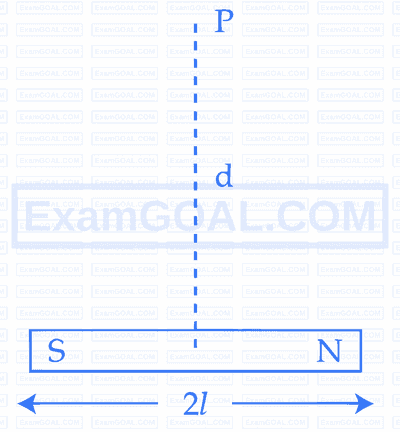
Q36 Physics Skipped (0)
JEE Main 2025 (Online) 28th January Evening Shift Physics - Magnetic Properties of Matter Question 5 English

A bar magnet has total length $2 l=20$ units and the field point P is at a distance $\mathrm{d}=10$ units from the centre of the magnet. If the relative uncertainty of length measurement is $1 \%$, then uncertainty of the magnetic field at point P is :

A

10%

B

5%

C

3%

D

4%

Solution:

To determine the uncertainty of the magnetic field at point P, we consider two approaches:

Without considering uncertainty in length $\ell$:

The magnetic field $ B $ at point P is given by:

$ B = \frac{\mu_0}{4 \pi} \frac{m}{r^3} $

Where $ B $ is inversely proportional to $ r^3 $:

$ B \propto \frac{1}{r^3} $

The relative uncertainty in $ B $, expressed as a percentage, is calculated by:

$ \frac{\Delta B}{B} = 3 \times \left(\frac{\Delta r}{r}\right) $

Given that the relative uncertainty in length measurement is $1\%$, the uncertainty in $ B $ becomes:

$ \% \text{ uncertainty in } B = 3 \% $

Method-2: Considering uncertainty in length $\ell$:

Here, we also account for the uncertainty in $\ell$:

$ B \propto \frac{1}{r^3} $

Thus, the combined relative uncertainty, incorporating $\ell$, is:

$ \frac{\Delta B}{B} = \frac{\Delta \ell}{\ell} + 3 \times \left(\frac{\Delta r}{r}\right) $

Substituting the given uncertainties:

$ \frac{\Delta B}{B} = 1 + 3 \times 1 = 4\% $

Therefore, the percentage uncertainty in $ B $, considering the length $\ell$, is $4\%$.

Q37 Physics Practice — not auto-scored

In the following circuit, the magnitude of current I_{1}, is ___________ A.

JEE Main 2023 (Online) 30th January Morning Shift Physics - Current Electricity Question 107 English

Solution:

The indicated diagram shows current flow diagram loops for writing Kirchhoff's law are also indicated, writing the equation

JEE Main 2023 (Online) 30th January Morning Shift Physics - Current Electricity Question 107 English Explanation

$2{I_3} + {I_1} + {I_3} + {I_2} = 5$

or ${I_1} + {I_2} + 3{I_3} = 5$ ..... (1)

${I_2} - 5 = 2({I_3} - {I_2}) + ({I_1} + {I_3} - {I_2})$

or ${I_1} - 4{I_2} + 3{I_3} = - 5$ ...... (2)

$({I_1} + {I_3}) + ({I_1} + {I_3} - {I_2}) = 2$

or $2{I_1} - {I_2} + 2{I_3} = 2$ ...... (3)

on solving ${I_1} = {3 \over 2}A,{I_2} = 2,{I_3} = {1 \over 2}A$

$ = 1.50$

Q38 Physics Skipped (0)

A sample of gas at temperature $T$ is adiabatically expanded to double its volume. The work done by the gas in the process is $\left(\mathrm{given}, \gamma=\frac{3}{2}\right)$ :

A $W=T R[\sqrt{2}-2]$
B $W=\frac{T}{R}[\sqrt{2}-2]$
C $W=\frac{R}{T}[2-\sqrt{2}]$
D $W=R T[2-\sqrt{2}]$
Solution: $\gamma=\frac{3}{2}$ $ \begin{aligned} & W =\frac{n R \Delta T}{1-\gamma}=\frac{n R T_{f}-n R T_{i}}{1-\gamma} \\\\ & =\frac{(P V)_{f}-\left(P V_{i}\right)}{1-\gamma} \quad \ldots \text { (1) } \\\\ & P V^{\gamma}=\text { constant } \\\\ & P_{i} V_{i}^{\gamma}=P_{f}\left(2 V_{i}\right)^{\gamma} \Rightarrow P_{f}=\frac{P_{i}}{2^{\gamma}}=\frac{P_{i}}{2 \sqrt{2}} ......(2) \end{aligned} $ From (1) and (2) $ \begin{aligned} & W=\frac{\frac{P_{i}}{2 \sqrt{2}} 2 V_{i}-P_{i} V_{i}}{1-\gamma}=\frac{P_{i} V_{i}}{-1 / 2}\left(\frac{1}{\sqrt{2}}-1\right) \\\\ & =-n R T(\sqrt{2}-2) \\\\ & =n R T(2-\sqrt{2}) \end{aligned} $
Q39 Physics Skipped (0)

Two uniformly charged spherical conductors $A$ and $B$ of radii $5 \mathrm{~mm}$ and $10 \mathrm{~mm}$ are separated by a distance of $2 \mathrm{~cm}$. If the spheres are connected by a conducting wire, then in equilibrium condition, the ratio of the magnitudes of the electric fields at the surface of the sphere $A$ and $B$ will be :

A 1 : 2
B 2 : 1
C 1 : 1
D 1 : 4
Solution:

After connection

${\sigma _1}{R_1} = {\sigma _2}{R_2}$

Now $E = {\sigma \over {{\varepsilon _0}}}$

$ \Rightarrow {{{E_1}} \over {{E_2}}} = {{{\sigma _1}} \over {{\sigma _2}}} = {{{R_2}} \over {{R_1}}} = {2 \over 1}$

Q40 Physics Skipped (0)

Given below are two statements : one is labelled as Assertion A and the other is labelled as Reason R

Assertion A : When a body is projected at an angle $45^{\circ}$, it's range is maximum.

Reason R : For maximum range, the value of $\sin 2 \theta$ should be equal to one.

In the light of the above statements, choose the correct answer from the options given below:

A Both $\mathbf{A}$ and $\mathbf{R}$ are correct and $\mathbf{R}$ is the correct explanation of $\mathbf{A}$
B $\mathbf{A}$ is true but $\mathbf{R}$ is false
C $\mathbf{A}$ is false but $\mathbf{R}$ is true
D Both $\mathbf{A}$ and $\mathbf{R}$ are correct but $\mathbf{R}$ is NOT the correct explanation of $\mathbf{A}$
Solution: Assertion A: When a body is projected at an angle of $45^{\circ}$, its range is maximum. This is true, and it's a well-established fact in physics. The maximum range of a projectile, assuming no air resistance and flat terrain, is achieved at an angle of $45^{\circ}$. Reason R: For maximum range, the value of $\sin 2\theta$ should be equal to one. This is also true. The range of a projectile, again assuming no air resistance and flat terrain, can be calculated using the formula $R = (v^{2}/g) \cdot \sin(2\theta)$, where $v$ is the initial velocity of the projectile, $g$ is the acceleration due to gravity, and $\theta$ is the launch angle. For the range to be maximized, $\sin(2\theta)$ must be maximized, and the maximum value of $\sin(2\theta)$ is 1. This occurs when $2\theta = 90$ degrees, or $\theta = 45$ degrees, which corresponds to the assertion.
Q41 Physics Skipped (0)

The Boolean expression $\mathrm{Y}=A \bar{B} C+\bar{A} \bar{C}$ can be realised with which of the following gate configurations.

A. One 3-input AND gate, 3 NOT gates and one 2-input OR gate, One 2-input AND gate,

B. One 3 -input AND gate, 1 NOT gate, One 2 -input NOR gate and one 2 -input OR gate

C. 3 -input OR gate, 3 NOT gates and one 2 -input AND gate

Choose the correct answer from the options given below:

A B, C Only
B A, B, C Only
C A, B Only
D A, C Only
Solution:

JEE Main 2025 (Online) 4th April Morning Shift Physics - Semiconductor Question 2 English Explanation

$\because \overline{\mathrm{A}} \cdot \overline{\mathrm{C}}+\overline{\mathrm{A}+\mathrm{C}} \equiv$ NOR gate

Q42 Physics Skipped (0)
Two wires of same length and radius are joined end to end and loaded. The Young's modulii of the materials of the two wires are Y_{1} and Y_{2}. The combination behaves as a single wire then its Young's modulus is :
A $Y = {{2{Y_1}{Y_2}} \over {3({Y_1} + {Y_2})}}$
B $Y = {{2{Y_1}{Y_2}} \over {{Y_1} + {Y_2}}}$
C $Y = {{{Y_1}{Y_2}} \over {2({Y_1} + {Y_2})}}$
D $Y = {{{Y_1}{Y_2}} \over {{Y_1} + {Y_2}}}$
Solution: In series combination $\Delta$l = l_{1} + l_{2} $Y = {{F/A} \over {\Delta l/l}} \Rightarrow \Delta l = {{Fl} \over {AY}}$ $ \Rightarrow \Delta l \propto {l \over Y}$ Equivalent length of rod after joining is = 2l As, lengths are same and force is also same in series $\Delta l = \Delta {l_1} + \Delta {l_2}$ ${{{l_{eq}}} \over {{Y_{eq}}}} = {l \over {{Y_1}}} + {l \over {{Y_2}}} \Rightarrow {{2l} \over Y} = {l \over {{Y_1}}} + {l \over {{Y_2}}}$ $\therefore$ $Y = {{2{Y_1}{Y_2}} \over {{Y_1} + {Y_2}}}$
Q43 Physics Skipped (0)

Two blocks of masses 10 kg and 30 kg are placed on the same straight line with coordinates (0, 0) cm and (x, 0) cm respectively. The block of 10 kg is moved on the same line through a distance of 6 cm towards the other block. The distance through which the block of 30 kg must be moved to keep the position of centre of mass of the system unchanged is :

A 4 cm towards the 10 kg block
B 2 cm away from the 10 kg block
C 2 cm towards the 10 kg block
D 4 cm away from the 10 kg block
Solution:

For COM to remain unchanged,

m_{1}x_{1} = m_{2}x_{2}

$\Rightarrow$ 10 $\times$ 6 = 30 $\times$ x_{2}

$\Rightarrow$ x_{2} = 2 cm towards 10 kg block.

Q44 Physics Skipped (0)

The momentum of an electron revolving in $\mathrm{n}^{\text {th }}$ orbit is given by :

(Symbols have their usual meanings)

A $\frac{\mathrm{nh}}{2 \pi \mathrm{r}}$
B $ \frac{n h}{2 r} $
C $ \frac{\mathrm{nh}}{2 \pi} $
D $\frac{2 \pi r}{\mathrm{nh}}$
Solution:

$\because$ $mvr = {{nh} \over {2\pi }}$

$ \Rightarrow mv = {{nh} \over {2\pi r}}$

Q45 Physics Skipped (0)

In an electromagnetic system, a quantity defined as the ratio of electric dipole moment and magnetic dipole moment has dimension of $\left[\mathrm{M}^{\mathrm{P}} \mathrm{L}^{\mathrm{Q}} \mathrm{T}^R A^{\mathrm{S}}\right]$. The value of P and Q are :

A $-1,0$
B $0,-1$
C $-1,1$
D $1,-1$
Solution:

Electric dipole moment $(\overrightarrow{\mathrm{P}})=\mathrm{q} \times 2 \ell$

Magnetic dipole moment $(\overrightarrow{\mathrm{M}})=\mathrm{IA}$

$\left[\frac{\mathrm{P}}{\mathrm{M}}\right]=\left[\frac{\mathrm{LTA}}{\mathrm{~L}^2 \mathrm{~A}}\right]=\mathrm{L}^{-1} \mathrm{~T}=\mathrm{M}^0 \mathrm{~L}^{-1} \mathrm{~T}^1 \mathrm{~A}^0$

After compering values of $\mathrm{P} \& \mathrm{Q}$ are $0,-1$

Correct Answer : Option 4

Q46 Physics Practice — not auto-scored
A capacitor of 50 $\mu$F is connected in a circuit as shown in figure. The charge on the upper plate of the capacitor is ______________$\mu$C. JEE Main 2021 (Online) 31st August Morning Shift Physics - Capacitor Question 77 English
Solution: JEE Main 2021 (Online) 31st August Morning Shift Physics - Capacitor Question 77 English Explanation Potential Difference across each resistor = 2V q = CV = 50 $\times$ 10^{$-$6} $\times$ 2 = 100 $\times$ 10^{$-$6} = 100 $\mu$C
Q47 Physics Skipped (0)

$0.08 \mathrm{~kg}$ air is heated at constant volume through $5^{\circ} \mathrm{C}$. The specific heat of air at constant volume is $0.17 \mathrm{~kcal} / \mathrm{kg}^{\circ} \mathrm{C}$ and $\mathrm{J}=4.18$ joule/$\mathrm{~cal}$. The change in its internal energy is approximately.

A 318 J
B 298 J
C 284 J
D 142 J
Solution:

To find the change in the internal energy of air when it is heated at constant volume, we use the formula for heat transfer at constant volume, which is given by:

$\Delta U = m c_v \Delta T$

Where:

  • $\Delta U$ is the change in internal energy,
  • $m$ is the mass of the substance (in this case, air),
  • $c_v$ is the specific heat at constant volume,
  • $\Delta T$ is the change in temperature.

Given that:

  • The mass of air, $m = 0.08 \, \text{kg},$
  • The specific heat of air at constant volume, $c_v = 0.17 \, \text{kcal/kg}^{\circ}\text{C},$
  • The change in temperature, $\Delta T = 5^{\circ} \text{C},$
  • And the conversion factor from calories to Joules, $1 \, \text{cal} = 4.18 \, \text{J}.$

First, convert the specific heat from kcal to Joules:

$c_v = 0.17 \, \text{kcal/kg}^{\circ}\text{C} \times 1000 \, \text{cal/kcal} \times 4.18 \, \text{J/cal} = 710.6 \, \text{J/kg}^{\circ}\text{C}$

Now, substitute the values into the formula:

$\Delta U = 0.08 \times 710.6 \times 5$

$\Delta U = 284 \, \text{J}$

Thus, the change in internal energy is approximately 284 Joules.

Q48 Physics Skipped (0)

A square loop of side $15 \mathrm{~cm}$ being moved towards right at a constant speed of $2\mathrm{~cm} / \mathrm{s}$ as shown in figure. The front edge enters the $50 \mathrm{~cm}$ wide magnetic field at $t=0$. The value of induced emf in the loop at $t=10 \mathrm{~s}$ will be :

JEE Main 2024 (Online) 9th April Evening Shift Physics - Electromagnetic Induction Question 12 English

A zero
B 4.5 mV
C 0.3 mV
D 3 mV
Solution:

Time taken to cross the field region

$=\frac{50}{2}=25 \mathrm{~s}$

At $10 \mathrm{~s}$ the loop is inside field and flux is not changing.

$\therefore \quad \varepsilon_{\text {induced }}=0$

Q49 Physics Practice — not auto-scored

The energy released per fission of nucleus of $^{240}$X is 200 MeV. The energy released if all the atoms in 120g of pure $^{240}$X undergo fission is ____________ $\times$ 10$^{25}$ MeV.

(Given $\mathrm{N_A=6\times10^{23}}$)

Solution: $120 \mathrm{~g}$ of $^{240}X$ will have $\frac{1}{2}$ mole of $X$ Number of atom of $X=\frac{1}{2} \times N_{A}=3 \times 10^{23}$ atom Energy released $=3 \times 10^{23} \times 200 ~ \mathrm{MeV}$ $ =6 \times 10^{25} ~\mathrm{MeV} $
Q50 Physics Skipped (0)

Sand is being dropped from a stationary dropper at a rate of $0.5 \,\mathrm{kgs}^{-1}$ on a conveyor belt moving with a velocity of $5 \mathrm{~ms}^{-1}$. The power needed to keep the belt moving with the same velocity will be :

A 1.25 W
B 2.5 W
C 6.25 W
D 12.5 W
Solution:

${{dm} \over {dt}} = 0.5$ kg/s

$v = 5$ m/s

$F = {{vdm} \over {dt}} = 2.5$ kg m/s^{2}

$P = \overline F \,.\,\overline v = (2.5)(5)$ W

$ = 12.5$ W

Q51 Chemistry Skipped (0)

Among the following, basic oxide is :

A SO_{3}
B SiO_{2}
C CaO
D Al_{2}O_{3}
Solution: Since, oxides of metals are basic in nature. Hence CaO is a basic oxide. SO_{3} and SiO_{2} are acidic oxides and Al_{2}O_{3} is a amphoteric oxide.
Q52 Chemistry Skipped (0)

Given below are two statements: one is labelled as Assertion A and the other is labelled as Reason R.

Assertion A: $\mathrm{LiF}$ is sparingly soluble in water.

Reason R: The ionic radius of $\mathrm{Li}^{+}$ ion is smallest among its group members, hence has least hydration enthalpy.

In the light of the above statements, choose the most appropriate answer from the options given below.

A Both A and R are true and R is the correct explanation of A.
B Both A and R are true but R is NOT the correct explanation of A.
C A is true but R is false.
D A is false but R is true.
Solution: LiF is sparingly soluble in water. The low solubility of LiF in water is due to its high lattice enthalpy (Since $\mathrm{Li}^{+}$ and $\mathrm{F}^{-}$ are small in size). Also, due to small size of $\mathrm{Li}^{+}$, its hydration enthalpy is high. Hence, Assertion is true but Reason is false
Q53 Chemistry Skipped (0)
Given that the standard potentials (E^{o}) of Cu^{2+}/Cu and Cu^{+}/Cu are 0.34 V and 0.522 V respectively, the E^{o} of Cu^{2+}/Cu^{+} :
A - 0.182 V
B - 0.158 V
C 0.182 V
D +0.158 V
Solution: Cu^{+2} + 2e^{–} $ \to $ Cu    E^{o} = 0.34 V ....(1) Cu^{+} + e^{–} $ \to $Cu    E^{o} = 0.522 V Cu $ \to $ Cu^{+} + e^{–}     E^{o} = -0.522 V ...(2) By adding (1) and (2) we get, Cu^{+2} + e^{–} $ \to $ Cu^{+} E^{o}_{cell} = ${{0.34 \times 2 + 1 \times \left( { - 0.522} \right)} \over 1}$ = 0.158 V
Q54 Chemistry Skipped (0)

Which of the following options are correct for the reaction

$2\left[\mathrm{Au}(\mathrm{CN})_{2}\right]^{-}(\mathrm{aq})+\mathrm{Zn}(\mathrm{s}) \rightarrow 2 \mathrm{Au}(\mathrm{s})+\left[\mathrm{Zn}(\mathrm{CN})_{4}\right]^{2-}(\mathrm{aq})$

A. Redox reaction

B. Displacement reaction

C. Decomposition reaction

D. Combination reaction

Choose the correct answer from the options given below:

A A and B only
B C and D only
C A only
D A and D only
Solution: $2\left[\stackrel{+1}{\mathrm{Au}}(\mathrm{CN})_2\right]^{-}+\stackrel{0}{\mathrm{Z}} \mathrm{n}(\mathrm{s}) \longrightarrow 2 \stackrel{0}{\mathrm{Au}}+\left[\stackrel{+2}{\mathrm{Zn}}(\mathrm{CN})_4\right]^{-2}$ $\mathrm{Zn}$ displaced $\mathrm{Au}^{+}$ Reduction and Oxidation both are taking place.
Q55 Chemistry Skipped (0)

Given below are two statements : one is labelled as Assertion (A) and the other is labelled as Reason (R).

Assertion (A) : Dissolved substances can be removed from a colloidal solution by diffusion through a parchment paper.

Reason (R) : Particles in a true solution cannot pass through parchment paper but the colloidal particles can pass through the parchment paper.

In the light of the above statements, choose the correct answer from the options given below :

A Both (A) and (R) are correct and (R) is the correct explanation of (A)
B Both (A) and (R) are correct but (R) is not the correct explanation of (A)
C (A) is correct but (R) is not correct
D (A) is not correct but (R) is correct
Solution: Parchment paper is a semi-permeable membrane which allows particles of true solution to pass through as their size are too small. Assertion is correct but reason is incorrect.
Q56 Chemistry Practice — not auto-scored
For the reaction A + B $\rightleftharpoons$ 2C the value of equilibrium constant is 100 at 298 K. If the initial concentration of all the three species is 1 M each, then the equilibrium concentration of C is x $\times$ 10^{$-$1} M. The value of x is ____________. (Nearest integer)
Solution: JEE Main 2021 (Online) 25th July Morning Shift Chemistry - Chemical Equilibrium Question 54 English Explanation $K = {{[C]_{eq}^2} \over {{{[A]}_{eq}}{{[B]}_{eq}}}} = {{{{(1 + 2x)}^2}} \over {(1 - x)(1 - x)}}$ $100 = {\left( {{{1 + 2x} \over {1 - x}}} \right)^2}$ $\left( {{{1 + 2x} \over {1 - x}}} \right) = 10$ $x = {3 \over 4}$ $[C]{e_{q.}} = 1 + 2x$ $ = 1 + 2\left( {{3 \over 4}} \right)$ = 2.5 M = 25 $\times$ 10^{-1} M
Q57 Chemistry Skipped (0)
Given below are two statements : Statement I : A mixture of chloroform and aniline can be separated by simple distillation. Statement II : When separating aniline from a mixture of aniline and water by steam distillation aniline boils below its boiling point. In the light of the above statements, choose the most appropriate answer from the options given below :
A Both Statement I and Statement II are true
B Both Statement I and Statement II are false
C Statement I is true but Statement II is false
D Statement I is false but Statement II is true
Solution: Mixture of chloroform and aniline can be separated by simple distillation as these two liquids have sufficient difference in boiling point. Chloroform (b.p. 334 K), aniline (b.p. 457 K) In steam distillation, if one of the substances is water and the other, a water insoluble substance (like aniline) then the mixture will boil close to but below 373 K.
Q58 Chemistry Skipped (0)
Solubility of calcium phosphate (molecular mass, M) in water is $\mathrm{W_{g}}$ per $100 \mathrm{~mL}$ at $25^{\circ} \mathrm{C}$. Its solubility product at $25^{\circ} \mathrm{C}$ will be approximately.
A $10^7\left(\frac{W}{M}\right)^3$
B $10^3\left(\frac{\mathrm{W}}{\mathrm{M}}\right)^5$
C $10^7\left(\frac{W}{M}\right)^5$
D $10^5\left(\frac{\mathrm{W}}{\mathrm{M}}\right)^5$
Solution:

To determine the solubility product (K_{sp}) of calcium phosphate, we need to consider its chemical formula and how it dissociates in water. The formula for calcium phosphate is $\text{Ca}_3(\text{PO}_4)_2$. When dissolved in water, it dissociates according to the following equation:

$ \text{Ca}_3(\text{PO}_4)_2 (s) \rightleftharpoons 3 \text{Ca}^{2+} (aq) + 2 \text{PO}_4^{3-} (aq) $

Let $S$ be the molar solubility of calcium phosphate in $\text{mol}/L$. According to the stoichiometry of the dissociation, if $S$ moles per liter of calcium phosphate dissolve, $3S$ moles per liter of calcium ions and $2S$ moles per liter of phosphate ions are produced.

The expression for the solubility product constant (Ksp) for calcium phosphate in water is the product of the concentrations of the ions raised to the power of their respective coefficients in the balanced equation:

$ K_{sp} = [\text{Ca}^{2+}]^3 [\text{PO}_4^{3-}]^2 $

Substituting the concentrations with $3S$ for $\text{Ca}^{2+}$ and $2S$ for $\text{PO}_4^{3-}$, we get:

$ K_{sp} = (3S)^3 (2S)^2 = 27S^3 \cdot 4S^2 = 108S^5 $

If the solubility of calcium phosphate is $\text{W}_{g}$ per $100 \text{ mL}$ of water at $25^\circ\text{C}$, we need to convert grams to moles to find $S$. Solubility in moles per liter (which is the same as moles per $1000 \text{ mL}$) is:

$ S = \frac{\text{W}}{\text{M}} \times \frac{1000 \text{ mL}}{100 \text{ mL}} = 10\frac{\text{W}}{\text{M}} $

Now, substituting $S$ with $10\frac{\text{W}}{\text{M}}$ into the expression for $K_{sp}$:

$ K_{sp} = 108 \left(10\frac{\text{W}}{\text{M}}\right)^5 $

This simplifies to:

$ K_{sp} = 108 \times 10^5 \left(\frac{\text{W}}{\text{M}}\right)^5 $

Since $108$ is on the order of $10^2$, we can approximate this to:

$ K_{sp} \approx 10^7 \left(\frac{\text{W}}{\text{M}}\right)^5 $

Therefore, the correct answer based on the options provided is:

Option C: $10^7 \left(\frac{\text{W}}{\text{M}}\right)^5$

Q59 Chemistry Skipped (0)

Given below are two statements:

Statement I: In group 13, the stability of +1 oxidation state increases down the group.

Statement II : The atomic size of gallium is greater than that of aluminium.

In the light of the above statements, choose the most appropriate answer from the options given below :

A Statement I is incorrect but Statement II is correct
B Statement I is correct but Statement II is incorrect
C Both Statement I and Statement II are correct
D Both Statement I and Statement II are incorrect
Solution:

Statement I:

"In group 13, the stability of +1 oxidation state increases down the group."

Analysis:

Group 13 Elements:

Boron (B)

Aluminum (Al)

Gallium (Ga)

Indium (In)

Thallium (Tl)

Common Oxidation States:

The typical oxidation state for group 13 elements is +3.

However, due to the inert pair effect, the +1 oxidation state becomes more stable as we move down the group.

Inert Pair Effect:

The reluctance of the s-electrons (ns²) in the valence shell to participate in bonding.

This effect becomes more significant in heavier elements due to poor shielding by inner d and f orbitals.

Stability Trend:

Boron (B): Exhibits only the +3 oxidation state.

Aluminum (Al): Predominantly +3 oxidation state.

Gallium (Ga): +3 is more stable, but +1 oxidation state starts appearing.

Indium (In): +1 oxidation state becomes significant.

Thallium (Tl): The +1 oxidation state is more stable than the +3 oxidation state.

Conclusion for Statement I:

Correct.

The stability of the +1 oxidation state increases as we move down group 13 due to the inert pair effect.


Statement II:

"The atomic size of gallium is greater than that of aluminium."

Analysis:

Expected Trend:

Generally, atomic size increases down a group because each successive element has an additional electron shell.

Actual Atomic Radii:

Aluminum (Al): Approximately 143 picometers (pm)

Gallium (Ga): Approximately 135 pm

Anomalous Behavior:

**Gallium's atomic radius is *slightly smaller* than that of aluminum.**

This anomaly is due to the presence of 10 d-electrons in gallium's electron configuration (Ga: [Ar] 3d¹⁰ 4s² 4p¹).

Poor Shielding Effect:

3d electrons do not shield the nuclear charge effectively.

As a result, the effective nuclear charge increases, pulling the outer electrons closer to the nucleus.

This causes gallium to have a smaller atomic radius compared to aluminum.

Conclusion for Statement II:

Incorrect.

The atomic size of gallium is less than that of aluminum due to poor shielding by d-electrons.


Final Answer:

Statement I is correct, as the stability of the +1 oxidation state increases down group 13.

Statement II is incorrect, because gallium has a smaller atomic radius than aluminum.


Answer: Option B

Q60 Chemistry Skipped (0)
If a reaction follows the Arrhenius equation, the plot ln k vs ${1 \over {\left( {RT} \right)}}$ gives straight line with a gradient ($-$ y) unit. The energy required to active the reactant is :
A y unit
B y/R unit
C yR unit
D $-$y unit
Solution: According to Arrhenius equation, k = A${e^{ - {{{E_a}} \over {RT}}}}$ or ln k = ln A - ${{{{E_a}} \over {RT}}}$ Comparing the above equation with straight line equation, y = mx + c, we get, slope or gradient (m) = –E_{a} and Intercept (c) = ln A Also given that slope or gradient (m) = -y $ \therefore $ -y = –E_{a} $ \Rightarrow $ E_{a} = y So the activation energy of the reactant, E_{a} = y unit
Q61 Chemistry Skipped (0)
The vapour pressures of pure liquids A and B are 400 and 600 mmHg, respectively at 298 K on mixing the two liquids, the sum of their initial volume is equal ot the volume of the final mixture. The mole fraction of liquid B is 0.5 in the mixture, The vapour pressure of the final solution, the mole fractions of components A and B in vapour phase, respectively are :
A 500 mmHg. 0.5,0.5
B 500 mmHg, 0.4, 0.6
C 450 mmHg, 0.4,0.6
D 450 mmHg.0.5,0.5
Solution: Given $P_A^0$ = 400 mm of Hg $P_B^0$ = 600 mm of Hg Mole fraction of B (x_{B}) in liquid phase = 0.5 Mole fraction of A (x_{A}) in liquid phase = 1 - 0.5 = 0.5 Pressure of solution : P_{s} = x_{A}$P_A^0$ + x_{B}$P_B^0$ = 0.5 $ \times $ 400 + 0.5 $ \times $ 600 = 500 mm of Hg From Roult's law we know, Partial pressure of A (P_{A}) = x_{A}$P_A^0$ ......(1) From Dalton'sRoult's law we know, Partial pressure of A (P_{A}) = y_{A}P_{s} ........(2) here y_{A} = mole fraction of A in vapour phase From (1) and (2) we can write, x_{A}$P_A^0$ = y_{A}P_{s} $ \Rightarrow $ y_{A} = ${{{x_A}P_A^0} \over {{P_s}}}$ = ${{0.5 \times 400} \over {500}}$ = 0.4 Mole fraction of A in vapour phase = 0.4 $ \therefore $ mole fraction of B in vapour phase = 1 - 0.4 = 0.6
Q62 Chemistry Skipped (0)

Correct statements for the given reaction are :

JEE Main 2023 (Online) 12th April Morning Shift Chemistry - Alcohols, Phenols and Ethers Question 42 English

A. Compound '$\mathrm{B}$' is aromatic

B. The completion of above reaction is very slow

C. 'A' shows tautomerism

D. The bond lengths of C-C in compound $B$ are found to be same

Choose the correct answer from the options given below:

A B, C and D only
B A, C and D only
C A, B and D only
D A, B and C only
Solution: JEE Main 2023 (Online) 12th April Morning Shift Chemistry - Alcohols, Phenols and Ethers Question 42 English Explanation 1 JEE Main 2023 (Online) 12th April Morning Shift Chemistry - Alcohols, Phenols and Ethers Question 42 English Explanation 2 Resonance hybrid of B showing all C-C bond length same JEE Main 2023 (Online) 12th April Morning Shift Chemistry - Alcohols, Phenols and Ethers Question 42 English Explanation 3
Q63 Chemistry Skipped (0)
Which one of the following compounds is aromatic in nature?
A JEE Main 2021 (Online) 1st September Evening Shift Chemistry - Basics of Organic Chemistry Question 147 English Option 1
B JEE Main 2021 (Online) 1st September Evening Shift Chemistry - Basics of Organic Chemistry Question 147 English Option 2
C JEE Main 2021 (Online) 1st September Evening Shift Chemistry - Basics of Organic Chemistry Question 147 English Option 3
D JEE Main 2021 (Online) 1st September Evening Shift Chemistry - Basics of Organic Chemistry Question 147 English Option 4
Solution: (a) (Acenaphthene) JEE Main 2021 (Online) 1st September Evening Shift Chemistry - Basics of Organic Chemistry Question 147 English Explanation 1 $\to$ 10 $\pi$e^{$-$} in cyclic conjugation $\Rightarrow$ Aromatic "Note: For a compound with multiple cyclic rings to exhibit aromaticity, it must conform to Hückel's rule, which stipulates that the molecule should have (4n+2) π-electrons in the largest periphery of continuous conjugation. Rings with sp^{3} hybridized carbon atoms are not considered in this context. Despite their potential π-bonds, these rings cannot participate in resonance with π-bonds of the other rings due to the sp^{3} hybridization, and thus do not contribute to the overall aromaticity of the compound." (b) JEE Main 2021 (Online) 1st September Evening Shift Chemistry - Basics of Organic Chemistry Question 147 English Explanation 2 $\to$ 4 $\pi$e^{$-$} in ring conjugation $\Rightarrow$ Anti Aromatic (c) JEE Main 2021 (Online) 1st September Evening Shift Chemistry - Basics of Organic Chemistry Question 147 English Explanation 3 $\Rightarrow$ 4 $\pi$e^{$-$} in ring conjugation $\Rightarrow$ Antiaromatic (d) JEE Main 2021 (Online) 1st September Evening Shift Chemistry - Basics of Organic Chemistry Question 147 English Explanation 4 6$\pi$e^{$-$} in ring conjugation $\Rightarrow$ Aromatic
Q64 Chemistry Skipped (0)
For the given cell : Cu(s) | Cu^{2+}(C_{1}M) || Cu^{2+}(C_{2}M) | Cu(s) change in Gibbs energy ($\Delta $G) is negative, if :
A C_{2} = $\sqrt 2 $C_{1}
B C_{2} = ${{{C_1}} \over {\sqrt 2 }}$
C C_{1} = 2C_{2}
D C_{1} = C_{2}
Solution: Given $\Delta $G < 0 $ \therefore $ -nFE_{cell} < 0 $ \Rightarrow $ E_{cell} > 0 We know, E_{cell} = $E_{cell}^0$ - ${{RT} \over {2F}}\ln \left( {{{{C_1}} \over {{C_2}}}} \right)$ = 0 - ${{RT} \over {2F}}\ln \left( {{{{C_1}} \over {{C_2}}}} \right)$ $ \therefore $ - ${{RT} \over {2F}}\ln \left( {{{{C_1}} \over {{C_2}}}} \right)$ > 0 $ \Rightarrow $ $\ln \left( {{{{C_1}} \over {{C_2}}}} \right)$ < 0 $ \Rightarrow $ C_{1} < C_{2} By checking option, we can see C_{2} = $\sqrt 2 $C_{1} satisfy the condition C_{1} < C_{2}.
Q65 Chemistry Skipped (0)

Identify the major product in the following reaction.

JEE Main 2024 (Online) 5th April Evening Shift Chemistry - Haloalkanes and Haloarenes Question 21 English

A JEE Main 2024 (Online) 5th April Evening Shift Chemistry - Haloalkanes and Haloarenes Question 21 English Option 1
B JEE Main 2024 (Online) 5th April Evening Shift Chemistry - Haloalkanes and Haloarenes Question 21 English Option 2
C JEE Main 2024 (Online) 5th April Evening Shift Chemistry - Haloalkanes and Haloarenes Question 21 English Option 3
D JEE Main 2024 (Online) 5th April Evening Shift Chemistry - Haloalkanes and Haloarenes Question 21 English Option 4
Solution:

JEE Main 2024 (Online) 5th April Evening Shift Chemistry - Haloalkanes and Haloarenes Question 21 English Explanation

Q66 Chemistry Skipped (0)

The depression in freezing point observed for a formic acid solution of concentration $0.5 \mathrm{~mL} \mathrm{~L}^{-1}$ is $0.0405^{\circ} \mathrm{C}$. Density of formic acid is $1.05 \mathrm{~g} \mathrm{~mL}^{-1}$. The Van't Hoff factor of the formic acid solution is nearly : (Given for water $\mathrm{k}_{\mathrm{f}}=1.86\, \mathrm{k} \,\mathrm{kg}\,\mathrm{mol}^{-1}$ )

A 0.8
B 1.1
C 1.9
D 2.4
Solution: $\Delta \mathrm{T}_{\mathrm{f}}$ of formic acid $=0.0405^{\circ} \mathrm{C}$ Concentration $=0.5 \mathrm{~mL} / \mathrm{L}$ and density $=1.05 \mathrm{~g} / \mathrm{mL}$ $\therefore$ Mass of formic acid in solution $=1.05 \times 0.5 \mathrm{~g}$ $ =0.525 \mathrm{~g} $ $\therefore$ According to Van't Hoff equation, $ \begin{aligned} &\Delta \mathrm{T}_{\mathrm{f}}=\mathrm{i} \mathrm{k}_{\mathrm{f}} \cdot \mathrm{m} \\ &0.0405=\mathrm{i} \times 1.86 \times \frac{0.525}{46 \times 1} \end{aligned} $ (Assuming mass of $1 \mathrm{~L}$ water $=\mathrm{kg}$ ) $ \mathrm{i}=\frac{0.0405 \times 46}{1.86 \times 0.525}=1.89 \approx 1.9 $
Q67 Chemistry Skipped (0)
2, 4-DNP test can be used to identify :
A ether
B amine
C aldehyde
D halogens
Solution: 2,4 DNP test is used to identify – (CO) – group. It gives addition reaction with carbonyl compounds. So, it can be used to identify aldehyde in the given option. It gives yellow/ orange ppt with carbonyl containing compounds. JEE Main 2021 (Online) 26th February Evening Shift Chemistry - Aldehydes, Ketones and Carboxylic Acids Question 149 English Explanation
Q68 Chemistry Skipped (0)
Which one of the following reactions will not form acetaldehyde?
A $C{H_3}C{H_2}OH\mathrel{\mathop{\kern0pt\longrightarrow} \limits_{573K}^{Cu}} $
B $C{H_3}C{H_2}OH\buildrel {Cr{O_3} - {H_2}S{O_4}} \over \longrightarrow $
C $C{H_2} = C{H_2} + {O_2}\mathrel{\mathop{\kern0pt\longrightarrow} \limits_{{H_2}O}^{Pd(II)/Cu(II)}} $
D $C{H_3}CN\mathrel{\mathop{\kern0pt\longrightarrow} \limits_{ii)\,{H_2}O}^{i)\,DIBAL - H}} $
Solution: JEE Main 2021 (Online) 25th February Morning Shift Chemistry - Aldehydes, Ketones and Carboxylic Acids Question 156 English Explanation
Q69 Chemistry Skipped (0)

JEE Main 2025 (Online) 22nd January Evening Shift Chemistry - Aldehydes, Ketones and Carboxylic Acids Question 22 English

Residue (A) + HCl (dil) $\rightarrow$ Compound (B)

Structure of residue (A) and compound (B) formed respectively is :

A JEE Main 2025 (Online) 22nd January Evening Shift Chemistry - Aldehydes, Ketones and Carboxylic Acids Question 22 English Option 1
B JEE Main 2025 (Online) 22nd January Evening Shift Chemistry - Aldehydes, Ketones and Carboxylic Acids Question 22 English Option 2
C JEE Main 2025 (Online) 22nd January Evening Shift Chemistry - Aldehydes, Ketones and Carboxylic Acids Question 22 English Option 3
D JEE Main 2025 (Online) 22nd January Evening Shift Chemistry - Aldehydes, Ketones and Carboxylic Acids Question 22 English Option 4
Solution: JEE Main 2025 (Online) 22nd January Evening Shift Chemistry - Aldehydes, Ketones and Carboxylic Acids Question 22 English Explanation
Q70 Chemistry Skipped (0)

The minimum energy that must be possessed by photons in order to produce the photoelectric effect with platinum metal is :

[Given : The threshold frequency of platinum is 1.3 $\times$ 10^{15} s^{$-$1} and h = 6.6 $\times$ 10^{$-$34} J s.]

A 3.21 $\times$ 10^{$-$14} J
B 6.24 $\times$ 10^{$-$16} J
C 8.58 $\times$ 10^{$-$19} J
D 9.76 $\times$ 10^{$-$20} J
Solution:

The minimum energy possessed by photons will be equal to the work function of the metal.

$ \therefore $ E_{min} = h$\nu $_{0} J

= 6.6 $\times$ 10^{$-$34} $ \times $ 1.3 $\times$ 10^{15}

= 8.58 $\times$ 10^{$-$19} J

Q71 Chemistry Skipped (0)

$ \text { Match the LIST-I with LIST-II } $

LIST-I (Family) LIST-II (Symbol of Element)
A. Pnictogen (group 15) I Ts
B Chalcogen II Og
C Halogen III Lv
D Noble gas IV Mc
Choose the correct answer from the options given below:
A A-IV, B-I, C-II, D-III
B A-IV, B-III, C-I, D-II
C A-III, B-I, C-IV, D-II
D A-II, B-III, C-IV, D-I
Solution:

To correctly match the elements with their respective families and symbols, consider the following associations:

Pnictogen is matched with Moscovium (Mc), which has the atomic number 115.

Chalcogen corresponds to Livermorium (Lv), with the atomic number 116.

Halogen is associated with Tennessine (Ts), with atomic number 117.

Noble gas correlates with Oganesson (Og), which has an atomic number of 118.

This alignment clarifies the classification of elements based on their family groups and chemical symbols.

Q72 Chemistry Practice — not auto-scored

From the compounds given below, number of compounds which give positive Fehling's test is _________.

Benzaldehyde, Acetaldehyde, Acetone, Acetophenone, Methanal, 4nitrobenzaldehyde, cyclohexane carbaldehyde.

Solution:

Acetaldehyde $(\mathrm{CH}_3 \mathrm{CHO})$, Methanal $(\mathrm{HCHO})$, and cyclohexane carbaldehyde JEE Main 2024 (Online) 29th January Morning Shift Chemistry - Aldehydes, Ketones and Carboxylic Acids Question 49 English Explanation

Q73 Chemistry Practice — not auto-scored
Consider the cell at 25$^\circ$C Zn | Zn^{2+} (aq), (1M) || Fe^{3+} (aq), Fe^{2+} (aq) | Pt(s) The fraction of total iron present as Fe^{3+} ion at the cell potential of 1.500 V is x $\times$ 10^{$-$2}. The value of x is ______________. (Nearest integer) (Given : $E_{F{e^{3 + }}/F{e^{2 + }}}^0 = 0.77V$, $E_{Z{n^{2 + }}/Zn}^0 = - 0.76V$)
Solution: $Zn\mathrel{\mathop{\kern0pt\longrightarrow} \limits_{}} Z{n^{2 + }} + 2{e^ - }$ $2F{e^{3 + }}\mathrel{\mathop{\kern0pt\longrightarrow} \limits_{}} 2{e^ - } + 2{e^{2 + }}$ $Zn + 2F{e^{3 + }}\buildrel {} \over \longrightarrow Z{n^{2 + }} + 2F{e^{2 + }}$ $E_{cell}^0 = 0.77 - (0.76)$ $ = 1.53$ V $1.50 = 1.53 - {{0.06} \over 2}\log {\left( {{{F{e^{2 + }}} \over {F{e^{3 + }}}}} \right)^2}$ $\log \left( {{{F{e^{2 + }}} \over {F{e^{3 + }}}}} \right) = {{0.03} \over {0.06}} = {1 \over 2}$ ${{[F{e^{2 + }}]} \over {[F{e^{3 + }}]}} = {10^{1/2}} = \sqrt {10} $ ${{[F{e^{3 + }}]} \over {[F{e^{2 + }}]}} = {1 \over {\sqrt {10} }}$ ${{[F{e^{3 + }}]} \over {[F{e^{2 + }}] + [F{e^{3 + }}]}} = {1 \over {1 + \sqrt {10} }} = {1 \over {4.16}}$ = 0.2402 = 24 $\times$ 10^{-2}
Q74 Chemistry Practice — not auto-scored

Consider the following transformation involving first order elementary reaction in each step at constant temperature as shown below.

JEE Main 2024 (Online) 4th April Morning Shift Chemistry - Chemical Kinetics and Nuclear Chemistry Question 34 English

Some details of the above reactions are listed below.

Step Rate constant (sec$^{-1}$) Activation energy (kJ mol$^{-1}$)
1 $\mathrm{k_1}$ 300
2 $\mathrm{k_2}$ 200
3 $\mathrm{k_3}$ $\mathrm{Ea_3}$

If the overall rate constant of the above transformation (k) is given as $\mathrm{k=\frac{k_1 k_2}{k_3}}$ and the overall activation energy $(\mathrm{E}_{\mathrm{a}})$ is $400 \mathrm{~kJ} \mathrm{~mol} \mathrm{~m}^{-1}$, then the value of $\mathrm{Ea}_3$ is ________ integer)

Solution:

$\begin{aligned} & k=\frac{k_1 k_2}{k_3} \\ & E_{a_{e f f}}=E_{a_1}+E_{a_2}-E_{a_3} \end{aligned}$

$\begin{aligned} & 400=300+200-E_{\mathrm{a}_3} \\ & 400=500-E_{\mathrm{a}_3} \\ & E_{\mathrm{a}_3}=100 \mathrm{~kJ} \mathrm{~mole}^{-1} \end{aligned}$

Q75 Chemistry Practice — not auto-scored
A soft drink was bottled with a partial pressure of CO_{2} of 3 bar over the liquid at room temperature. The partial pressure of CO_{2} over the solution approaches a value of 30 bar when 44 g of CO_{2} is dissolved in 1 kg of water at room temperature. The approximate pH of the soft drink is ______ $ \times $ 10^{–1}. (First dissociation constant of H_{2}CO_{3} = 4.0 $ \times $ 10^{–7}; log 2 = 0.3; density of the soft drink = 1 g mL^{–1}) .
Solution: CO_{2} + H_{2}O $ \to $ H_{2}CO_{3} At 30 bar pressure mass of CO_{2} in 1 kg water = 44 gm At 3 bar pressure mass of CO_{2} in 1 kg water = 4.4 gm $ \therefore $ Moles of CO_{2} in 1 kg water = ${{4.4} \over {44}}$ = 0.1
H_{2}CO_{3} H^{+} + HCO_{3}^{-}
t = 0 0.1 0 0
t = t_{eq} 0.1(1 - $\alpha $) 0.1$\alpha $ 0.1$\alpha $
4.0 $ \times $ 10^{–7} = ${{0.1{\alpha ^2}} \over {1 - \alpha }}$ ${1 - \alpha }$ $ \simeq $ 1 $ \Rightarrow $ 0.1${{\alpha ^2}}$ = 4 $ \times $ 10^{-7} $ \Rightarrow $ $\alpha $ = 2 $ \times $ 10^{-3} [H^{+}] = 0.1$\alpha $ = 2 $ \times $ 10^{-4} $ \therefore $ pH = –[– 4 × log(2)] = 3.7 = 37 × 10^{–1}