Q1 Mathematics Skipped (0)
The mean of the data set comprising of 16 observations is 16. If one of the observation valued 16 is deleted and three new observations valued 3, 4 and 5 are added to the data, then the mean of the resultant data, is :
A 15.8
B 14.0
C 16.8
D 16.0
Solution: Initially we have $16$ observations and among them one is $16.$ So, we have $15$ unknowns. Let those are ${a_1},a{}_2,{a_3}.....{a_{15}}$ $\therefore\,\,\,$ Mean of $16$ datal set $ = {{{a_1} + {a_2} + .....{a_{15}} + 16} \over {16}}$ According to the question, ${{{a_1} + {a_2} + .....{a_{15}} + 16} \over {16}} = 16$ $ \Rightarrow {a_1} + {a_2} + ...... + {a_{15}} = 256 - 16 = 240$ Now we deleted $16$ and replaced by there new numbers $3,4,$ and $5.$ So, new mean $ = {{{a_1} + {a_2} + .......{a_{15}} + \left( {3 + 4 + 5} \right)} \over {18}}$ $ = {{240 + \left( {3 + 4 + 5} \right)} \over {18}}$ $ = {{240 + 12} \over {18}}$ $=14$
Q2 Physics Practice — not auto-scored
A radiation is emitted by 1000W bulb and it generates an electric field and magnetic field at P, placed at a distance of 2m. The efficiency of the bulb is 1.25%. The value of peak electric field at P is x $\times$ 10^{$-$1} V/m. Value of x is ___________. (Rounded off to the nearest integer) [Take ${\varepsilon _0} = 8.85 \times {10^{ - 12}}$ C^{2}N^{$-$1} m^{$-$2}, c = $3 \times {10^8}$ ms^{$-$1}]
Solution: Intensity of electro magnetic wave is, $I = {1 \over 2}c{\varepsilon _0}E_0^2 = {P \over {4\pi {r^2}}}$ ${1 \over 2}4\pi {\varepsilon _0} \times c \times E_0^2 = {P \over {{r^2}}}$ ${1 \over 2} \times {{3 \times {{10}^5} \times E_0^2} \over {9 \times {{10}^9}}} = {{1000 \times 1.25} \over {{{(2)}^2}}} \times {1 \over {100}}$ $E_0^2 = {{60 \times 1000 \times 1.25} \over {4 \times 100}} = {{125 \times 3} \over 2}$ $E_0^2 = {{375} \over 2} = 187.5$ ${E_0} = 13.69$ ${E_0} \approx 137 \times {10^{ - 1}}$ v/m
Q3 Chemistry Wrong (-1)
50 mL of 0.2 M ammonia solution is treated with 25 mL of 0.2 M HCl. If pK_{b} of ammonia solution is 4.75, the pH of the mixture will be :
A 3.75
B 4.75
C 8.25
D 9.25
Solution: NH_{3} + HCl $ \to $ NH_{4}Cl moles of HCl = 0.2 M × 25 × 10^{–3} L = 0.005 moles HCl (total consumed) moles of NH_{3} = 0.2 M × 50 × 10^{–3} L = 0.01 moles HCl excess NH_{3} = 0.01 – 0.005 = 0.005 moles From reaction, 1 mole ammonia = 1 mole NH4Cl $ \therefore $ 0.005 NH_{3} = 0.005 NH_{4}Cl Total Volume = V_{HCl} + V_{NH3} = 25 + 50 = 75 mL [NH_{3}] = [NH_{4}Cl] = ${{0.005} \over {75 \times {{10}^{ - 3}}}}$ = 0.066 M pOH = pK_{b} + log ${{\left[ {salt} \right]} \over {\left[ {base} \right]}}$ = pK_{b} + log${{\left[ {N{H_4}Cl} \right]} \over {\left[ {N{H_3}} \right]}}$ = 4.75 + log${{\left[ {0.066} \right]} \over {\left[ {0.066} \right]}}$ $ \Rightarrow $ pOH = 4.75 $ \therefore $ pH = 14 – 4.75 = 9.25
Q4 Mathematics Wrong (-1)

Suppose $f: \mathbb{R} \rightarrow(0, \infty)$ be a differentiable function such that $5 f(x+y)=f(x) \cdot f(y), \forall x, y \in \mathbb{R}$. If $f(3)=320$, then $\sum_\limits{n=0}^{5} f(n)$ is equal to :

A 6875
B 6525
C 6575
D 6825
Solution:

$5f(x + y) = f(x).f(y)$

$5f(3) = f(1).f(2)$

$5f(2) = {(f(1))^2}$

$f(10) = 5$

$f(1) = 20$

$ \Rightarrow f(1).{{{{(f(1))}^2}} \over 5} = 1600$

$\sum\limits_{n = 0}^5 {f(n) = f(0) + 20 + 80 + 320 + 1280 + 5120} $

$ = 1750 + 5120 = 6825$

Q5 Chemistry Wrong (-1)

Compound A contains 8.7% Hydrogen, 74% Carbon and 17.3% Nitrogen. The molecular formula of the compound is,

Given : Atomic masses of C, H and N are 12, 1 and 14 amu respectively.

The molar mass of the compound A is 162 g mol^{$-$1}.

A C_{4}H_{6}N_{2}
B C_{2}H_{3}N
C C_{5}H_{7}N
D C_{10}H_{14}N_{2}
Solution:

Mole ratio of H, C and N

$ = {{8.7} \over 1}:{{74} \over {12}}:{{17.\,3} \over {14}}$

$ = 8\,.7:6.167:1.23$

$ = {{8.7} \over {1.23}}:{{6.167} \over {1.23}}:{{1.23} \over {1.23}}$

$ = 7:5:1$

$\therefore$ Emperical formula = ${{C_5}{H_7}N}$

$\therefore$ Molecular formula $ = {\left( {{C_5}{H_7}N} \right)_n}$

Given molecular mass = 162

Molecular mass of ${\left( {{C_5}{H_7}N} \right)_n}$

$ = (5 \times 12 + 7 \times 1 + 14) \times n$

$ = (81) \times n$

$\therefore$ $81 \times n = 162$

$ \Rightarrow n = 2$

$\therefore$ Molecular formula = C_{10}H_{14}N_{2}

Q6 Physics Wrong (-1)

Choose the correct statement for processes A & B shown in figure.

JEE Main 2024 (Online) 30th January Evening Shift Physics - Heat and Thermodynamics Question 78 English

A $P V=k$ for process $B$ and $A$.
B $\frac{P^{\gamma-1}}{T^\gamma}=k$ for process $B$ and $T=k$ for process $A$.
C $\frac{T^\gamma}{P^{\gamma-1}}=k$ for process $A$ and $P V=k$ for process $B$.
D $P V^{\prime}=k$ for process $B$ and $P V=k$ for process $A$.
Solution:

Steeper curve (B) is adiabatic

Adiabatic $\Rightarrow \mathrm{PV}^v=$ const.

Or $\mathrm{P}\left(\frac{\mathrm{T}}{\mathrm{P}}\right)^v=$ const.

$\frac{\mathrm{T}^v}{\mathrm{P}^{v-1}}=\text { const. }$

Curve (A) is isothermal

$\mathrm{T}=$ const.

$\mathrm{PV}=$ const.

Q7 Physics Wrong (-1)
When a car is at rest, its driver sees rain drops falling on it vertically. When driving the car with speed v, he sees that rain drops are coming at an angle 60° from the horizontal. On further increasing the speed of the car to (1 + $\beta $)v, this angle changes to 45^{o}. The value of $\beta $ is close to :
A 0.50
B 0.73
C 0.37
D 0.41
Solution: JEE Main 2020 (Online) 6th September Evening Slot Physics - Motion in a Plane Question 60 English Explanation tan 60^{o} = ${{{V_r}} \over V}$ .....(1) tan 45^{o} = ${{{V_r}} \over {\left( {1 + \beta } \right)V}}$ .....(2) From (i) and (ii), we get ${{\sqrt 3 } \over 1} = {{{1 \over V}} \over {{1 \over {\left( {1 + \beta } \right)V}}}}$ $ \Rightarrow $ ${\sqrt 3 = \left( {1 + \beta } \right)}$ $ \Rightarrow $ $\beta $ = 0.732
Q8 Chemistry Wrong (-1)
Among the following compounds, geometrical isomerism is exhibited by :
A JEE Main 2020 (Online) 5th September Evening Slot Chemistry - Basics of Organic Chemistry Question 181 English Option 1
B JEE Main 2020 (Online) 5th September Evening Slot Chemistry - Basics of Organic Chemistry Question 181 English Option 2
C JEE Main 2020 (Online) 5th September Evening Slot Chemistry - Basics of Organic Chemistry Question 181 English Option 3
D JEE Main 2020 (Online) 5th September Evening Slot Chemistry - Basics of Organic Chemistry Question 181 English Option 4
Solution: JEE Main 2020 (Online) 5th September Evening Slot Chemistry - Basics of Organic Chemistry Question 181 English Explanation
Q9 Chemistry Practice — not auto-scored

For the reaction taking place in the cell :

Pt (s)| H_{2} (g)|H^{+}(aq) || Ag^{+}(aq) |Ag (s)

E$_{cell}^o$ = + 0.5332 V.

The value of $\Delta$_{f}G$^\circ$ is ______________ kJ mol^{$-$1}. (in nearest integer)

Solution:

JEE Main 2022 (Online) 27th June Evening Shift Chemistry - Electrochemistry Question 99 English Explanation

# At anode, oxidation occur

H_{2} $\to$ 2H^{+} + 2e^{$-$} ....... (1)

# At cathode, reduction occur

2Ag^{+} + 2e^{$-$} $\to$ 2Ag ...... (2)

Adding equation (1) and (2), we get n = 2, where n = cancelled out electron

Now,

$\Delta G^\circ = - nF\,E_{cell}^o$

$ = - 2 \times 96500 \times 0.5332$

$ = - 102907.6$

$ = - 102.9$ kJ/mol

$ = - 103$ kJ/mol

Q10 Mathematics Wrong (-1)
Let $a_{1}=1, a_{2}, a_{3}, a_{4}, \ldots .$. be consecutive natural numbers. Then $\tan ^{-1}\left(\frac{1}{1+a_{1} a_{2}}\right)+\tan ^{-1}\left(\frac{1}{1+a_{2} a_{3}}\right)+\ldots . .+\tan ^{-1}\left(\frac{1}{1+a_{2021} a_{2022}}\right)$ is equal to :
A $\frac{\pi}{4}-\cot ^{-1}(2022)$
B $\frac{\pi}{4}-\tan ^{-1}(2022)$
C $\cot ^{-1}(2022)-\frac{\pi}{4}$
D $\tan ^{-1}(2022)-\frac{\pi}{4}$
Solution: $a_{1}=1, a_{2}, a_{3}, a_{4}, \ldots .$. be consecutive natural numbers. $ \begin{aligned} & \therefore \quad a_2=2, a_3=3, \ldots ., a_{2021}=2021, a_{2022}=2022 \\\\ & \tan ^{-1}\left[\frac{1}{1+a_1 a_2}\right]=\tan ^{-1}\left[\frac{1}{1+1 \cdot 2}\right]=\tan ^{-1}(1)-\tan ^{-1}\left(\frac{1}{2}\right) \\\\ & \tan ^{-1}\left[\frac{1}{1+a_2 a_3}\right]=\tan ^{-1}\left[\frac{1}{1+2 \cdot 3}\right]=\tan ^{-1}\left(\frac{1}{2}\right)-\tan ^{-1}\left(\frac{1}{3}\right) \end{aligned} $ . . . . $ \begin{aligned} \tan ^{-1}\left[\frac{1}{1+a_{2021} a_{2022}}\right] & =\tan ^{-1}\left[\frac{1}{1+2021 \cdot 2022}\right] \\\\ & =\tan ^{-1}\left(\frac{1}{2021}\right)-\tan ^{-1}\left(\frac{1}{2022}\right) \end{aligned} $ $ \therefore $ $\tan ^{-1}\left(\frac{1}{1+a_{1} a_{2}}\right)+\tan ^{-1}\left(\frac{1}{1+a_{2} a_{3}}\right)+\ldots . .+\tan ^{-1}\left(\frac{1}{1+a_{2021} a_{2022}}\right)$ $ =\tan ^{-1}(1)-\tan ^{-1}\left(\frac{1}{2022}\right)=\frac{\pi}{4}-\cot ^{-1}(2022) $ $ =\frac{\pi}{4}-\left(\frac{\pi}{2}-\tan ^{-1}(2022)\right)=\tan ^{-1}(2022)-\frac{\pi}{4} $
Q11 Physics Wrong (-1)

A cylinder of fixed capacity of 44.8 litres contains helium gas at standard temperature and pressure. The amount of heat needed to raise the temperature of gas in the cylinder by 20.0$^\circ$C will be :

(Given gas constant R = 8.3 JK^{$-$1}-mol^{$-$1})

A 249 J
B 415 J
C 498 J
D 830 J
Solution:

$\Delta Q = n{C_v}\Delta T$ (Isochoric process)

$ = 2 \times {{3R} \over 2} \times 20$

$ = 498$ J

Q12 Mathematics Wrong (-1)

Let $S = 2 + {6 \over 7} + {{12} \over {{7^2}}} + {{20} \over {{7^3}}} + {{30} \over {{7^4}}} + \,.....$. Then 4S is equal to

A ${\left( {{7 \over 3}} \right)^2}$
B ${{{7^3}} \over {{3^2}}}$
C ${\left( {{7 \over 3}} \right)^3}$
D ${{{7^2}} \over {{3^3}}}$
Solution:

$S = 2 + {6 \over 7} + {{12} \over {{7^2}}} + {{20} \over {{7^3}}} + {{30} \over {{7^4}}} + $ ..... ...... (i)

${1 \over 7}S = {2 \over 7} + {6 \over {{7^2}}} + {{12} \over {{7^3}}} + {{20} \over {{7^4}}} + $ .... ....... (ii)

(i) - (ii)

${6 \over 7}S = 2 + {4 \over 7} + {6 \over {{7^2}}} + {8 \over {{7^3}}} + $ ...... ....... (iii)

${6 \over {{7^2}}}S = {2 \over 7} + {4 \over {{7^2}}} + {6 \over {{7^3}}} + $ ..... ......... (iv)

(iii) - (iv)

${\left( {{6 \over 7}} \right)^2}S = 2 + {2 \over 7} + {2 \over {{7^2}}} + {2 \over {{7^3}}} + $ ......

$ = 2\left[ {{1 \over {1 - {1 \over 7}}}} \right] = 2\left( {{7 \over 6}} \right)$

$\therefore$ $4S = 8{\left( {{7 \over 6}} \right)^3} = {\left( {{7 \over 3}} \right)^3}$

Q13 Physics Correct (4)
An electron having de-Broglie wavelength $\lambda$ is incident on a target in a X-ray tube. Cut-off wavelength of emitted X-ray is :
A 0
B ${{2{m^2}{c^2}{\lambda ^2}} \over {{h^2}}}$
C ${{2mc{\lambda ^2}} \over h}$
D ${{hc} \over {mc}}$
Solution: $\lambda = {h \over {mv}}$ kinetic energy, ${{{P^2}} \over {2m}} = {{{h^2}} \over {2m{\lambda ^2}}} = {{hc} \over {{\lambda _c}}}$ ${\lambda _c} = {{2mc{\lambda ^2}} \over h}$
Q14 Chemistry Wrong (-1)
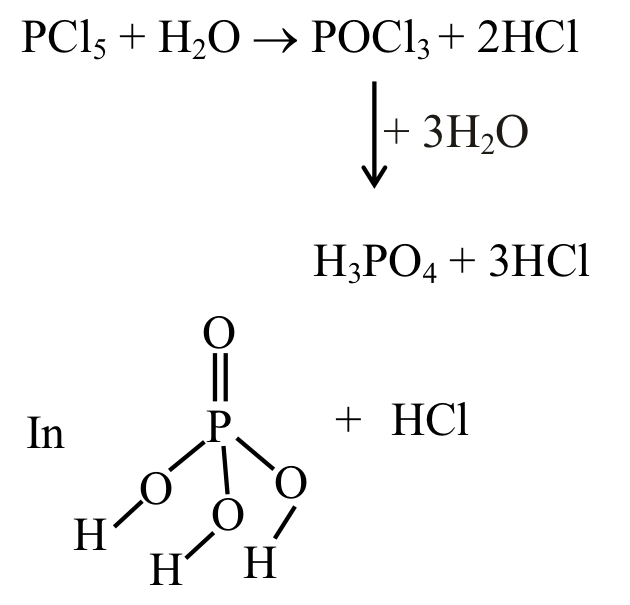
The number of non-ionisable hydrogen atoms present in the final product obtained from the hydrolysis of PCl_{5} is :
A 0
B 2
C 1
D 3
Solution: JEE Main 2021 (Online) 26th August Evening Shift Chemistry - p-Block Elements Question 133 English Explanation Here all hydrogens are ionisable. $\therefore$ Answer is zero.
Q15 Mathematics Practice — not auto-scored

Let $\mathrm{Q}$ and $\mathrm{R}$ be two points on the line $\frac{x+1}{2}=\frac{y+2}{3}=\frac{z-1}{2}$ at a distance $\sqrt{26}$ from the point $P(4,2,7)$. Then the square of the area of the triangle $P Q R$ is ___________.

Solution:

$L:{{x + 1} \over 2} = {{y + 2} \over 3} = {{2 - 1} \over 2}$

JEE Main 2022 (Online) 26th July Morning Shift Mathematics - 3D Geometry Question 166 English Explanation

Let $T(2t - 1,\,3t - 2,\,2t + 1)$

$\because$ $PT\,{ \bot ^r}\,QR$

$\therefore$ $2(2t - 5) + 3(3t - 4) + 2(2t - 6) = 0$

$17t = 34$

$\therefore$ $t = 2$

So $T(3,4,5)$

$\therefore$ $PT = \sqrt {1 + 4 + 4} = 3$

$\therefore$ $QT = \sqrt {26 - 9} = \sqrt {17} $

$\therefore$ Area of $\Delta PQR = {1 \over 2} \times 2\sqrt {17} \times 3 = 3\sqrt {17} $

$\therefore$ Square of $ar(\Delta PQR) = 153$.